First Increase Since 2015... Exceeds Bloomberg Forecast by 0.5%P
[Asia Economy Reporter Park Byung-hee] On the 17th (local time), the Central Bank of Brazil significantly raised its benchmark interest rate from the previous 2% to 2.75% at its monetary policy meeting.
The 0.75 percentage point increase is the largest in over 10 years and exceeds the 0.5 percentage point forecast aggregated from Wall Street analysts surveyed by Bloomberg.
This indicates that the Central Bank of Brazil views the inflation risk as high. It is the first time since 2015 that the Central Bank of Brazil has raised the benchmark interest rate. The Central Bank of Brazil stated that it may further raise the benchmark interest rate significantly at the next monetary policy meeting.
In a statement released after the monetary policy meeting, the Central Bank of Brazil said it could raise the rate by an additional 0.75 percentage points at the May meeting.
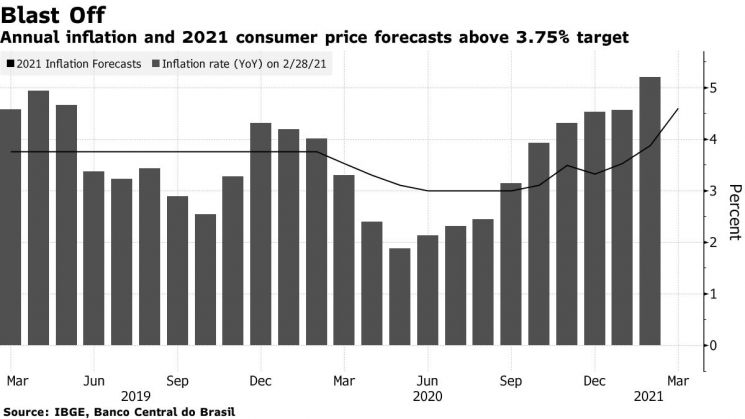
Brazil's consumer price index in February rose 5.2% compared to the same month last year, significantly exceeding the Central Bank of Brazil's inflation target of 3.75%.
Brazil's consumer price inflation rate had been within the central bank's target range until September last year, but it exceeded 4% in November last year and surpassed the 5% mark within four months.
In the statement, the central bank explained, "The current situation has led to the suspension of exceptional stimulus policies," and "We have decided to reduce the scale of exceptional stimulus and partially proceed with the normalization process."
The significant hike in Brazil's benchmark interest rate suggests that the economic gap between advanced and emerging countries may widen further after COVID-19.
On the same day, the U.S. central bank, the Federal Reserve (Fed), concluded its two-day monetary policy meeting schedule and maintained its existing monetary easing stance. Although concerns about U.S. inflation are growing among market experts, Fed Chair Jerome Powell said the inflation risk is not yet significant. He also stated that there would be no change to the Fed's existing monetary policy operation plan of not raising the benchmark interest rate until 2023.
The U.S. central bank expects inflation risk to be low, while the Central Bank of Brazil anticipates that inflation poses a significant risk to the economy.
Earlier, Kristalina Georgieva, Managing Director of the International Monetary Fund (IMF), expressed concern that the economic gap between rich and poor countries could widen after COVID-19.
© The Asia Business Daily(www.asiae.co.kr). All rights reserved.
![Clutching a Stolen Dior Bag, Saying "I Hate Being Poor but Real"... The Grotesque Con of a "Human Knockoff" [Slate]](https://cwcontent.asiae.co.kr/asiaresize/183/2026021902243444107_1771435474.jpg)











