Limit-Up on Listing Day... Strong Performance Expected in Q4 as Well
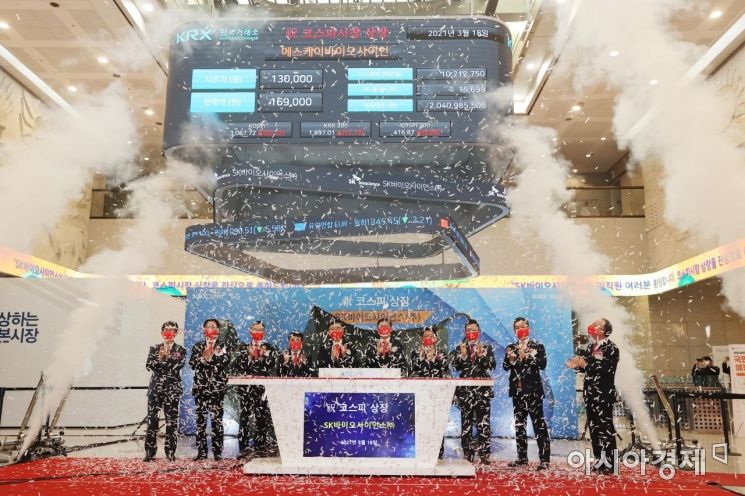 On the 18th, a ceremony commemorating the new KOSPI listing of SK Bioscience, a vaccine development and manufacturing company, was held at the Korea Exchange in Yeongdeungpo-gu, Seoul. From the left: Song Young-hoon, Deputy General Manager of the Korea Exchange KOSPI Market Division; Ahn Sang-hwan, Chairman of the Korea IR Council; Cho Woong-ki, CEO of Mirae Asset Daewoo; Lim Jae-jun, General Manager of the Korea Exchange KOSPI Market Division; Son Byung-doo, Chairman of the Korea Exchange; Ahn Jae-yong, CEO of SK Bioscience Co., Ltd.; Park Chan-joong, President of SK Discovery; Jung Il-moon, CEO of Korea Investment & Securities; Yoon Byung-woon, Head of IB1 Division at NH Investment & Securities; Kim Young-kyun, Executive Director of the Listed Companies Association. Photo by Kim Hyun-min kimhyun81@
[Asia Economy Reporter Seo So-jeong] "With solid performance backing it, is there any benefit to selling now?"
SK Bioscience, considered a major IPO in the first half of this year, made a spectacular debut on the stock market on the 18th, bringing broad smiles to SK Bioscience employees.
On that day, SK Bioscience's opening price was 130,000 KRW, double the public offering price, and it traded at 169,000 KRW, hitting the maximum price limit (30%), achieving the so-called 'ttasang' (double opening and limit up). As the stock price soared, the market capitalization quickly expanded to 12.9285 trillion KRW, jumping to 28th place in the KOSPI market cap rankings.
According to SK Bioscience, the shares allocated to about 600 employees vary depending on years of service, performance, and seniority, but calculated at the public offering price (65,000 KRW), the average per person is about 500 million KRW. If an employee bought all the shares possible with 500 million KRW, it would be about 7,700 shares per person, resulting in a capital gain of over 800 million KRW in just one day.
Some express concerns about employees leaving en masse to realize profits, but SK Bioscience largely considers it 'too early' for that. Employee stock ownership is subject to a one-year lock-up period, but if an employee resigns, they can dispose of the shares immediately. In the case of SK Biopharm, which was listed earlier, collective resignations of employees became a hot topic.
An SK Bioscience employee said, "Last year's third-quarter performance alone surpassed the entire 2019 results, and the fourth quarter, to be announced at the end of this month, is also expected to show strong results," adding, "At the point when vaccine contract manufacturing performance is becoming full-scale, not many employees are expected to choose to resign." SK Bioscience employees purchased 4.49 million shares worth 291.9 billion KRW through the employee stock ownership association.
Another employee drew a clear distinction, saying, "In the case of SK Biopharm, it is an R&D-based company with only about 200 employees and recorded losses in its first post-listing performance, but our case is different because performance supports us."
Brokerages expect the stock price to continue rising for the time being. SK Bioscience has signed contracts for COVID-19 vaccine contract manufacturing (CMO) and contract development and manufacturing (CDMO) with AstraZeneca and Novavax, and additional growth drivers are abundant due to premium vaccine development.
Kim Ji-ha, a researcher at Meritz Securities, said, "Considering the global average unit price and profit structure, the CMO and CDMO business performance is expected to be 496.9 billion KRW this year and 739.5 billion KRW next year," adding, "The stock price could gain momentum depending on inclusion in the KOSPI 200 index in the first half of the year and the results of the Phase 1 clinical trial of the COVID-19 vaccine."
© The Asia Business Daily(www.asiae.co.kr). All rights reserved.

















