Chinese State Media: US Secretary of State and Defense Secretary Visit Korea... Unlikely to Get What They Want in Korea
China Claims Deep Economic Ties with Korea and Mediation Role on North Korean Nuclear Issues
[Asia Economy Beijing=Special Correspondent Jo Young-shin] Chinese state media reported that South Korea is the 'weak link' in the United States' strategy to strengthen East Asian alliances, and that the U.S. will not get what it wants from South Korea.
The Global Times, in an article titled "South Korea is the Weak Link in the U.S. China Pressure Strategy" on the 18th, reported that U.S. Secretary of State Tony Blinken and Secretary of Defense Lloyd Austin visited South Korea for a top-level (2+2) meeting but will not achieve the desired results there.
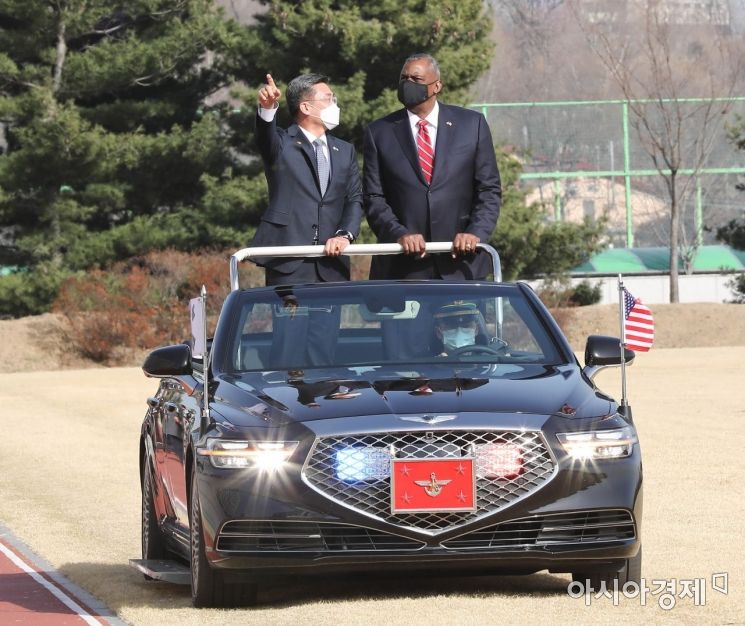 Minister of National Defense Seo Wook and U.S. Secretary of Defense Lloyd Austin are reviewing the honor guard at the Ministry of National Defense in Yongsan-gu, Seoul, on the afternoon of the 17th. Photo by Joint Press Corps
The media cited experts saying that while the U.S. achieved its goal of pressuring China in the 2+2 talks with Japan, it is unlikely to produce the same outcome in South Korea.
The Global Times reported that South Korean Minister of National Defense Seo Wook emphasized the importance of maintaining strong deterrence against North Korea and a joint defense posture during his meeting with U.S. Secretary of Defense Austin. It added that Minister Seo did not mention China.
The media suggested that South Korea's reluctance to publicly mention China is due to its political (North Korea and nuclear issues) and economic ties, and predicted that South Korea will distance itself from the U.S. strategy of building East Asian alliances to contain China.
Jung Ji-yong, head of the Korea Research Center at Fudan University, said, "South Korea could be the weak link in the U.S. East Asian alliance strategy to pressure China," citing structural issues South Korea faces. He explained, "South Korea needs China's mediation to improve relations with North Korea, including nuclear issues, and must consider economic ties."
The media downplayed the joint statement issued after the U.S. Secretary of State and Secretary of Defense's visit to Japan, evaluating that Japan has degraded itself into a strategic appendage of the U.S. It reported that the U.S. and Japan claimed in the joint statement that China does not conform to the existing international order.
In this regard, Zhao Lijian, spokesperson for the Chinese Ministry of Foreign Affairs, said, "The U.S.-Japan joint statement maliciously attacks China's foreign policy, interferes in China's internal affairs, and harms China's interests," adding that China firmly opposes this. He emphasized, "China's position on Hong Kong, Taiwan, Xinjiang, the South China Sea, and the Diaoyu Islands (Japanese name: Senkaku Islands) is consistent and clear," and stressed that China has definite sovereignty over the South China Sea and its adjacent waters, as well as the Diaoyu Islands and their affiliated islets.
Lu Yaodong, director of the Japan Research Institute at the Chinese Academy of Social Sciences, analyzed, "Japan mentioned topics such as Hong Kong and Xinjiang, which it had not addressed in the past, indicating an intention to deliberately cause problems." He added, "If Japan continues to follow the U.S. strategy, Sino-Japanese relations will further deteriorate."
© The Asia Business Daily(www.asiae.co.kr). All rights reserved.

















