The Biggest Challenge at PGA National Golf Course: Holes 15-17 'Bear Trap', 75% of Players Have Fallen In at Least One Over 14 Years
 At the 15th hole, the most critical point of the PGA National Golf Club, there is a large bear statue along with a sign that reads, "You are now entering the Bear Trap."
[Asia Economy Golf Specialist Reporter Kim Hyun-jun] ‘Bear Trap’.
The nickname given to holes 15 to 17 at PGA National Golf Club (par 70, 7,125 yards) in Palm Beach Gardens, Florida, the fierce battleground of the Honda Classic (total prize money $7 million) opening on the night of the 18th (Korean time). The name itself, ‘Bear Trap,’ sounds intimidating. Naturally, it is the decisive battleground for the champion. Im Sung-jae (23, CJ Logistics) actually gained momentum by making two birdies on holes 15 and 17 on the final day when he won last year.
Jack Nicklaus (USA) remodeled it in 2001, modeling it after the ‘Amen Corner’ of holes 11 to 13 at Augusta National, and it immediately became known as the PGA Tour’s ‘notorious three consecutive holes.’ Other notorious three-hole stretches include the ‘Snake Pit’ (holes 16-18, par 71, 7,340 yards) at Innisbrook, the venue for the Valspar Championship, and the ‘Green Mile’ (holes 16-18, par 71, 7,554 yards) at Quail Hollow, the stage for the Wells Fargo Championship.
Unlike Augusta National, the Bear Trap is composed of ‘par 3 - par 4 - par 3.’ At the teeing ground of the 15th hole, a large bear statue and a sign saying “You have now entered the Bear Trap” have been erected. The fact that two of the three holes are par 3s means that ‘precise iron shots’ are absolutely crucial. This is because of the lake. Among the 650 players who have participated over the past 14 years since 2007, 75%, or 488 players, have missed at least one hole. Even just making par can win the tournament.
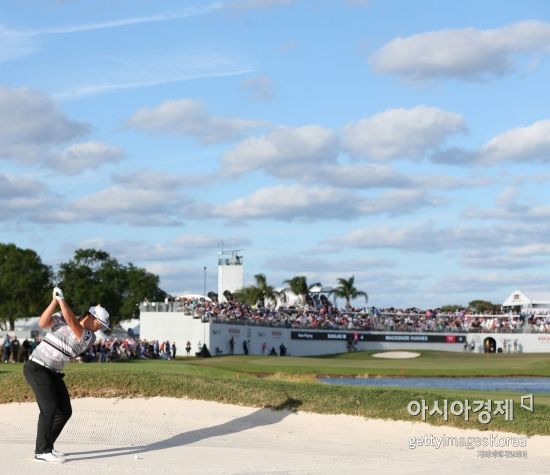 Im Sung-jae hitting a bunker shot on the 16th hole, the "heart of the Bear Trap," during the final day of last year's Honda Classic.
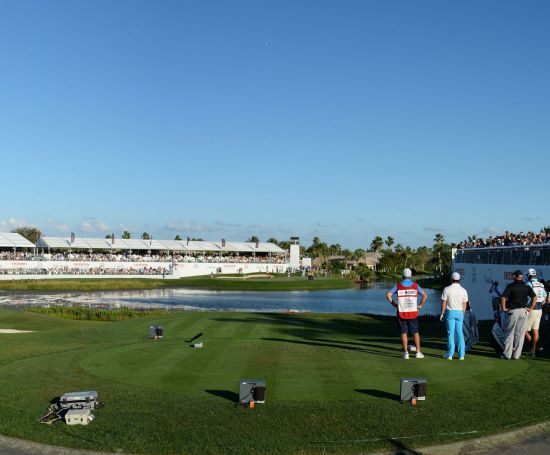
The 15th hole (par 3, 165 yards) is the first test. Crossing the water to reach the small green is the top priority. There is a bunker to the left of the green, and water hazards to the right and behind. Adding to this, the wind changes direction and strength constantly, increasing the difficulty of aiming and club selection. Gavin Coles (USA) famously scored an octuple bogey with an 8-over-par 11 on the third day in 2007 after his tee shot flew into the lake four times.
The 16th hole (par 4, 440 yards) is considered the most difficult par 4 on the PGA Tour. It is a dogleg right that bends nearly 90 degrees along the lake, and the tee shot is especially important. The fairway slopes down to the right. The second shot is also a challenging journey, requiring another water carry from about 200 yards out. Missing the fairway costs at least one stroke, and if the ball lands in the water hazard, it results in a double bogey or worse, a critical blow.
The 17th hole (par 3, 178 yards) is shaped like a semicircle to the right. A short tee shot lands in the lake, while a long one ends up in the bunker. If the pin is located at the front of the green, there is literally no room to retreat. The overall difficulty of these three holes is more than one stroke above the average score. One stroke per day, four strokes over four days, can change the owner of the championship trophy. Domestic fans are placing their hopes on Im Sung-jae, who was particularly strong in the ‘Bear Trap’ last year with four birdies, five pars, and three bogeys, finishing one under par.
© The Asia Business Daily(www.asiae.co.kr). All rights reserved.