In-Depth Analysis of the 4·7 By-Election's 3 Major Pledges - ▶Real Estate ②Jobs ③COVID-19 Support
Increasing Supply to Stabilize Housing Prices Has Zero Feasibility
Actual Term Is 1 Year 3 Months, Yet 5-Year Pledges Made with Re-Election in Mind
"Wasting Time on Planning and System Reforms"
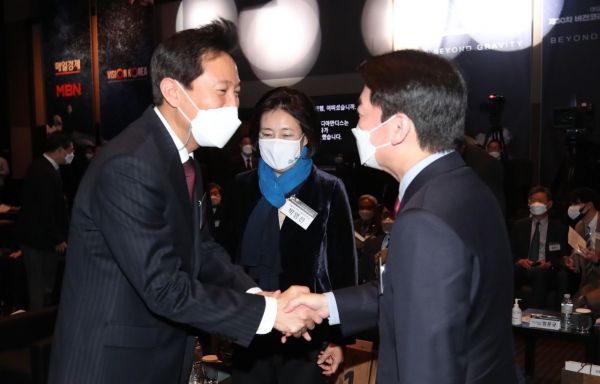 Park Young-sun, the Democratic Party candidate for Seoul mayor, Oh Se-hoon, the People Power Party candidate for Seoul mayor, and Ahn Cheol-soo, the People's Party candidate for Seoul mayor, are greeting each other at an event held on the 17th at the Shilla Hotel in Jung-gu, Seoul. Photo by the National Assembly Press Photographers Group
[Asia Economy Reporters Kim Hyemin and Im Onyu] Although candidates from both ruling and opposition parties running in the April 7 Seoul mayoral by-election are competitively presenting real estate pledges, experts generally gave them failing grades. This is because even if elected, the mayor’s term is just over one year, yet the candidates have either made grandiose mid- to long-term plans or filled their pledges with promises beyond the mayor’s authority.
This is the result of an analysis conducted by Asia Economy on April 17, with advice from six real estate market and policy experts, verifying each candidate’s real estate pledges.
Leading candidates such as Park Young-sun of the Democratic Party, Oh Se-hoon of the People Power Party, and Ahn Cheol-soo of the People’s Party have proposed real estate pledges based on the concept of stabilizing housing prices through ‘increased supply.’ However, upon examining feasibility, the possibility that they will supply all the promised housing units within their term is close to impossible. Each candidate has announced large-scale supply plans ranging from at least 300,000 to as many as 740,000 housing units. Their idea is to stabilize the sharply rising Seoul housing prices through massive supply.
However, the Seoul mayor elected in the April by-election will operate the city only until June 30, 2022, a period of 1 year and 3 months. Yet, the three candidates have presented pledges that assume re-election as a given, focusing only on plans spanning more than five years. There was a lack of concrete plans on how to supply housing and stabilize the market within the actual term. While the short term is a limitation, there was also criticism that they gave little thought to short-term supply. Because their focus was heavily skewed toward supply, measures to stabilize ‘jeonse’ (long-term lease) prices, which are of real concern to ordinary citizens, were neglected.
Professor Shim Gyo-eon of Konkuk University’s Department of Real Estate said, "They will spend the one-year term just establishing plans and adjusting systems." Kim Deok-rye, senior research fellow at the Korea Research Institute for Human Settlements, also pointed out, "The pledges do not seem to consider the one-year term. They are premised on successful re-election, but if re-election fails, the pledges are practically non-existent." Professor Lee Chang-moo of Hanyang University’s Department of Urban Engineering criticized, "The scale of housing they aim to produce is exaggerated and unrealistic."
© The Asia Business Daily(www.asiae.co.kr). All rights reserved.

















