Plan to Reduce to 180 Withdrawn, Increased to 260
Additional F-35 Purchases, Strengthening Overseas Base Capabilities
[Asia Economy Reporter Hyunwoo Lee] The UK government has announced an expansion of its nuclear arsenal for the first time since joining the Nuclear Non-Proliferation Treaty (NPT) in 1970. Aiming to strengthen nuclear deterrence in immediate response to threats from China and Russia, the number of nuclear warheads, which had been planned to be reduced to 180, will instead increase to 260 by 2025. Alongside this, the UK plans to significantly bolster its conventional forces and enhance military cooperation with key allies in the Asia-Pacific region such as the United States, Japan, and Australia, continuing pressure on China. Within the UK, there are concerns that this move is as dangerous as a declaration of withdrawal from the NPT, and criticisms that there is no concrete strategy to specifically counter the threat from China.
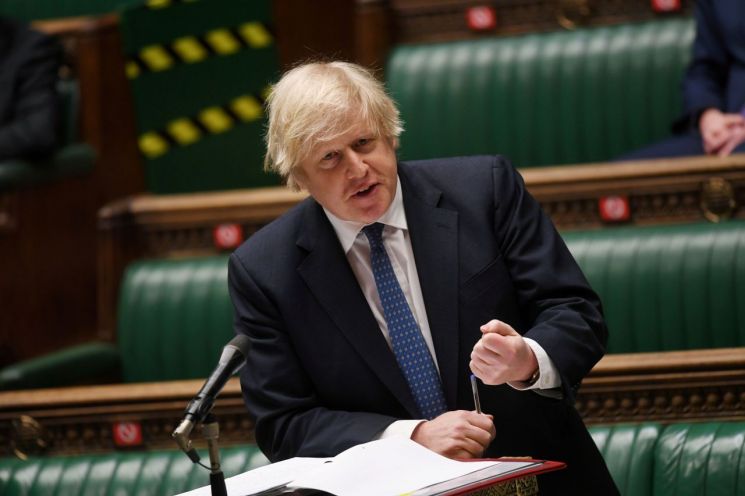
According to foreign media including the BBC on the 16th (local time), UK Prime Minister Boris Johnson presented a new foreign and security policy report titled "Global Britain in an Age of Competition" to Parliament. The extensive 114-page report centers on the expansion of the UK's nuclear forces, with plans to increase the number of nuclear warheads to 260 by 2025. Considering the UK government's earlier announcement in 2010 to reduce its nuclear warheads to 180 by 2020, this represents an increase of 80 warheads, or about 40%, compared to current levels.
This is the first official declaration of nuclear force expansion by the UK government since the NPT came into effect in 1970. According to the Arms Control Association (ACA), the UK possessed over 500 nuclear warheads, including US nuclear weapons stationed in the UK, until the 1970s. Since then, nuclear disarmament under the NPT has led to a continuous reduction in the number of warheads.
Prime Minister Johnson stated, "We must maintain the minimum nuclear deterrent necessary to address security threats from China and Russia," adding that "China represents the greatest national infrastructure threat to the UK's economic security, while Russia poses the most serious direct threat to the UK." He emphasized, "This is not a gesture to return to the old duties or glories of the British Empire, but an essential measure for the safety and prosperity of the British people for decades to come."
He also said, "We will further strengthen military cooperation with the Indo-Pacific region," pledging to increase pressure on China alongside allied countries. Johnson is scheduled to visit India next month, and the UK Royal Navy's aircraft carrier HMS Queen Elizabeth will be deployed to the Indian Ocean and East Asia this year for joint exercises with Japan and India.
Along with nuclear force expansion, conventional forces will also be strengthened. The UK government plans to increase defense spending by ?24 billion (approximately 37.57 trillion KRW) over the next four years until 2025. The increased budget will be used to procure an additional 48 F-35 stealth fighters and to build and deploy new warships, thereby enhancing conventional military capabilities. The capabilities of overseas British military bases in Kenya, Oman, Singapore, Cyprus, Gibraltar, and others will also be strengthened to accelerate military deployments in the Indian Ocean and South China Sea regions.
Within the UK, opposition to the plan is dominant due to concerns that it could be perceived internationally as a withdrawal from the NPT. The opposition Labour Party is particularly vocal. Keir Starmer, leader of the UK Labour Party, criticized at a press conference, "This report is full of gaps without concrete plans amid concerns about possible reductions in the UK military," adding, "Parliament's recommendations regarding threats from Russia and China have not been properly followed, and responses to these should come first."
© The Asia Business Daily(www.asiae.co.kr). All rights reserved.

















