China's Major Regulations on Digital Economy Including Fintech
Concerns Over Hindrance to Expansion of Domestic Companies with Local Investments
"'Major Shareholder Eligibility' Review Should Be Handled Flexibly"
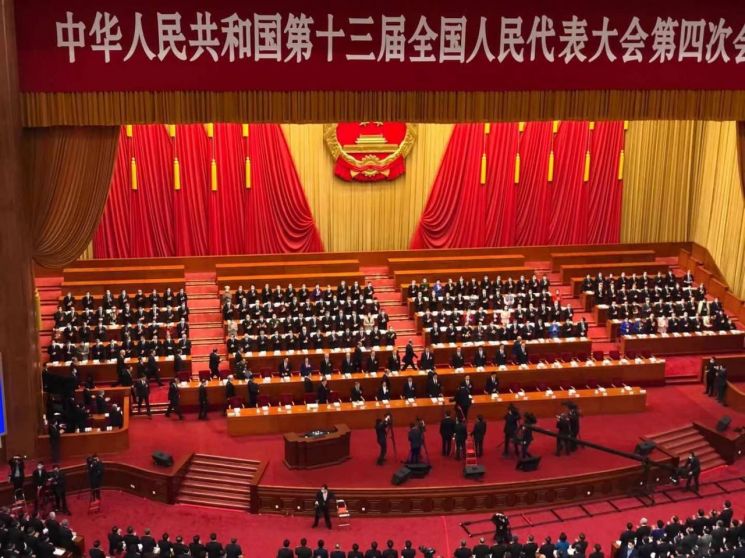 On the 5th, the annual session of the National People's Congress (NPC), China's highest legislative body, opened at the Great Hall of the People in Beijing, where President Xi Jinping, Premier Li Keqiang, and other leaders are entering. Photo by Yonhap News
[Asia Economy Reporter Kiho Sung] Concerns are emerging that China's sweeping regulations on its rapidly growing digital economy could adversely affect domestic financial companies. This is because the strong regulatory measures in China have increased the likelihood of 'major shareholder eligibility' issues arising for financial firms that have partnerships with Chinese companies or have received equity investments from them. Industry insiders point out that "it looks like overseas authorities are granting domestic licenses," emphasizing the urgent need for regulatory reform.
According to the financial sector on the 16th, Chinese authorities recently announced in the legislative work plan of the National People's Congress (NPC) that they will amend the Anti-Monopoly Law for the first time in 13 years. Analysts say the focus is on strengthening regulations on the rapidly growing digital economy. Last month, the State Administration for Market Regulation (SAMR), which plays a role similar to Korea's Fair Trade Commission, began enforcing regulations on internet companies. SAMR issued the "Guidelines of the State Council Anti-Monopoly Commission on Internet Platform Enterprises," signaling upcoming regulations on various fintech (finance + technology) companies.
Due to these regulatory risks in China, there is a growing possibility that domestic financial firms that have received investments from local platform companies will face difficulties in expanding their businesses. A representative example is Kakao Pay. In December last year, Kakao Pay applied for a preliminary permit for MyData but was put on hold due to incomplete submission of documents regarding whether its second-largest shareholder, Alipay Singapore Holdings, was subject to sanctions by Chinese authorities. The financial authorities' major shareholder eligibility review targets shareholders holding more than 10% of shares. Kakao Pay's shareholding structure is 56.1% by Kakao and 43.9% by Alipay, making it difficult to adjust shares for the main permit review.
Expert: "Ultimately, consumers suffer; exceptional measures needed to activate MyData"
Within the industry, criticism has arisen that "the final decision-maker for the MyData business has become the Chinese authorities." Kakao Pay is facing the risk of rejection due to friction between the Chinese government and local companies, regardless of its fintech business capabilities or integrity. In fact, Kakao Pay has not even received a preliminary permit for two months following the financial authorities' review.
Additionally, it is pointed out as a problem that if the equity of overseas capital, not only from China, becomes an issue, the domestic industry could also be impacted. Some voices express concerns that Chinese authorities might exploit regulations to suppress the growth of Korean companies amid tightening regulations.
Experts emphasize that our authorities need to respond more flexibly for the development of the domestic financial industry. Professor Jiyong Seo of the Department of Business Administration at Sangmyung University stated, "Given the nature of MyData, it is undesirable for the business to be derailed due to major shareholder eligibility issues," and stressed, "Instead, focus should be on security policies to protect consumers."
There are also calls for financial authorities to take exceptional measures as service interruptions could cause consumer inconvenience. Professor Seongyeop Lee of Korea University advised, "Exceptional measures are necessary to activate the MyData business," and suggested, "Various methods such as financial regulatory sandboxes, Board of Audit and Inspection consulting, and priority permits should be considered."
© The Asia Business Daily(www.asiae.co.kr). All rights reserved.