KOTRA Announces 2020 China K-Consumer Goods Import Trends

[Asia Economy Reporter Kim Heung-soon] Despite the contraction in trade due to the COVID-19 pandemic last year, China’s imports of Korean products were hardly affected. This is attributed to strong imports of consumer goods such as semiconductors, cosmetics, masks, and clothing from Korea, which helped partially offset the overall decline.
According to KOTRA on the 14th, China’s imports from Korea last year amounted to $173.5 billion, a slight decrease of 0.03% compared to the previous year. Korea ranked third among China’s top five import countries, following Taiwan ($202.1 billion) and Japan ($176.1 billion). Considering the reduced demand across various sectors due to COVID-19, this is a favorable performance.
The largest import item from Korea was semiconductors. According to the Korea International Trade Association, China’s semiconductor imports from Korea reached $39.99 billion last year. China accounted for 40.4% of Korea’s total semiconductor exports last year.
Notable Growth in Beauty, Fashion, Masks, and More
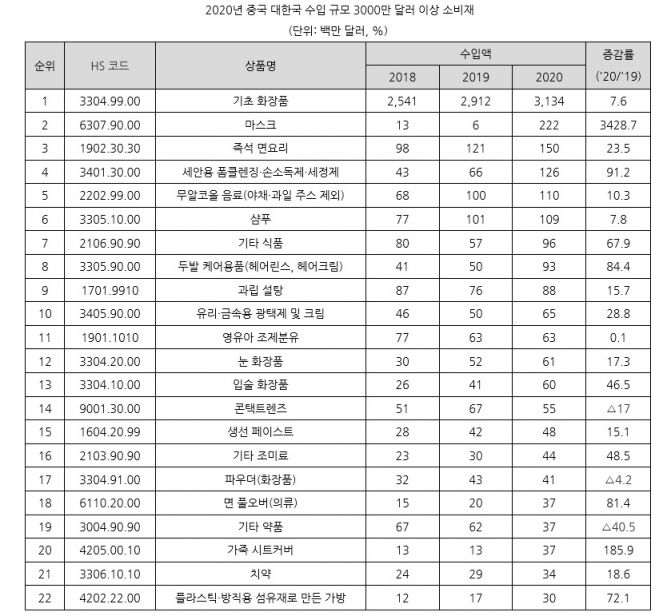
Imports of consumer goods were also active. Among China’s Korean consumer goods imports last year, 59 items had import values exceeding $10 million. Of these, 22 items surpassed $30 million, and the top six items each exceeded $100 million.
The top item, basic cosmetics (such as skincare products and mask packs), recorded an import value of $3.134 billion last year, up 7.6% from the previous year. Additionally, hair care products (such as hair rinses and hair creams) and lip cosmetics increased by 84.4% and 46.5%, respectively.
The second-ranked item was Korean masks, which surged more than 30 times year-on-year to $220 million. Fourth-ranked items, facial foam cleansers and hand sanitizers/cleansers ($126 million), also rose 91.2%, surpassing $100 million. Korean ramen ranked third with a 23.5% increase to $150 million. Imports of grain snacks and tteokbokki also grew by 43.9% and 99.9%, respectively.
Imports of Korean clothing also expanded significantly. Last year, the import volume of clothing and parts (multiple items) reached $480 million, an increase of 101.9% compared to the previous year. This was the largest growth among the top 10 clothing import countries.
KOTRA stated, "Due to China’s ‘Dual Circulation Strategy’ focusing on domestic demand growth and the recovery of consumer sentiment, demand for consumer goods such as cosmetics and processed foods is expected to expand for the time being. Our companies should showcase products that leverage the advantages of Korean materials, design, and product competitiveness to actively promote the excellence of K-consumer goods to Chinese consumers and target the market."
They added, "With changes in Chinese consumers’ consumption patterns and distribution methods due to the spread of COVID-19, and advancements in various technologies such as unmanned delivery, this trend is expected to accelerate further in the medium to long term. Efforts to expand online distribution channels for consumer goods with high competitiveness in the Chinese market are also necessary."
© The Asia Business Daily(www.asiae.co.kr). All rights reserved.