Korea Real Estate Board March 2nd Week Apartment Price Trends
Nationwide and Seoul Apartment Price Increase Rates Same as Previous Week
Gyeonggi-do and Incheon Show Slightly Reduced Increase Rates
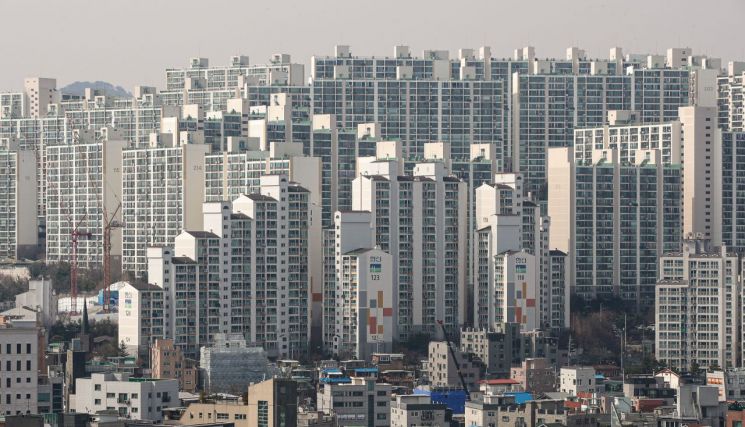
[Asia Economy Reporter Moon Jiwon] Following the government's announcement of the 2·4 housing supply plan, the demand for home purchases has weakened, leading to a further decline in the apartment price growth rate in the Seoul metropolitan area compared to the previous week. However, Seoul recorded the same rate of increase as the previous week.
Although a wait-and-see attitude is deepening mainly in the metropolitan area, there are growing concerns that future government measures may not be properly implemented due to recent allegations of speculation by employees of the Korea Land and Housing Corporation (LH) in new towns. Therefore, it is still considered premature to be confident that housing prices have entered a stabilization phase.
According to the weekly apartment price trend for the second week of March announced by the Korea Real Estate Board on the 11th, as of the 8th, nationwide apartment prices rose by 0.24%, maintaining the same rate of increase as the previous week.
Seoul apartment prices also rose by 0.07%, the same as the previous week. In Seoul, the apartment price growth rate rose to 0.10% in the first week of last month, but after the announcement of the 2·4 plan on the 4th of the same month, which included supplying about 830,000 households nationwide, the rate of increase has been shrinking almost every week.
The Korea Real Estate Board explained, "Due to the impact of the supply plan and concerns over US interest rate hikes, listings have increased and buying demand has weakened, leading to a wait-and-see stance," but added, "The rate of increase is being maintained mainly in reconstruction projects or relatively undervalued large-sized units."
South of the Han River, Seocho-gu (0.10%) continued its upward trend centered on reconstruction in Jamwon-dong, and Gangnam-gu (0.09%) and Songpa-gu (0.08%) also saw price increases mainly in large-sized units, although the rate of increase narrowed compared to the previous week. Yangcheon-gu maintained a 0.11% increase for three consecutive weeks, mainly in Mok-dong, where reconstruction expectations are high.
North of the Han River, buying demand was mainly concentrated in reconstruction complexes. Dobong-gu (0.08%) saw apartment prices rise mainly in older buildings in Ssangmun-dong and areas near Chang-dong Station, and Nowon-gu (0.08%) saw increases mainly in large complexes in Junggye-dong and Sanggye-dong, which have good school districts.
In Gyeonggi Province, the apartment price growth rate slightly slowed from 0.39% last week to 0.38% this week. Uiwang-si (0.91%) saw a large increase mainly in Ojeon and Gocheon-dong, where expectations for transportation improvements exist, and Ansan-si (0.76%), Uijeongbu-si (0.56%), and Gunpo-si (0.55%) also saw rises centered on areas with favorable factors. In particular, Siheung-si, recently designated as the sixth 3rd phase new town, saw buying demand concentrated mainly in the Eungye district (0.82%).
Incheon also rose by 0.39% this week, narrowing from 0.41% the previous week. Yeonsu-gu (0.49%) saw increases mainly in major complexes in Songdo New Town and Dongchun-dong, which have good residential environments, and Michuhol-gu (0.49%) saw rises mainly in older buildings in Yonghyeon and Hakik-dong, which are perceived as relatively low-priced compared to neighboring areas. Sejong City expanded its growth rate from 0.17% to 0.18% as prices rose mainly in some complexes in Jochiwon-eup.
Although the overall buying demand has weakened since the announcement of the 2·4 plan, Seoul showed a sideways movement this week, raising concerns that housing prices could become unstable again. In fact, distrust in the public sector triggered by recent allegations of preemptive speculation by LH employees in new towns is spreading, leading to analyses that not only the 2·4 plan but also the promotion of the 3rd phase new towns will be difficult.
Minister of Land, Infrastructure and Transport Byun Changheum stated at the National Assembly Land, Infrastructure and Transport Committee briefing on the 9th, "This incident should not lead to distrust of the entire public sector and push the real estate market into an unstable situation again," and pledged to steadily push forward follow-up measures of the supply plan, including the announcement of candidate sites in March. However, many expect it will not be easy as suspicions of public officials' speculation are growing day by day.
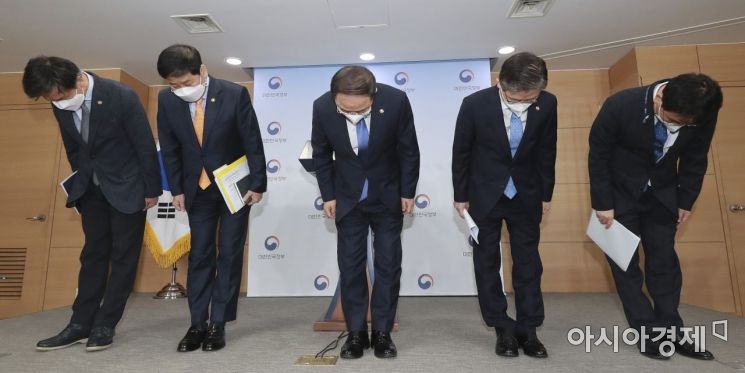 Deputy Prime Minister for Economy Hong Nam-ki and Minister of Land, Infrastructure and Transport Byeon Chang-heum, along with others, bow their heads during the announcement of the "Message to the People Regarding Real Estate" held at the Government Seoul Office in Jongno-gu, Seoul on the 7th. Photo by Yoon Dong-joo doso7@
The nationwide apartment jeonse (long-term lease) price growth rate slightly narrowed from 0.17% last week to 0.16% this week.
The slowdown in growth was significant in Gyeonggi Province (0.20%→0.18%) and Incheon (0.33%→0.25%), while Seoul (0.06%) recorded the same rate of increase as the previous week. In Seoul, jeonse prices rose mainly in new buildings in relatively lower-priced areas such as Jungnang-gu and Eunpyeong-gu, but listings accumulated and asking prices fell in some high-priced complexes.
According to the industry, areas such as Gangnam-gu (0.05%), Seocho-gu (0.05%), and Songpa-gu (0.04%), where jeonse prices rose significantly last year, are currently experiencing an accumulation of jeonse listings.
In Gyeonggi Province, jeonse price growth was relatively high in Siheung-si (0.60%), Dongducheon-si (0.50%), Pyeongtaek-si (0.43%), and Uiwang-si (0.37%). In Incheon, jeonse prices rose mainly in Jung-gu (0.44%), Namdong-gu (0.41%), Seo-gu (0.40%), and Bupyeong-gu (0.39%), but the rate of increase slightly narrowed due to increased supply and decreased demand.
Sejong City expanded its jeonse price growth rate from 0.16% to 0.24% following the rise in sale prices. The Korea Real Estate Board explained, "Jeonse prices in Sejong City expanded their rate of increase compared to last week," adding, "The rise was mainly in mid- to low-priced complexes in Hansol and Jongchon-dong within the Happy City and Jochiwon-eup."
© The Asia Business Daily(www.asiae.co.kr). All rights reserved.


















