Professor Kang Dong-woo's Team at Gachon University Discovers Activation of Immune Response Upon Attachment of Immune-Stimulating Protein Nanoparticles
[Asia Economy Reporter Kim Bong-su] A research result has been published that elucidates the mechanism by which immune responses are activated when nanomaterials are injected into the blood.
On the 11th, according to the Korea Research Foundation, a research team led by Professor Kang Dong-woo of Gachon University discovered that when immune response-inducing proteins in the blood are attached to nanoparticles, the protein structures become severely distorted, activating immune responses. When nanomaterials react with plasma proteins, a nano-corona is formed, but the understanding of which elements of the nano-corona trigger immune responses has been unclear, making clinical application difficult. Protein corona is a phenomenon that induces adsorption between nanomaterials and biological proteins and is known to cause toxicity by exposing the immune system.
The research team demonstrated that when nanomaterials are combined with immune response-inducing proteins, the protein structures undergo severe changes and immune cells are activated. This supports the evidence that a strategy to activate specific immune cells without toxicity is possible using only the nano-corona, without separate drugs. The results of this study were published on the 1st in the international journal Advanced Science.
The nano drug delivery system, based on nanometer-sized (10?150 nm) drug carriers, has recently been clinically implemented as the core technology for Moderna and Pfizer vaccines to form antibodies against COVID-19, and is expected to accelerate clinical applications as treatments and vaccines for various intractable diseases in the future. It is known that when nanomaterials are injected into the blood, numerous blood proteins adsorb onto the nanomaterials, forming so-called "protein corona." However, since immune responses caused by the nano-corona can be accompanied by inflammation and toxic reactions, immunological understanding of the nano-corona phenomenon has been recognized as a very important topic.
The problem is that for clinical application of the nano-corona, understanding the differential immune response mechanisms when numerous antibodies and plasma proteins in the blood interact with nanomaterials is necessary, but the innate and adaptive immune response mechanisms of the nano-corona are almost unknown.
The research team artificially combined nanomaterials, specifically nanotubes, with protein corona to analyze structural changes and confirm their effects on immune responses. Proteins reacting with nanomaterials in the blood include albumin, immunoglobulin, protease, alpha glycoprotein, lipoprotein, fibrinogen, vitronectin, and numerous others. Among these proteins, when immunoglobulin and alpha glycoprotein, which are related to immune responses, were artificially reacted with nanomaterials, a phenomenon of severe distortion in protein structure (Conformational Changes) was discovered.
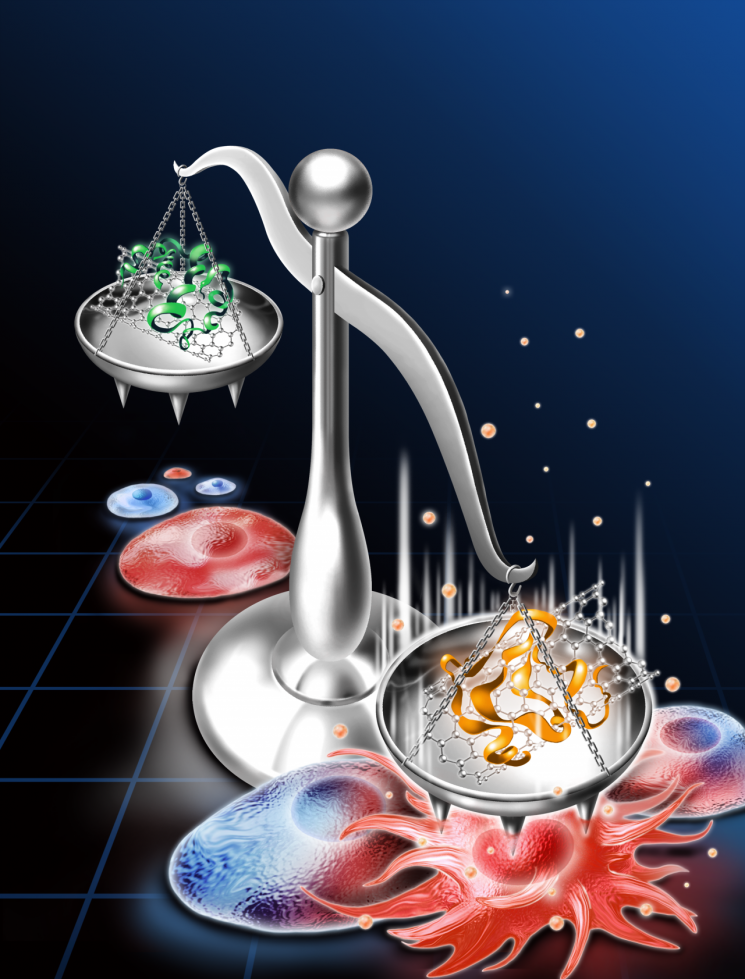
However, when fibrinogen and vitronectin, which are unrelated to immune responses, were artificially combined with nanomaterials, no structural changes in the proteins occurred. When the artificially synthesized "nano-corona" was reacted with immune cells, the nano-corona with severely distorted structure showed a significantly increased immune cell response, whereas the nano-corona without structural changes showed no immune cell response at all.
Furthermore, when the artificially formed nano-corona was injected into mice, the nano-corona with severely altered structure not only induced innate immune responses but also increased T cell activation and B cell antibody production after two weeks. However, the nano-corona without structural changes did not induce any immune response. Using the nano-corona with severely altered protein structures, increases in neutrophils, natural killer (NK) cells, and cytotoxic T cells are possible, and it was revealed for the first time worldwide that this can be utilized for cancer immunotherapy and virus vaccine development by enhancing innate and adaptive immunity.
The research team states that by artificially altering the structure of the corona, which exists abundantly in human blood, using nanomaterials, activation of innate and adaptive immunity is possible, enabling clinical applications for diseases related to immune regulation strategies. Moreover, the finding that immune responses stimulated by protein nano-corona selectively activate innate and adaptive immunity can provide new criteria for evaluating immune responses to nano drugs. From a drug delivery perspective, this strategy could be used as an adjuvant for virus antibody formation and to simultaneously enhance innate and acquired immune functions in tumor sites where immune cell activity is weakened.
© The Asia Business Daily(www.asiae.co.kr). All rights reserved.
![Clutching a Stolen Dior Bag, Saying "I Hate Being Poor but Real"... The Grotesque Con of a "Human Knockoff" [Slate]](https://cwcontent.asiae.co.kr/asiaresize/183/2026021902243444107_1771435474.jpg)
















