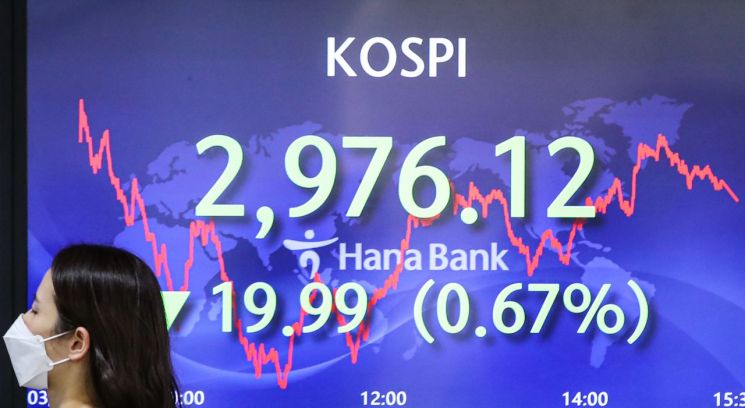
[Asia Economy Reporter Ji Yeon-jin] On the 10th, the KOSPI index, which started with a rebound, ended the trading session in a downward trend. Contrary to expectations that the domestic stock market would surge following a significant rise in the U.S. stock market the previous day, the strong dollar and concerns over interest rates continued to fuel market anxiety, causing the index to decline for the fifth consecutive day. The KOSDAQ also recovered the 900-point level in early trading but retreated to 890 due to selling pressure from foreign investors.
The KOSPI index closed at 2,958.12, down 18 points (0.60%) for the day. Opening 0.43% higher than the previous day, the KOSPI surged above the 3,000 mark in early trading, but strong selling by foreign investors and institutions during the session pulled the index down to the 2,950 level. In the latter part of the session, foreign investors reduced their net selling, lessening the decline, but the continued selling by pension funds led to a negative close.
On the day, individual investors were net buyers of 408.2 billion KRW, while foreign investors and institutions were net sellers of 11.2 billion KRW and 405.6 billion KRW, respectively. Foreign investors led the index decline by net selling about 170 billion KRW during the session but reduced their net selling volume before the close. Institutions sold about 180 billion KRW in the morning but decreased their net selling in the afternoon, while pension funds net sold 264.1 billion KRW on the day.
Among the top market capitalization stocks, Kakao (4.31%) and Naver (3.48%) showed strong gains. LG Chem (2.90%), which rose sharply in early trading following Tesla's surge in the New York market the previous day, lost momentum in the latter part of the session, and Samsung SDI (0%) closed flat.
Conversely, Samsung Electronics (-0.61%), SK Hynix (-2.56%), Hyundai Motor (-1.73%), Samsung Biologics (-0.29%), Celltrion (0.70%), and Kia Motors (-3.35%) recorded declines. Notably, POSCO fell by 23,500 KRW (7.41%) from the previous day, breaking below the 300,000 KRW mark.
Lee Kyung-min, head of investment strategy at Daishin Securities, said, "Although the U.S. stock market performed well, leading to a sharp rebound in the market, the attempt to stabilize the KOSPI above 3,000 is ongoing. Yesterday, the KOSPI partially recovered its intraday losses, but the impact of the Nasdaq's significant rise was limited. Foreign and institutional investors remain cautious due to the strong won-dollar exchange rate and China's tightening variables."
The KOSDAQ index closed at 890.41, down 5.29 points (0.70%). Individual investors were net buyers of about 157.8 billion KRW, while foreign investors and institutions were net sellers of 108.3 billion KRW and 45.7 billion KRW, respectively.
Among the top KOSDAQ stocks by market capitalization, Alteogen surged up to 19.83% following news of a free share issuance, and HL Biopharma also jumped 7.61% on the same announcement. Seegene (2.86%) showed strength on news of developing a diagnostic kit for a variant coronavirus, and EcoPro BM (1.76%), related to Tesla, closed higher.
On the other hand, KOSDAQ leaders such as Celltrion Healthcare (-1.82%), Celltrion Pharm (-2.57%), Kakao Games (-2.94%), SK Materials (-2.01%), and CJ ENM (-1.34%) showed declines.
Researcher Jung In-ji of Yuanta Securities analyzed, "Although interest rates fell in the U.S. market yesterday, the possibility of further increases remains, and the dollar's strength has led foreign investors to realize profits. Individual investors, who previously countered foreign and institutional selling, now lack the financial capacity to support the market as before."
© The Asia Business Daily(www.asiae.co.kr). All rights reserved.

















