Gwangju Institute of Science and Technology Research Team Achieves Accurate Diagnosis with Deep Learning
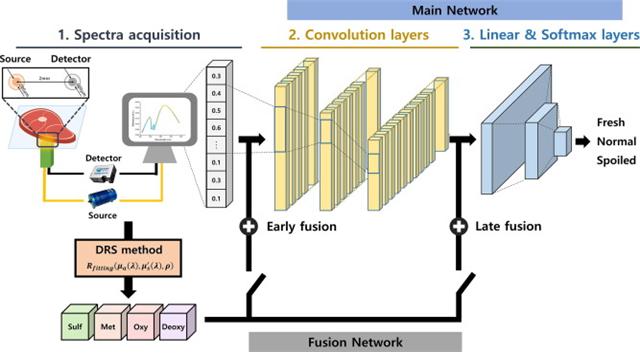 Schematic diagram of a deep spectral network for beef freshness classification. The input data required for freshness classification is the spectrum measured by a spectrometer. The proportions of myoglobin proteins, which show a high correlation with freshness, can be estimated from the spectrum through DRS. By fusing the spectral data and myoglobin ratio information, the deep learning model ultimately infers the freshness of the beef. Image provided by Gwangju Institute of Science and Technology.
[Asia Economy Reporter Kim Bong-su] A method to measure the freshness of meat such as beef and pork using low-cost and rapid artificial intelligence optical technology has been developed.
The Gwangju Institute of Science and Technology (GIST) announced on the 10th that a joint research team led by Professor Lee Gyubin of the Convergence Technology Institute and Professor Kim Jaegwan of the Department of Biomedical Engineering developed a deep learning-based technology that can quickly and non-destructively measure the freshness of beef by acquiring spectra from beef and extracting myoglobin information.
The research team confirmed through diffuse reflectance spectroscopy that as the storage period of beef lengthens and freshness decreases, spectral information and myoglobin information change simultaneously. The deep learning model successfully learned these information changes to classify freshness.
Methods to measure freshness deterioration in meat mainly include chemical analysis and microbiological analysis, but both methods take a long time and have the disadvantage of damaging the meat during the measurement process. Another problem is that the accuracy of the measurement results can vary significantly depending on the experimenter's skill level.
Recently, research has been conducted to overcome these limitations by measuring freshness quickly while minimizing damage to meat, but most require expensive equipment and very complex systems. They are sensitive to measurement environments and can only be used in controlled environments with regulated temperature and humidity.
The research team succeeded in solving these problems by applying diffuse reflectance spectroscopy, which is widely used in the biomedical engineering field, and deep learning, which is broadly applied in various fields. The diffuse reflectance spectroscopy system consists relatively simply of a spectrometer, white light, and optical fiber, making the overall system cost relatively low. Unlike previous studies, it selectively uses wavelength bands less affected by water, making the system less influenced by surrounding environmental factors such as temperature and humidity.
Professor Lee Gyubin said, “We have solved the limitations pointed out in existing meat freshness measurement methods, such as long measurement times, meat damage during measurement, and errors in results depending on the experimenter's skill level. It is expected to have broad applications in the food safety field in the future as it can be used in typical environments at a relatively low cost.”
© The Asia Business Daily(www.asiae.co.kr). All rights reserved.
![Clutching a Stolen Dior Bag, Saying "I Hate Being Poor but Real"... The Grotesque Con of a "Human Knockoff" [Slate]](https://cwcontent.asiae.co.kr/asiaresize/183/2026021902243444107_1771435474.jpg)
















