Tech Stock Index Falls Over 20% from Peak into Bear Market
US Treasury Yields Surge Amid Concerns Over China's Policies
[Asia Economy Reporter Ki Ha-young] As U.S. Treasury yields (interest rates) surged sharply, growth stocks such as Chinese technology and consumer stocks have plunged. Analysts say that concerns over global liquidity tightening and China's policy direction to guard against asset bubbles are overlapping, making the correction in Chinese-related stock markets more pronounced.
According to the financial investment industry on the 9th, the Shanghai Composite Index, the benchmark of the Chinese stock market, closed at 3,359.29 after falling 1.82% on the 9th, following a sharp 2.30% drop the previous day. The Shenzhen Component Index, which has a high proportion of technology stocks, also plunged nearly 3% on the 9th after dropping more than 4% the day before.
On the 8th alone, the market capitalization of stocks listed on the two major mainland Chinese stock exchanges, the Shanghai and Shenzhen Stock Exchanges, decreased by 2 trillion yuan (approximately 348 trillion won). The Hong Kong Hang Seng Index also closed slightly down on the 8th. The index has been fluctuating between gains and losses during trading on the 9th.
Major indices in the Chinese-related stock markets have been declining in unison since reaching their peak on the 18th of last month. The Shanghai Composite Index has fallen 9.98% during this period. The Shenzhen Component Index plunged 16.18%, approaching the threshold of a bear market. The Hang Seng Index's decline also reached the 8% range.
Above all, the decline was particularly notable among technology and consumer stocks, whose valuations had significantly increased due to sharp price rises since last year. Even on the previous day, Tencent, a representative technology stock listed on the Hong Kong Stock Exchange, plunged over 5%, while many other technology stocks such as Meituan (-8.37%) and Xiaomi (-8.59%) also plummeted.
Looking specifically at Chinese technology stocks, they have already entered a full-fledged bear market. Generally, in the stock market, a decline of more than 20% from the previous peak is considered the start of a bear market. The Hang Seng Tech Index, which reflects the prices of representative technology stocks listed on the Hong Kong Exchange, fell more than 20% from its recent peak on the 5th, entering a technical bear market. The decline has since deepened, approaching 30%. The ChiNext Index, reflecting the trend of small and medium-sized technology stocks on the Shenzhen Exchange, has also fallen more than 24% since the 18th of last month.
Along with technology stocks, consumer stocks are also falling together. Guizhou Moutai, a top-tier Baijiu producer listed on the Shanghai Stock Exchange, fell nearly 5% the previous day and dropped more than 1% on the day as well. The company's stock price has plunged more than 25% in the past month.
Experts diagnose that the sharp rise in U.S. Treasury yields has triggered a 'panic sell' phenomenon, where investors hurriedly dump growth stocks such as technology stocks, which are subject to valuation controversies. Stanley Chan, head of the Empire Securities Research Center, told the South China Morning Post (SCMP), "There remains strong selling pressure among investors due to concerns over U.S. Treasury yields and the high valuations of technology stocks," adding, "The concentrated selling that started in sectors with high valuations, including technology stocks, has expanded to other sectors."
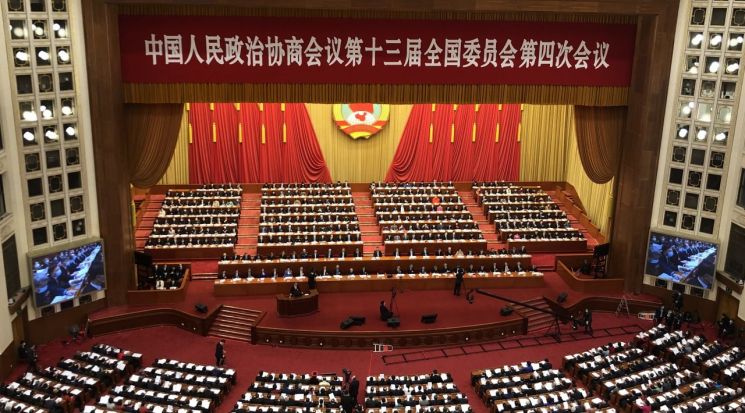
Furthermore, there is an analysis that the Chinese government's message to the market through the Two Sessions, which can gauge the medium- to long-term policy direction, presenting a lower-than-expected economic growth rate and signaling the removal of asset bubbles in stocks and other markets, is also a major factor behind the decline in Chinese-related stock prices.
On the 5th, when the annual plenary session of the National People's Congress (NPC) opened, the Chinese government set this year's economic growth target at "6% or above," which is significantly lower than the market's general expectation of the 8% range. The Chinese government has set this year's fiscal deficit target at around 3.2%, lower than last year's "3.6% or above," reducing the intensity of economic stimulus and implementing an exit strategy that shifts emergency economic policies to normal economic policies.
© The Asia Business Daily(www.asiae.co.kr). All rights reserved.
![Clutching a Stolen Dior Bag, Saying "I Hate Being Poor but Real"... The Grotesque Con of a "Human Knockoff" [Slate]](https://cwcontent.asiae.co.kr/asiaresize/183/2026021902243444107_1771435474.jpg)











