Electric Vehicle Market Explodes, but Policies and Infrastructure Still Focused on Internal Combustion Cars
EV Charger Growth Lags Behind EV Adoption Speed
Hundreds of Monthly Complaints About Charging Obstruction... Conflicts Intensify
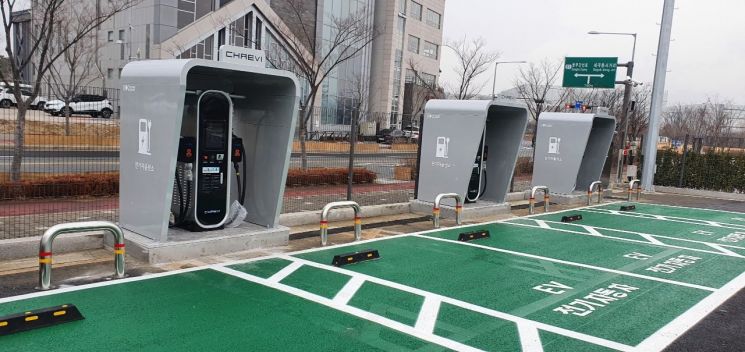 'Electric Vehicle Charging Station' installed in a public parking lot in Gangnam-gu, Seoul (file photo) [Image source=Yonhap News]
[Asia Economy Reporter Changhwan Lee] Regarding eco-friendly vehicles, not only subsidies and tax systems but also infrastructure issues are serious. While the number of electric vehicles is skyrocketing every year, the speed at which chargers are increasing cannot keep up, which is a representative problem. There are also criticisms that efforts to secure scarce minerals such as cobalt and lithium, which are key raw materials for electric vehicle batteries, are insufficient.
◆0.4 Chargers per Electric Vehicle... Increasingly Insufficient
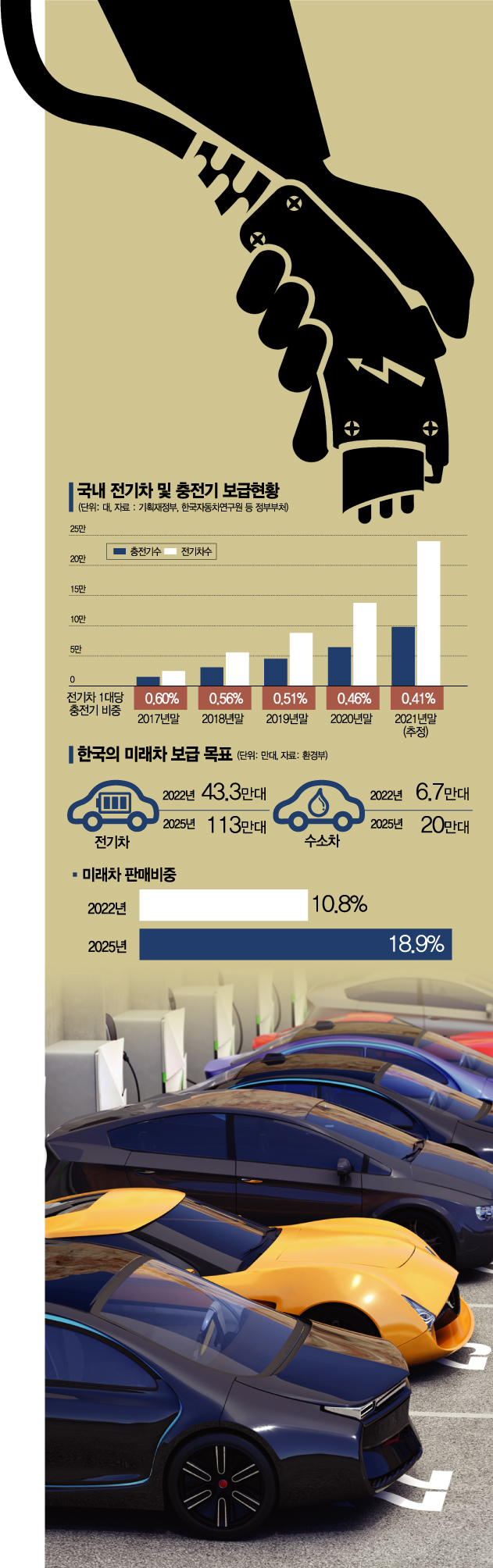
On the 9th, Asia Economy analyzed data from government ministries including the Ministry of Economy and Finance and the Ministry of Environment, and found that the number of electric vehicle chargers per electric vehicle is expected to decrease from 0.46 at the end of last year to 0.41 by the end of this year. This is the lowest level in six years since 2015.
The shortage of electric vehicle chargers is due to the fact that the speed of charger deployment cannot keep up with the increase in electric vehicles. As of the end of last year, the number of electric vehicle chargers installed nationwide was 64,188, a 4.3-fold increase compared to 2017, while during the same period, electric vehicles increased 5.5 times from 24,907 to 137,636.
The government plans to expand electric vehicle chargers by more than 30,000 units this year, but the expected sales volume of electric vehicles this year, excluding two-wheelers, is expected to reach 100,000 units, so the gap is expected to widen further by the end of the year.
The government argues that since the usual charging frequency for electric vehicles in daily life is once every two days, one charger per two electric vehicles is an appropriate level, but currently, even this is not being met. Compared to other countries, the situation is worse. According to the Federation of Korean Industries, as of the end of 2019, the number of electric vehicle chargers in Korea was only 0.8% of China’s, 1.4% of the United States’, and 10.1% of Japan’s.
Another eco-friendly vehicle, hydrogen cars, also face a serious shortage of chargers. Comparing the number of hydrogen vehicles per hydrogen refueling station among major countries, Korea has 232 vehicles per station, China 215, the United States 130, Japan 30, and Germany 9.4, indicating that Korea has the most severe shortage of hydrogen refueling stations relative to hydrogen vehicle deployment. Especially in metropolitan areas such as Seoul, Busan, and Gyeonggi, hydrogen refueling station construction is very poor due to space constraints.
Senior Research Fellow Kang Cheol-gu of the Gyeonggi Research Institute pointed out, "Currently, Korea ranks first in the world in the speed of electric vehicle and hydrogen vehicle deployment, but the construction of charging infrastructure is too slow and the number is very insufficient," adding, "As a result, last year’s achievement rate for new electric vehicle deployment targets remained at 60%."
Social Conflicts Worsen Due to Charger Shortage
Social conflicts are intensifying due to the insufficient charging system. There are cases where regular cars park in electric vehicle charging spots or occupy chargers for extended periods. According to Seoul City, complaints related to electric vehicle charging obstruction increased sharply by 49%, from an average of 153 cases per month in the first half of 2019 to 228 cases per month in the first half of last year.
Car owners suffering from stress after purchasing electric vehicles can be easily found nearby.
Choi, a 38-year-old office worker living in Seongdong-gu, Seoul, who bought an electric vehicle two years ago and is still driving it, is considering selling the car and returning to an internal combustion engine vehicle due to charging stress. Although the number of electric vehicles in the apartment is increasing, there are only two chargers, so a daily charging war is taking place. Not only are regular cars parked in electric vehicle spots, but there have also been cases where the owner did not answer calls after being asked to move the car once charging was complete. It is difficult to locate charging stations, and even when found, many chargers are defective, making long-distance travel a dream.
L, who purchased an electric vehicle last year, also asked the apartment management office if an electric vehicle charging system could be installed but was told it would be difficult under current conditions. L is forced to wander daily looking for public electric vehicle charging stations. L regrets purchasing an electric vehicle without having a "home meal" (a place where charging is easily possible).
In particular, Korea has a high rate of residents living in communal housing such as apartments, with 61% of the population residing in such housing, making it more difficult to secure charging infrastructure compared to other countries with higher rates of single-family housing. Accordingly, there is a high possibility that conflicts over charging infrastructure will increase every year.
Lee Ho, a senior researcher at the Korea Automotive Technology Institute, explained, "Conflicts among electric vehicle users regarding the use of public chargers are increasing not only in Korea but also overseas," adding, "The shortage of charger resources is causing conflicts." He added, "To respond flexibly to the increase in electric vehicles, it is necessary to mandate the construction of basic power facilities and to flexibly adjust the number of chargers according to deployment status and agreements among residents."
Securing Key Raw Materials for Electric Vehicle Batteries is Essential
There are calls for the government to actively secure raw materials for batteries, which are key components of electric vehicles. Electric vehicle batteries require many rare minerals such as cobalt and lithium. Korea lacks mineral resources and must rely mostly on imports from overseas. Major countries have acted swiftly to secure resources.
Last month, U.S. President Joe Biden issued an executive order instructing the administration to review supply chains for four key items?semiconductor chips, large-capacity batteries for electric vehicles, rare earth elements, and pharmaceuticals?within 100 days. The background of the executive order is the need for proactive resource securing as the electric vehicle market grows.
Since 2005, China has invested $144.9 billion and $272 billion in South America and Africa, respectively, to promote resource diplomacy for securing materials such as lithium and cobalt. Japan also established the "Four Major Strategies for Securing Rare Metals" in 2009 and supports overseas mining development by general trading companies. This year, Japan’s Ministry of Economy, Trade and Industry is strengthening special controls to stabilize the supply of 34 strategic metals including rare earths and cobalt.
An official from the Federation of Korean Industries emphasized, "In Korea, the self-sufficiency rate for lithium and cobalt is at the 0% level (as of 2017), so most battery raw materials are imported from China, making national-level resource development efforts essential."
© The Asia Business Daily(www.asiae.co.kr). All rights reserved.
![Clutching a Stolen Dior Bag, Saying "I Hate Being Poor but Real"... The Grotesque Con of a "Human Knockoff" [Slate]](https://cwcontent.asiae.co.kr/asiaresize/183/2026021902243444107_1771435474.jpg)


















