Student and Teacher Infection Cases Continue Nationwide
16 Confirmed Cases in High School Soccer Club Cluster in Gangdong-gu, Seoul
"Give Us the Choice to Attend School" 청 청원
Government: "School Site Quarantine Management Must Be Further Strengthened"
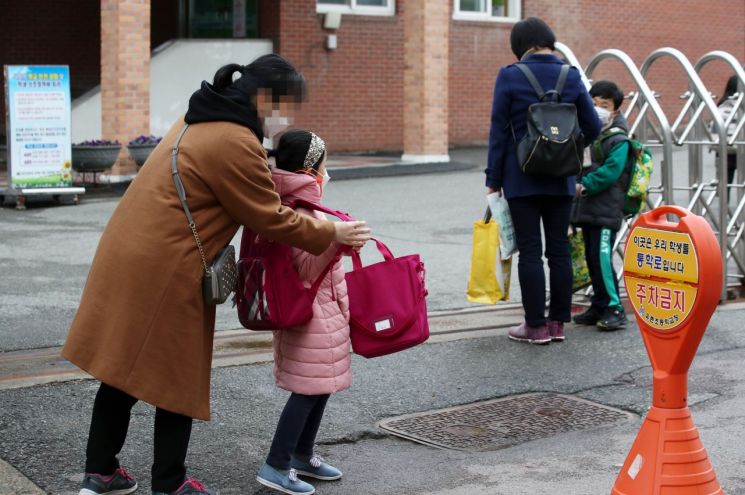 Parents are seeing off students at the school gate of an elementary school in Seo-gu, Gwangju as they go to school. The photo is unrelated to specific expressions in the article. [Image source=Yonhap News]
[Asia Economy Reporter Heo Midam] "Is it okay for kids to keep going to school while the COVID-19 risk still exists?"
One week after kindergartens and elementary, middle, and high schools reopened, COVID-19 infections have occurred in schools nationwide, putting school quarantine measures on high alert. In particular, a cluster infection occurred at a high school in Seoul where 16 students tested positive after the semester began.
As a result, concerns about a resurgence of COVID-19 are growing. Some parents are demanding the right to choose whether their children attend school in person, citing the ongoing risk of infection. The government has emphasized its commitment to strengthening quarantine management by inspecting school quarantine conditions.
According to quarantine authorities on the 8th, a total of 16 students at a high school in Gangdong-gu, Seoul, tested positive after the semester started. Of these, 15 belonged to a soccer club and had been living together near the school. Notably, the dormitory housed 31 people in total, including 27 students and 4 coaches. They had temporarily left the dormitory last October due to numerous resident complaints but recently resumed living together.
In addition, cases of teachers and students testing positive have been reported across the country. On the 7th, one middle school teacher and four third-year high school students in Jeju tested positive. Those schools switched to remote classes for two weeks.
On the same day, at a boarding high school in Samcheok, Gangwon Province, one student tested positive, prompting comprehensive testing of students and staff. Meanwhile, on the 6th, one student at a high school in Uijeongbu, Gyeonggi Province, tested positive, and in Yeosu, Jeollanam-do, one middle school student and one high school student were confirmed positive through their parents.
As infections among students and staff continue, concerns about sending children to school are rising. Since many students gather in confined spaces such as classrooms or cafeterias, the risk of infection is inevitably high.
Earlier, the government expanded in-person attendance this year due to the prolonged remote classes worsening care and academic gaps. Elementary grades 1-2, high school seniors, kindergarteners, and students in special schools (classes) attend school daily. Especially, small schools with fewer than 400 students and class sizes of 25 or fewer students are allowed to have all students attend school every day.
Regarding this, a member of a mom caf? said, "It’s touching to see kids carrying their backpacks and going to school after a long time, but on the other hand, I’m worried because of COVID-19. I’m also concerned whether the school is thoroughly enforcing quarantine. I worry that my child might take off their mask when talking with friends because it feels uncomfortable."
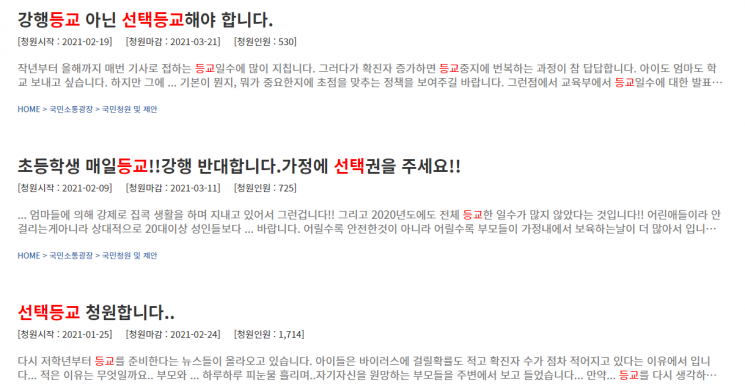 Recently, petitions requesting the recognition of the "right to choose attending school" have been continuously posted on the Blue House National Petition Board. Photo by Blue House National Petition Board capture.
Some voices are calling for the right to choose in-person attendance, citing concerns about infections at school. A petition titled "We need choice in school attendance, not forced attendance" was recently posted on the Blue House’s public petition board.
The petitioner stated, "This year, the number of confirmed cases is no better than last year, and considering variant viruses, we cannot comfortably send our children to school. Schools do some quarantine, but it varies by school and teacher. Some are very thorough, but many are not paying much attention."
They continued, "Younger children still have weak immunity. School quarantine alone is not safe for classrooms with more than 25 children in a confined space. Last fall, small-scale cluster infections occurred in nearby schools and academies. Considering this, the infection probability will obviously increase if younger children attend school every day."
Finally, the petitioner emphasized, "Every family has its own circumstances. Some must send their children to school daily, while others cannot. Considering these, parents should be allowed to choose, which would stop confusion about attendance days. Choice in attendance is necessary."
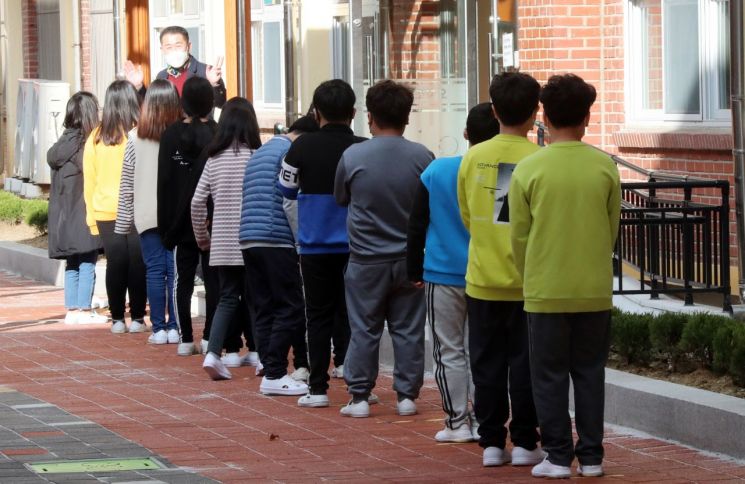 Students attending an elementary school in Buk-gu, Gwangju, are learning how to comply with COVID-19 prevention guidelines within the school as the new semester begins. Photo is unrelated to specific expressions in the article. [Image source=Yonhap News]
There were also opinions that the risk of infection is even greater in cafeterias because students remove their masks while eating.
A mom caf? member with elementary school children said, "The most worrisome part about sending kids to school is lunchtime. But at the school my kids attend, lunch is mandatory, not optional. I was surprised because I thought lunch was optional, but it’s mandatory."
However, the Ministry of Education is considering further expanding in-person attendance on the premise of strict quarantine. On the morning of the 7th, Yoo Eun-hye, Deputy Prime Minister and Minister of Education, appeared on KBS’s 'Sunday Diagnosis Live' and explained, "We are discussing easing attendance criteria based on density standards and expanding in-person classes under the premise that schools enforce quarantine thoroughly."
She added, "If vaccination expands and local infection stabilizes, we hope to expand flexible academic operations and possibly allow full attendance. However, it is necessary to be cautious and consider the overall situation before specifying the timing of attendance expansion."
Meanwhile, the government emphasized the need to strengthen quarantine management at schools. Prime Minister Chung Sye-kyun stressed at the Central Disaster and Safety Countermeasure Headquarters meeting, "To prevent the suspension of in-person classes, which were difficult to expand due to infections spreading in schools, quarantine management at school sites must be further strengthened."
He continued, "The Ministry of Education, local education offices, and frontline schools should recheck for any gaps in quarantine and actively implement necessary supplementary measures. For this semester, we ask schools and local communities to work together so that our students can have ample learning opportunities in a safe environment free from COVID-19."
© The Asia Business Daily(www.asiae.co.kr). All rights reserved.