March's Top 5 Banks' Credit Loans at 136.2 Trillion Won... Increased by 1.03 Trillion Won in 4 Business Days
DSR to Apply to All Loans This Month, with 2,100 New Revolving Credit Accounts Opened Daily
[Asia Economy Reporter Kwangho Lee] Demand for unsecured loans is surging again in March. Although last month saw a pause in the stock market's upward trend and rising loan interest rates, leading to a temporary slowdown, it is analyzed that last-minute demand is pouring in as borrowers try to secure unsecured loans ahead of the mid-March announcement of the financial authorities' ultra-strong loan regulations.
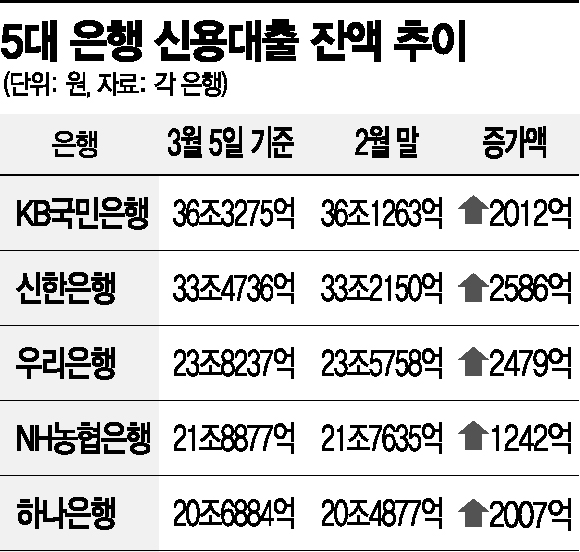
According to the financial sector on the 9th, as of the 5th, the outstanding balance of unsecured loans at the five major banks?KB Kookmin, Shinhan, Hana, Woori, and NH Nonghyup?was recorded at 136.2009 trillion won. This figure increased by 1.0326 trillion won in just four business days compared to the previous month.
Unsecured loans at the five major banks surged by 1.5918 trillion won month-on-month until January due to the booming stock market and real estate investment frenzy driven by "Yeongkkeul (pulling together all resources)" and "Bittou (investing with borrowed money)," but turned to a decline in February. This is attributed to lump-sum payments such as Lunar New Year bonuses and year-end tax refunds, a shift to a correction phase in the stock market, and rising loan interest rates.
Average of 2,100 New Overdraft Accounts Opened Daily in March
However, the atmosphere changed this month. From the first business day on the 2nd, the number of customers seeking unsecured loans noticeably increased, followed by a sharp rise in new overdraft account openings. The average daily new overdraft accounts in March reached 2,100, far exceeding the previous month's average of 1,600. Shinhan and Woori Banks saw about 100 new accounts opened in just one day.
This is interpreted as anxiety stemming from the prolonged COVID-19 situation causing varying funding needs across social strata and the possibility of funding drying up soon due to the strong loan regulations to be announced mid-month.
An official from a commercial bank said, "In the ongoing financial pressure caused by the prolonged COVID-19 situation, demand for loans is increasing as people try to secure loans before the financial authorities strengthen loan regulations." In fact, when the financial authorities announced in November last year the DSR 40% regulation on unsecured loans exceeding 100 million won for high-income earners with annual income over 80 million won, last-minute demand surged, increasing unsecured loan balances at the five major banks by 1.5 trillion won within a week.
The Financial Services Commission plans to announce household debt management measures as early as next week or by the end of this month at the latest. The core of this plan is to apply the Debt Service Ratio (DSR), which assesses borrowers' total debt and income to determine repayment ability, to all loans. The DSR standard is expected to be set around 40%. This means loans can be taken out as long as the total principal and interest to be repaid annually do not exceed 40% of annual income. However, the Financial Services Commission intends not to retroactively apply the new system to loans taken before the regulation is implemented.
Significant Burden on Households Due to Future Market Volatility
Experts express concern that forcing loans amid the recent rise in market interest rates could impose a significant burden on households depending on future market volatility.
Professor Taeyoon Sung of Yonsei University's Department of Economics pointed out, "The rapid rise in U.S. Treasury yields will continue to affect domestic financial market volatility. If housing prices or stock prices plummet, households that borrowed heavily to buy homes or stocks could face severe shocks, so management is necessary."
The financial authorities also plan to strengthen monitoring of the rapidly increasing household loans. Do Kyusang, Vice Chairman of the Financial Services Commission, emphasized at the Financial Risk Response Team meeting that day, "If global interest rate hikes and synchronization with domestic interest rates occur, risks such as increased corporate funding costs and higher interest burdens on household loans may arise. We will closely monitor financial market risk factors by sector and prepare to respond promptly when necessary."
© The Asia Business Daily(www.asiae.co.kr). All rights reserved.
![Clutching a Stolen Dior Bag, Saying "I Hate Being Poor but Real"... The Grotesque Con of a "Human Knockoff" [Slate]](https://cwcontent.asiae.co.kr/asiaresize/183/2026021902243444107_1771435474.jpg)
















