Eight Financial Public Institutions Have Just Over 10% Women Including Non-Executive Directors
Government National Tasks Include This, and Even Lawmakers' Criticism Fails to Change It
Experts Say "Male-Centered and Conservative Practices Are the Problem"
[Asia Economy Reporter Song Seung-seop] It has been revealed that there is not a single female executive director among public institutions under the financial ministry. This highlights the persistent and severe “glass ceiling” (an invisible barrier blocking women’s advancement to senior positions) in the firmly established financial public institutions within government agencies.
The Glass Ceiling in Financial Public Institutions Grows Stronger... Women Make Up Just About 10% Even Including Non-Executive Directors
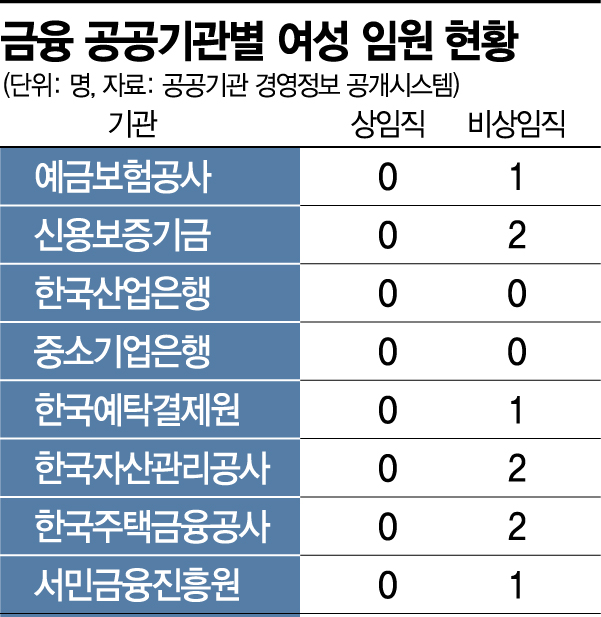
According to the latest executive status data disclosed by each institution on the public institution management disclosure system Alio as of the 9th, all 42 executive directors of eight Financial Services Commission-affiliated institutions?KDB Industrial Bank, IBK Industrial Bank, Korea Securities Depository, Korea Asset Management Corporation (KAMCO), Korea Housing Finance Corporation, Korea Credit Guarantee Fund, Deposit Insurance Corporation, and the Korea Inclusive Finance Agency?are male.
Even when including non-executive directors, only 9 out of 85 executives are women, accounting for approximately 10.58%. This slight increase came after last year when the Korea Housing Finance Corporation appointed lawyer Seo Chae-ran, who previously served as a senior administrative officer at the Blue House’s Ministry of Land, Infrastructure and Transport Secretariat, as a non-executive director.
By institution, KDB and IBK have no female non-executive directors, while Korea Credit Guarantee Fund, KAMCO, and Korea Housing Finance Corporation each have two female non-executive directors. Compared to a year ago, only Korea Housing Finance Corporation saw an increase in female non-executive directors.
The average proportion of women combining regular employees and executives rose by 1.08 percentage points from the previous year to 34.02%. The thickest glass ceiling was found at the Korea Credit Guarantee Fund, where only 714 of 2,768 employees are women, making up the smallest share at 25.79%. The Korea Inclusive Finance Agency showed the largest increase in female employees during the same period, rising from 37.03% to 41.24%. IBK had the highest female ratio among financial public enterprises at 46.65%, but this was a 0.3 percentage point decrease from the previous year.
Despite Inclusion in Government National Tasks and Lawmaker Reprimands... Financial Public Institutions Are Moving Backwards
Financial public institutions have consistently faced criticism for insufficient efforts to address the glass ceiling issue. In October last year, Justice Party lawmaker Bae Jin-kyo pointed out during the National Assembly’s Political Affairs Committee audit that “there were only two female executives in financial public institutions (as of 2019),” emphasizing the need for institutional improvements to increase the proportion of women in senior positions.
Not only the proportion of female executives but also wage gaps and length of service disparities were significant. According to lawmaker Bae, among 6,012 women at grade 3 or higher (senior positions), only 899 were women, accounting for 14.9%. The average length of service for female workers was 9.5 years, 4.9 years shorter than the 14.4 years for men. Women’s wages were only 71.3% of men’s.
According to the Ministry of Gender Equality and Family’s data on “Enhancing Women’s Representation in the Public Sector,” as of the end of the first half of last year, the proportion of female executives in public institutions was 20.8%, and the proportion of female managers was 25.6%. This is the result of the government’s direct establishment and five-year plan implementation as one of the 100 major national tasks, yet financial public institutions are moving in the opposite direction.
The situation is similar when compared to private companies. According to a survey by global headhunting specialist Unico Search on female executives in Korea’s top 100 companies last year, there were 286 female executives, a 17.2% increase from 244 the previous year. Sixty companies had female executives.
Experts attribute this to the male-centered and conservative practices still prevalent in the financial sector. A former member of the financial labor union’s women’s committee criticized, “Deposit operations are assigned to women, while men mainly handle loans and corporate credit, which are performance-driven areas. This division of experience creates differences in promotion.”
Professor Lee Byung-tae of KAIST’s Department of Economics analyzed, “Finance is an industry with deeply rooted conservative culture. Because women’s advancement is delayed, internal promotions are rare, and efforts to recruit from outside are insufficient.”
© The Asia Business Daily(www.asiae.co.kr). All rights reserved.
![Clutching a Stolen Dior Bag, Saying "I Hate Being Poor but Real"... The Grotesque Con of a "Human Knockoff" [Slate]](https://cwcontent.asiae.co.kr/asiaresize/183/2026021902243444107_1771435474.jpg)
















