Market Concerns Spread Amid Inflation Fears and Large-Scale Treasury Auction Announcement
Dollar Also Strengthens Contrary to Expected Decline
Nasdaq Plummets 2.4%... Enters Correction Phase
[Asia Economy New York=Correspondent Baek Jong-min] Janet Yellen, the U.S. Treasury Secretary, has lost face. Despite Yellen’s remarks that there are no inflation concerns, U.S. Treasury yields surpassed 1.6%. With Jerome Powell, Chairman of the U.S. Federal Reserve (Fed), unable to stop the rise in interest rates, the market is now speculating about the possibility of Treasury yields reaching 3%.
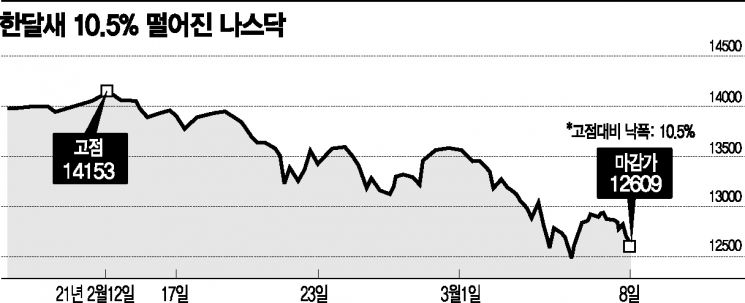
Due to the burden of rising Treasury yields, the tech-heavy Nasdaq plunged 2.4%. There is also analysis suggesting that Nasdaq has officially entered a correction phase.
On the 8th (local time), Secretary Yellen said in an interview with MSNBC, "Before the COVID-19 pandemic, the unemployment rate was only 3.5%, but there were no signs of inflation. Even if prices rise and cause problems, the administration has tools to respond."
Yellen added, "If full efforts are made toward vaccination and school normalization, there is a prospect that the labor market can truly get back on track by the end of this year or next year," attempting to quell market concerns about the relationship between economic recovery from the $1.9 trillion stimulus package and inflation.
The result was a failure. The 10-year U.S. Treasury yield fluctuated in the 1.5% range after Yellen’s remarks but eventually entered the 1.6% range.
Concerns about inflation and rising Treasury yields continue to grow. On the same day, Bloomberg reported that the gap between the U.S. nominal gross domestic product (GDP) growth rate and the 10-year Treasury yield will widen to the largest since 1966. Bloomberg noted that experts’ forecast for this year’s nominal GDP growth rate reached 7.6%, diagnosing that the current Treasury yield of 1.6% does not properly reflect economic growth. The nominal GDP growth rate was calculated by adding the expected real GDP growth rate of 5.5% and the inflation expectation of 2.1%.
This indicates there is ample room for Treasury yields to rise further. Since 2010, the gap between nominal GDP growth and Treasury yields has remained around 2%, but it has now surged to 6%.
On the same day, hedge fund titan David Tepper predicted that the U.S. Treasury sell-off would soon end, but the market is leaning more toward rising yields. Jeffrey Gundlach, founder of DoubleLine Capital and known as the ‘Bond King,’ argued that considering German bonds and U.S. real GDP growth, U.S. Treasury yields should be in the 3% range. According to the New York Federal Reserve on the day, expected inflation over the next year was 3.1%, the highest since July 2014.
Due to the burden of Treasury yields, Nasdaq closed down 2.4% from the previous day. The Nasdaq index has fallen 10.5% since the 12th of last month. The Wall Street Journal diagnosed on the day that "Nasdaq has entered a correction phase."
This week’s scheduled U.S. Treasury auctions are also unsettling investors. On the 10th, the 10-year Treasury auction will be held immediately after the Consumer Price Index (CPI) release, followed by the 30-year auction the next day. If the CPI is higher than expected, there is a possibility that the auctions will perform poorly again, potentially causing yields to surge sharply.
The rise in U.S. Treasury yields is also driving up the value of the dollar. The dollar index, which shows the dollar’s value against major currencies, soared to 92.42 on the day. Amid the strong dollar, gold prices plunged to their lowest level in nine months.
© The Asia Business Daily(www.asiae.co.kr). All rights reserved.

















