Single Room Use, Lower Infection Risk... "Great Support for Patients Complaining of Depression"
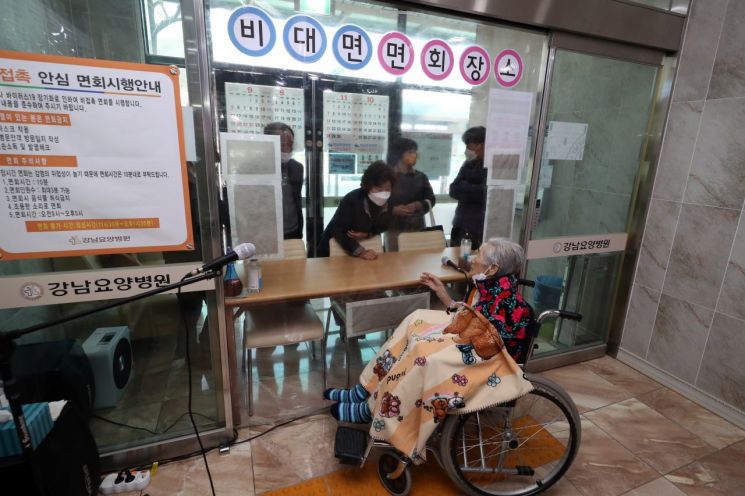
[Asia Economy Reporters Seo So-jung and Kim Ji-hee] "I am seeing my sister after 14 months. I hope the day comes soon when we can hold hands without worry."
Kim Jin-cheol (52), who is hospitalized at Carnation Nursing Hospital, could not take his eyes off his sister’s face when they met on the 9th after more than a year. He kept looking repeatedly, as if afraid to forget her face. Although the visit took place with him lying down due to his illness, he was so happy to see his family after a long time that he barely slept the night before. Kim said, "I recently completed the COVID-19 vaccination," and added, "I am really happy to see my family whom I missed."
From this day, non-contact face-to-face visits were suddenly allowed at some nursing hospitals and facilities where visits had been restricted to prevent COVID-19 infection, leading to family reunions across the country. Although non-face-to-face (untact) visits had been conducted, some nursing hospitals restricted not only contact visits but also non-contact face-to-face visits through glass walls due to infection concerns, forcing families to endure long separations. Nursing hospitals were busy with numerous inquiries about family visits.
Lee Hyun-mi (in her 60s), who visits her mother hospitalized for three years at a nursing hospital in Seoul, said, "Since the Lunar New Year holiday, non-contact face-to-face visits have been allowed, so visits were conducted by hearing each other’s voices over the phone with a glass wall in between," adding, "We see each other’s faces but cannot even hold hands, so it is more heartbreaking. I hope the COVID-19 situation stabilizes soon enough to allow contact visits."
The government allowed non-contact face-to-face visits unconditionally but permitted contact visits only in cases of end-of-life, unconscious or equivalently severe patients, or when the attending physician recognizes the necessity of visits for the patient’s emotional stability. Visitors must wear personal protective equipment including KF94 or N95 masks, disposable waterproof long-sleeve gowns, disposable gloves, goggles or face shields, and shoe covers, and meet in single rooms or separate independent spaces.
Nursing hospitals and facilities also prepared to prevent infection spread. Kim Ki-ju, director of Seonhanbit Nursing Hospital, explained, "Visitors must submit a negative PCR test result taken within 24 hours, and since meetings occur in single rooms, the risk of infection is not high," but added, "We are strengthening our own disinfection measures just in case." Labor Director of Carnation Nursing Hospital, Roh Dong-hoon, said, "This measure will be a great support to patients who have been suffering from depression or missing their families."
© The Asia Business Daily(www.asiae.co.kr). All rights reserved.

















