Set Special Inspection Period for the Entire Month of March
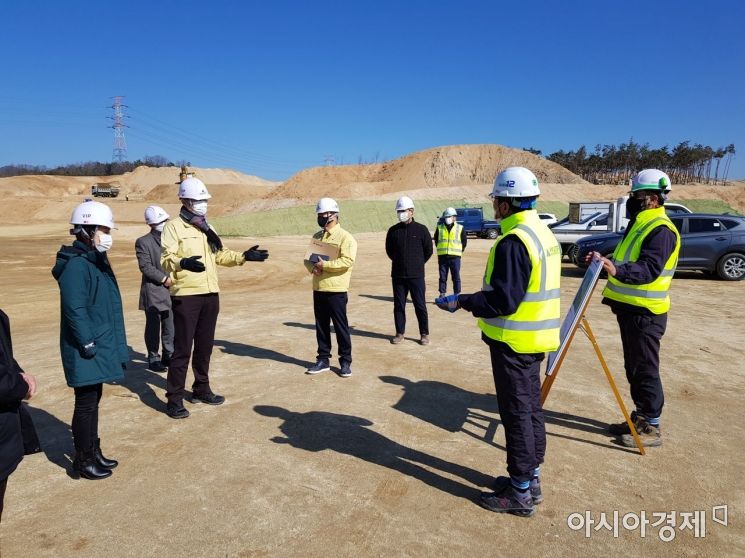 Director Jo Gwang-rae of the Environmental Forestry Resources Bureau of Gyeongbuk Province is visiting a large construction site to review the status of fine dust reduction.
[Asia Economy Yeongnam Reporting Headquarters, Reporter Park Dong-wook] Gyeongbuk Province announced on the 9th that it has designated March, the month with the highest concentration of fine dust, as a special inspection period and will actively work to reduce fine dust emissions in the industrial, residential, and transportation sectors.
Gyeongbuk Province, which established the 'Seasonal Fine Dust Management System' last December for intensive management during high concentration periods, will apply reduction measures that must be implemented upon issuance of emergency reduction orders to public workplaces and government-contracted construction sites throughout March to reduce emissions in the industrial sector.
For public workplaces, measures include reducing operating hours and rates, and increasing the efficiency of prevention facilities by adding chemicals. For government-contracted construction sites, efforts will be made to shorten construction hours, increase water spraying, and strengthen the installation of dust prevention covers.
In the residential sector, campaigns to eradicate illegal burning will be promoted, and enforcement will be strengthened together with wildfire monitors. Additionally, road cleaning along heavily managed roads near residential areas will be expanded to 2 to 3 times daily using street sweepers.
In the transportation sector, special inspections of vehicle emissions will be conducted, and vehicles caught violating the Grade 5 driving restriction in the metropolitan area and other regions will be actively encouraged to take low-emission measures as part of focused management.
Gyeongbuk Province is also implementing various support measures to reduce fine dust emissions. It is providing 23.4 billion KRW to install and replace air pollution prevention facilities at 200 small and medium-sized enterprises, 1.2 billion KRW for the installation of 207 joint collection sites for agricultural waste in rural areas to support waste collection, and 3.2 billion KRW in compensation for rural plastic waste collection.
Furthermore, to reduce emissions from old diesel vehicles in the transportation sector, a budget of 90.8 billion KRW is being used to support early scrapping of 29,050 vehicles and low-emission measures such as installing reduction devices on 10,432 vehicles.
Jo Gwang-rae, Director of the Environment, Forestry, and Resources Bureau of Gyeongbuk Province, stated, "The occurrence of high-concentration fine dust is caused by a combination of three major factors: foreign inflow, atmospheric stagnation weather conditions, and accumulation of domestic emissions." He added, "Through an all-out response in March and proactive self-emission reductions, we will do our best to suppress the occurrence of high-concentration fine dust."
© The Asia Business Daily(www.asiae.co.kr). All rights reserved.

















