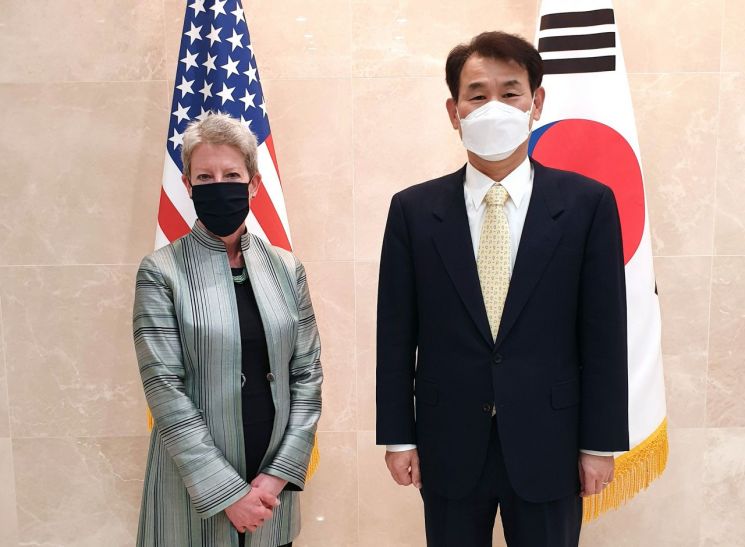
[Asia Economy Reporter Lee Ji-eun] The agreement on the Special Measures Agreement (SMA) for defense cost-sharing between the South Korean and U.S. governments is being evaluated as an opportunity that reaffirmed the strong South Korea-U.S. alliance once again. The Biden administration of the U.S. has "normalized" the "abnormal" approach of the previous Trump administration by adopting an "alliance-centered" policy. However, concerns have been raised that the U.S. may strongly demand South Korea's participation in the Quad Plus as a pretext for strengthening the alliance to counter China.
According to the Ministry of Foreign Affairs on the 8th, the recent defense cost-sharing negotiations between the South Korean and U.S. governments were concluded 46 days after President Biden took office. In March last year, at the last face-to-face meeting held in Los Angeles (LA), the two sides tentatively agreed to increase South Korea's defense cost-sharing for 2020 by about 13% from the previous year's contribution (1.0389 trillion KRW), but the final agreement was not reached as then-President Trump did not approve it. President Trump had demanded an amount about five times higher, $5 billion (approximately 5.6 trillion KRW).
The negotiations, which began at the end of 2019 and failed to find common ground for over a year, changed atmosphere with President Biden's inauguration. President Biden, who set rebuilding alliances as a diplomatic goal, sent a message to South Korea immediately after his election that he would "not exploit allies," distinguishing himself from Trump. This was interpreted as emphasizing cooperation with allies rather than increasing defense costs. Professor Shin Yul of Myongji University’s Department of Political Science and Diplomacy said, "It is a kind of 'normalization of abnormality,'" adding, "In the past, it was difficult to reach an agreement on the defense cost-sharing pact because Trump acted abnormally toward allies, but now it is a signal that normalization is happening under the Biden administration."
The defense cost increase rate is expected to be decided at the 13% level tentatively agreed upon last year. If the agreement is made at the 13% level, the multi-year contract thereafter will adjust the amount by a certain rate considering inflation. Therefore, if the annual increase rate is higher than the inflation rate, it is pointed out that the contract cannot be considered successful. Currently, neither the Ministry of Foreign Affairs nor the State Department has disclosed detailed terms such as the increase rate. However, the State Department stated, "This agreement includes a meaningful increase in South Korea's contribution." In this regard, The Wall Street Journal (WSJ), citing diplomatic sources, reported that the new agreement will be maintained until 2026. Since the 2020 contribution is applied retroactively, if the agreement is valid until 2026, it will be a seven-year contract.
However, concerns have also been raised that South Korea's defense burden may increase further under the Biden administration. The U.S. may link the SMA with the Indo-Pacific strategy and force South Korea's role and participation. Shin Beom-chul, head of the Foreign and Security Center at the Korea Institute for Industrial Economics and Trade, said, "Just because the defense cost-sharing issue was easily resolved does not mean that the South Korea-U.S. alliance issues are over; rather, more complex and strategic issues remain," and analyzed, "The Biden administration will emphasize South Korea's more active role in defense and will demand an increased role for South Korea not only in South Korea-U.S.-Japan security cooperation but also in countering China in East Asia."
© The Asia Business Daily(www.asiae.co.kr). All rights reserved.

















