IMF's Policy Advice on Asia in the COVID-19 Era
If the Trade War Intensifies Leading to Technological Decoupling
Excluding China, Korea Faces the Largest GDP Impact
India Could Benefit by Replacing Chinese Production Facilities
[Asia Economy Reporter Eunbyeol Kim] If the trade war in the technology sector between the United States and China escalates beyond the current level, Korea is expected to suffer the greatest economic damage excluding China. Should the trade war disrupt technology exports and force exporters to choose between the U.S. and China, Korea's gross domestic product (GDP) is estimated to decrease by more than 5% compared to projections after 10 years. Since China is a direct party to the U.S.-China conflict, Korea would experience the most severe impact among third countries.
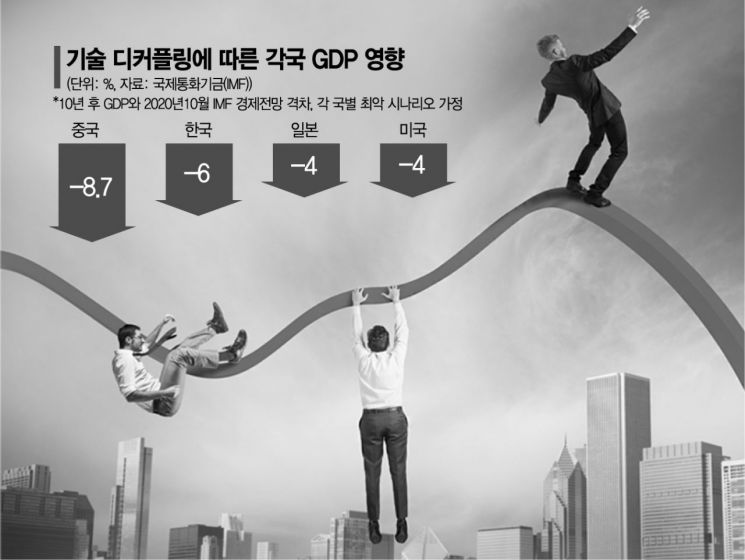
On the 8th, the International Monetary Fund (IMF) stated in its report titled "Policy Advice for Asia in the COVID-19 Era" that if the U.S.-China technological hegemony competition continues and leads to "technological decoupling"?a reduction in mutual technology supply and dependence?Korea's GDP is expected to decline by 5.4% from the original forecast (approximately 2,500 trillion KRW) after 10 years. Among countries excluding China, the economic damage from the technology war is projected to be the largest for Korea.
Besides Korea, Japan's GDP is expected to decrease by about 4% from projections. The impact on the Eurozone (19 countries using the euro) and the United States is estimated to be around 4%, which is less than Korea's. The IMF pointed out that the main reason for the severe impact is the high trade dependence of Asian export countries on China and the high likelihood that trade with either the U.S. or China would be cut off if the U.S.-China trade war escalates. Korea's export share to China is about 25%.
Among the countries, China is identified as the one that would lose the most if a technological gap arises due to the U.S.-China trade war. According to the IMF, if technological decoupling occurs, China's GDP could shrink by between 1.7% and 8.7% compared to forecasts. This is because exports would inevitably decrease, as seen last year when the U.S. restricted component exports to China's Huawei.
India is identified as a country that could benefit if technological decoupling occurs due to the trade war. This is because India can replace China's production bases, gaining significant advantages in the labor market.
If the technology trade war spreads beyond the U.S. and China to other countries within the Organisation for Economic Co-operation and Development (OECD), the impact on each country is expected to be even greater. Assuming the technology war extends to Germany, Korea's GDP is projected to fall by about 7% compared to forecasts after 10 years. The IMF pointed out that the emergence of technological decoupling amid the gradual recovery from the COVID-19 pandemic is a concerning factor. The IMF advised, "Rather than responding to the technology war with an eye-for-an-eye approach, it is constructive for countries to preserve and foster the international trade system by recognizing advanced technology goods and services trade."
© The Asia Business Daily(www.asiae.co.kr). All rights reserved.
![Clutching a Stolen Dior Bag, Saying "I Hate Being Poor but Real"... The Grotesque Con of a "Human Knockoff" [Slate]](https://cwcontent.asiae.co.kr/asiaresize/183/2026021902243444107_1771435474.jpg)
















