Yeo's External Think Tank 'The Future Institute' Advocates for Subscription System Reform

[Asia Economy Reporter Kim Hye-min] A ruling party think tank has called for a reform of the housing subscription system to benefit long-term non-homeowners in their 40s and 50s. The current subscription system favors 30-something newlyweds, particularly those from certain groups who can receive parental support, which is considered inequitable. The current point-based system, which assigns the highest scores based on the number of dependents, effectively excludes long-term non-homeowner households of one or two people from homeownership, indicating a need for revision.
On the 7th, The Future Research Institute argued in its report titled "Suggestions on the Problems and Improvement Directions of the Housing Sale System" that the current subscription system needs to be redesigned. The Future Research Institute is an external think tank of the Democratic Party, headed by former Democratic Party lawmaker Kim Ki-sik.
The report pointed out, "In terms of quantity, the current housing sale system grants the most benefits to newlyweds, and in terms of selection criteria, it places the greatest weight on the number of dependents, making it difficult for long-term non-homeowners to purchase their own homes."
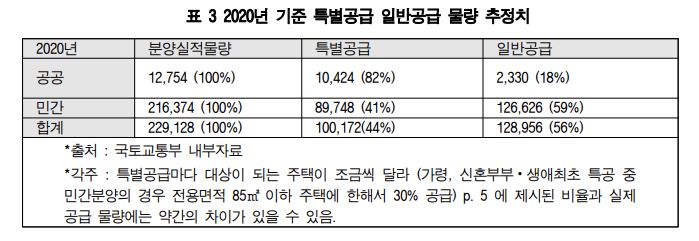
◆ "Current subscription system designed to favor only some newlyweds who can afford high sale prices" = The current supply method for sale housing includes special allocations for specific groups such as multi-child families and newlyweds, and general allocations for those who do not fall under these categories. The special allocation for newlyweds was first introduced in 2008 under the Lee Myung-bak administration and was significantly expanded under the Moon Jae-in administration. It currently accounts for 30% of public sale units and 20% of private sale units. Newlyweds can also receive benefits from the lifetime first-time special supply, which was also greatly expanded under the Moon administration (expanded to 25% for public sales, and newly established at 15% for public land and 7% for private land in private sales).
The report emphasized the need for critical review. The Future Research Institute stated, "While it is difficult to deny the need for housing support for the younger generation, it is necessary to critically examine whether providing a disproportionate amount of housing supply benefits to 30-something newlyweds is appropriate from the perspective of intergenerational equity."
It added, "Looking at the age distribution of non-homeowner households, those in their 40s and 50s also represent a significant proportion comparable to those in their 30s. Considering life cycle demands, stable housing is needed for work and children's education. Missing this period makes it difficult to seize the opportunity to own a home, so the need for homeownership is greater than that of 30-something newlyweds."
The report pointed out that considering that sale prices in Seoul and the metropolitan area approach 600 million to 900 million KRW, the special allocation for newlyweds may unintentionally benefit only a subset of the upper class among the 30-something youth who can afford such high prices, granting them both winning chances and capital gains.

◆ "Point system places too much weight on number of dependents... 1-2 person households excessively excluded" = The point system applied to general sales also assigns a high proportion of points based on the number of dependents, effectively depriving 1-2 person households of winning opportunities, the report criticized. It stated, "For multi-child families, both public and private sales allocate 10% of units as special supply, and for households supporting elderly parents, 5% in public sales and 3% in private sales are allocated as special supply, effectively giving double benefits to households with many dependents."
The Future Research Institute said, "While the policy intent to encourage childbirth is understandable, considering that the point system based on the number of dependents has been in place for 14 years and birth rates have continued to decline, it is difficult to see the point system as effectively encouraging childbirth. Research showing that higher household income correlates with more children suggests that additional benefits are merely given to relatively affluent households capable of supporting multiple children."
◆ "Provide 30-somethings with opportunities to save for homeownership, and give subscription chances to 40s and 50s" = The report argued that affordable long-term rental housing should be supplied to 30-something newlyweds to reduce housing cost burdens and help them save for homeownership, while the sale system should be reformed to prioritize housing sale opportunities for long-term non-homeowners in their 40s and 50s.
The report stated, "In the sale system, the proportion of general supply units should be increased, and the benefits based on the number of dependents should be significantly reduced. To this end, the special supply for 30-something newlyweds and special supply for previous institutions and institutional recommendations should be reduced, and the proportion of general supply units available to non-homeowners in their 40s and 50s should be greatly expanded."
It added, "To prevent households in their 40s and 50s with fewer dependents from being disadvantaged in the subscription system, measures such as removing either the additional points for dependents in the point system or one of the special supplies for multi-child or elderly-parent-supporting households should be considered to reduce their weight."
© The Asia Business Daily(www.asiae.co.kr). All rights reserved.



















