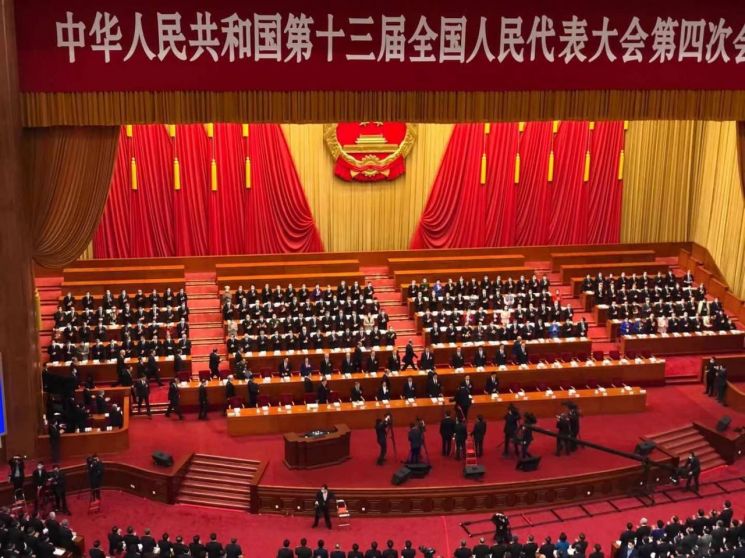
[Asia Economy Reporter Ki-min Lee] The draft of China's 14th Five-Year Economic Plan (14·5 Plan, 2021?2025) includes a strategic focus on fostering eight key industries such as rare earths, new materials, and robotics. This is interpreted as an effort to secure independent competitiveness amid the expansion of US-China conflicts into the technology sector.
On the 5th, the opening day of the annual plenary session of the National People's Congress, the State Council of China revealed the draft of the '14·5 Plan and Long-term Goals through 2035,' which outlined plans to intensively develop eight key industries as part of strengthening the core competitiveness of manufacturing by 2025 under the 14·5 Plan.
The eight key industries include ▲ new materials such as rare earths ▲ major technological equipment such as high-speed rail, large LNG carriers, and the C919 large passenger aircraft ▲ smart manufacturing and robotics technology ▲ aircraft engines ▲ Beidou (北斗) satellite positioning system applications ▲ new energy vehicles and smart cars ▲ advanced medical equipment and new drugs ▲ and agricultural machinery.
China previously established the 'Made in China 2025' strategy, a national initiative to foster advanced industries such as robotics, information and communications, new materials, and automobiles. However, after the US criticized it as an unfair industrial subsidy policy, China has avoided using this terminology.
Some view this draft as a revival of 'Made in China 2025.' On the 6th, Hong Kong's South China Morning Post (SCMP) stated, "Due to complaints from the US and Europe, China had not promoted 'Made in China 2025,'" and interpreted that "China's renewed focus on advanced manufacturing shows the government's determination to pursue high-tech transformation in this sector."
SCMP evaluated, "Through this, China can enhance its position in the global supply chain and reduce dependence on foreign technology," adding, "It will also help strengthen competitiveness against the United States."
Additionally, the State Council presented a goal in the draft to achieve breakthroughs in seven advanced scientific and technological research areas as part of the long-term economic plan through 2035. The seven areas are ▲ artificial intelligence (AI) ▲ quantum information ▲ integrated circuits ▲ brain science ▲ genetics and biotechnology ▲ clinical medicine and healthcare ▲ space, deep-sea, and polar exploration.
Chinese Premier Li Keqiang emphasized in the previous day's NPC work report, "Basic research is the source of scientific and technological innovation, so stable funding for basic research must be guaranteed." He added, "We must overcome difficulties in key core technology projects," and "We need to cultivate a spirit of sharpening a single blade over ten years to achieve major breakthroughs in core areas."
© The Asia Business Daily(www.asiae.co.kr). All rights reserved.
![Clutching a Stolen Dior Bag, Saying "I Hate Being Poor but Real"... The Grotesque Con of a "Human Knockoff" [Slate]](https://cwcontent.asiae.co.kr/asiaresize/183/2026021902243444107_1771435474.jpg)
















