Statistics Korea, January Industrial Activity Trends
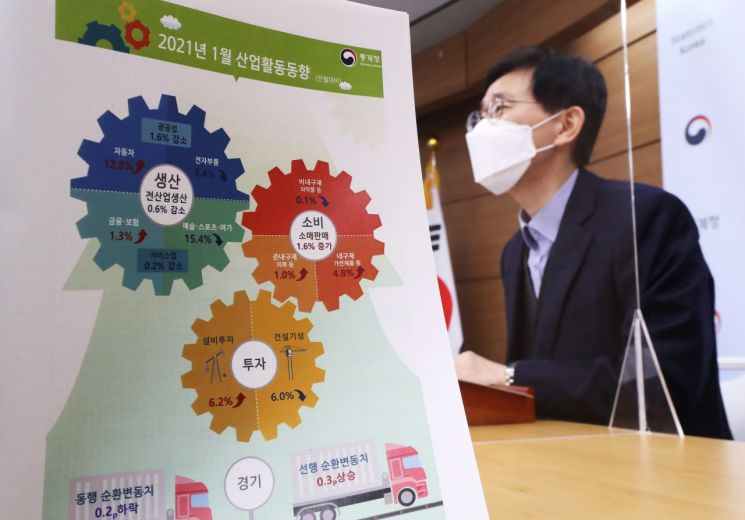 Eounseon, Director of Economic Trend Statistics at the Statistics Korea, is announcing the January 2021 Industrial Activity Trends on the morning of the 2nd at the Government Complex Sejong in Sejong City. [Image source=Yonhap News]
[Asia Economy Reporter Joo Sang-don] In January this year, overall industrial production turned to a decline. Manufacturing production contracted due to the resurgence of COVID-19, and the service sector continued to decrease. However, consumption increased for the second consecutive month as 'home-stay consumption' rose amid strict social distancing measures and cold waves.
According to the January industrial activity trends released by Statistics Korea on the 2nd, overall industrial production fell by 0.6% compared to the previous month due to decreases in manufacturing, service, and construction sectors. This marks the first decline in eight months since May last year (-1.5%).
Oh Un-seon, Director of Economic Trend Statistics at Statistics Korea, explained, "The resurgence of COVID-19 caused a reduction in service sector production, and manufacturing shifted to a decline due to the base effect from a 2.7% increase in December last year compared to the previous month. Overall, the contraction was due to a relative adjustment from the high figures of the previous month."
Manufacturing production decreased by 1.7% compared to the previous month. Semiconductor production in January rose by 0.3% from the previous month due to strong exports, but the growth rate sharply slowed compared to 11.6% in December last year. This is the first decline in manufacturing production compared to the previous month in three months since October last year (-0.6%).
Retail sales, an indicator of consumption trends, increased by 1.6% compared to the previous month, with sales of durable goods such as home appliances (4.8%) and semi-durable goods such as clothing (1.0%) rising, although non-durable goods like pharmaceuticals decreased slightly (-0.1%). This is the largest increase since August last year (3.0%). Statistics Korea analyzed that consumption increased due to more indoor activities amid COVID-19 and the overlapping winter cold wave. Facility investment rose by 6.2% compared to the previous month, while construction output fell by 6.0%.
Diagnoses and future outlooks for the current economy were mixed. The coincident index cyclical component fell by 0.2 points to 99.5 compared to the previous month, ending a seven-month consecutive rise that lasted until December last year. The leading index cyclical component rose by 0.3 points to 102.7 compared to the previous month, marking an eight-month consecutive increase. This is the longest upward trend since a 12-month rise from February 2009 to January 2010.
However, it is difficult to confidently say that the upward trend in the leading index cyclical component will continue. Director Oh said, "Financial indicators such as the KOSPI index and the short- and long-term interest rate spread have led the rise in the leading index, but recently there has been some divergence between financial and real indicators. Since the future economic outlook is variable depending on the COVID-19 situation, it is appropriate to view it cautiously."
© The Asia Business Daily(www.asiae.co.kr). All rights reserved.

















