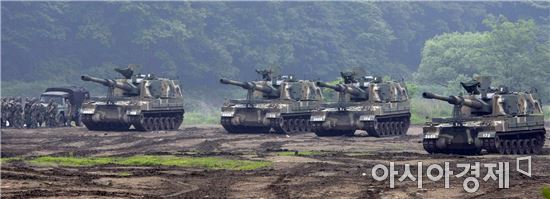
 K-9 Self-Propelled Howitzer
[Asia Economy Yang Nak-gyu, Military Specialist Reporter] The engine, considered the heart of the K-9 self-propelled howitzer?one of our military's premium weapons?is being developed using domestic technology. The K-9 self-propelled howitzer has been exported to countries such as Turkey, India, Poland, Finland, and Australia, so success in domesticating its engine is expected to greatly contribute to defense exports.
According to the Defense Acquisition Program Administration (DAPA) on the 6th, the Ministry of Trade, Industry and Energy and DAPA announced a public notice in February for the development of a domestically produced engine for the K-9 self-propelled howitzer. The amount invested solely for domestic production of K-9 howitzer engine parts is expected to reach 25 billion KRW over five years. Considering that more than 2,000 units of the K-9 self-propelled howitzer and K-10 ammunition carriers have been supplied to the Republic of Korea Army, maintenance costs for the military can also be reduced in the future.
It is known that Doosan Infracore and STX Engine have thrown their hats into the ring for the K-9 self-propelled howitzer engine localization project.
Doosan Infracore previously participated in the K2 tank localization project. At that time, Doosan Infracore was responsible for the engine part of the domestically produced powerpack (engine + transmission), while SNT Heavy Industries handled the transmission. Doosan Infracore aimed to complete engine development by 2011 but failed. The military only completed development after lowering the Required Operational Capability (ROC) in 2017.
However, the damage to Hyundai Rotem, the system integrator, as well as to over 100 K2 tank partner companies, was significant. For the first batch of K2 tank production, the military had no choice but to use imported engines. The transmission localization also failed, and the German transmission is still in use. As a result, the first batch used German powerpacks, and from the second batch onward, the tanks have been equipped with German transmissions, earning the stigma of having a "foreign heart."
The government invested a total of 2.8354 trillion KRW since 2010 in the K2 tank localization project, which is why criticism has arisen suggesting the project was a failure. Consequently, DAPA excluded the transmission from the K-9 engine localization project.
A DAPA official stated, "The transmission was excluded from the K-9 engine localization project considering the economic and technological ripple effects."
Within the industry, STX Engine, which produces the engine installed in the K-9 self-propelled howitzer, is being closely watched. Hanwha Defense has also internally expressed concerns that "if a company that has not produced the K-9 howitzer engine attempts localization, the engine configuration might change, potentially requiring redesign of the K-9 howitzer itself, which could be burdensome."
If STX Engine wins the project, the industry expects that "while the K-9 howitzer engine was produced with German MTU's technical cooperation and achieved only 60% localization, applying proprietary technology through this localization project could raise the localization rate to 100%." Especially if the intermediate performance goals during the three-year engine development phase are met, exports to countries such as the UAE are also considered possible.
Meanwhile, STX Engine, established in 1976, is evaluated as producing diesel engines with world-class competitiveness. In 1977, it signed a diesel engine overhaul agreement with Germany's MTU and achieved 20 million horsepower of domestically produced defense diesel engines for the first time in Korea in 2018. Notably, it developed a 1,360-horsepower engine for performance improvement of the K1A2 tank powerpack under the Defense Acquisition Program Administration's weapon system modification and development project.
STX Engine supplies diesel engines not only for the Army's main battle tanks such as the K1 and its variants, K1A2 tanks, K9 self-propelled howitzers, and K10 ammunition carriers, but also for naval vessels including destroyers (KDX class), fast attack crafts, frigates, patrol vessels, and submarines (KSS2 and KSS3).
© The Asia Business Daily(www.asiae.co.kr). All rights reserved.
![Clutching a Stolen Dior Bag, Saying "I Hate Being Poor but Real"... The Grotesque Con of a "Human Knockoff" [Slate]](https://cwcontent.asiae.co.kr/asiaresize/183/2026021902243444107_1771435474.jpg)















