Tunisia, Which Sparked the 2011 Middle East Democratic Wave
Economic Crisis Due to COVID-19 and Intensified Political Conflicts
Large-Scale Protests Continue After Democratic Demonstrations
WP: "Tunisia's Democracy Faces Crisis Again"
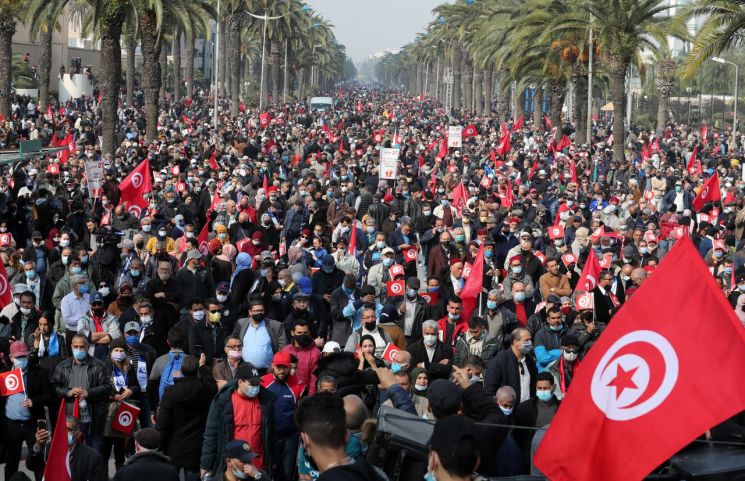 ▲ On the 27th of last month, a large-scale anti-government protest took place in Tunis, the capital of Tunisia. Tunis (Tunisia) = EPA Yonhap News Photo
[Asia Economy Reporter Kim Suhwan] Tunisia, the protagonist of the "Arab Spring" that sparked a wave of democratization across the Middle East after ending a dictatorship through massive anti-government protests in 2011, is facing another crisis. As economic difficulties caused by COVID-19 have accumulated public dissatisfaction, protests have continued since last year, and with casualties emerging, the political future of Tunisia is shrouded in uncertainty.
The 2011 Democratization Movement in Tunisia, the Origin of the "Arab Spring"
The 2011 Tunisian democratization protests, known as the "Arab Spring," began when a young man suffering from economic hardship set himself on fire. This incident triggered widespread public discontent due to ongoing economic difficulties, leading many Tunisians to flood the streets demanding the resignation of then-President Ben Ali's regime. As the protests grew uncontrollable, the president ordered police and military forces to open fire on the demonstrators. However, the military and police refused the orders and effectively sided with the protesters. Cornered, President Ali fled to Saudi Arabia, ending his 23-year dictatorship.
Following this, democratization movements spread throughout the Middle East, including neighboring North African countries Libya and Egypt, as well as Yemen and Syria. However, Libya, where the dictatorship was overthrown, remains embroiled in civil war, and Egypt and Syria continue under authoritarian governments. Tunisia remains the only country where democratization has been properly established.
Economic Recession and Political Conflicts Continue After Democratization... Citizens Say "Nothing Has Changed"
More than a decade after achieving the "Arab Spring," signs of large-scale protests are emerging again. Amid a decade-long economic crisis and the spread of COVID-19, anti-government sentiment among the public has begun to explode once more.
According to The Washington Post (WP), over 6,500 anti-government protests took place last year alone. Since January, more than 1,000 citizens have been arrested by the police, and on January 26, a citizen injured during a police crackdown died.
Protesters say that nothing has changed compared to ten years ago. One citizen told WP in an interview, "What hasn't changed over the past 10 years is not only the economic crisis but also how government authorities treat citizens," adding, "Like the protests in 2011, the government is again brutally suppressing the people." Another citizen said, "Public dissatisfaction is about to explode," and "It seems another revolution is about to begin."
The resurgence of protests is largely due to prolonged lockdown measures to control COVID-19, which have worsened the economic crisis. Since the first confirmed COVID-19 case in March last year, the government imposed strict lockdowns, closed borders, and ordered most businesses to cease operations. These measures caused Tunisia's key industry, tourism, to plummet by 61% in August compared to the previous year, WP reported. The International Monetary Fund (IMF) also revealed that Tunisia's economic growth rate last year recorded a negative 8.2%, the lowest since Tunisia's independence in 1956.
Max Gallien, a political economist at the University of Sussex, said, "The economic impact of strict lockdown measures is inevitably greater in developing countries." Youssef Cherif, a North African political analyst at Columbia University, also analyzed, "Tunisians have long been dissatisfied with the economic situation," and "A large-scale movement protesting the government is unfolding again, ten years after the Arab Spring."
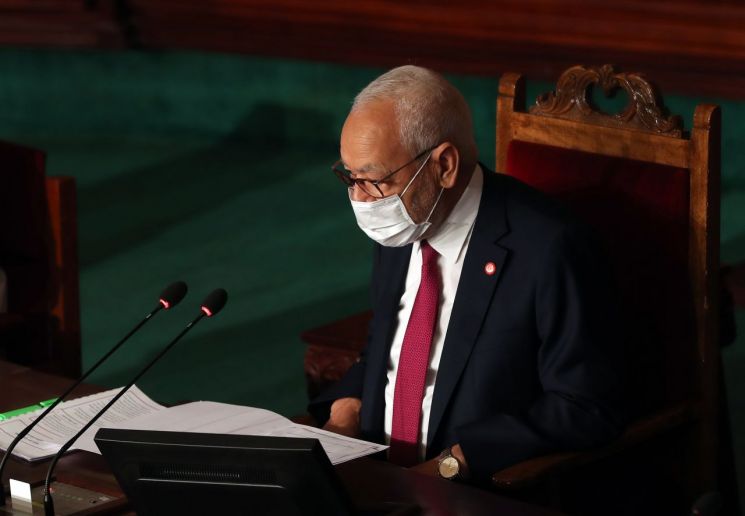
Alongside the economic crisis, political turmoil has intensified, fueling public backlash. In July last year, then-Prime Minister Elyes Fakhfakh resigned amid conflicts with Ennahda, the largest party in parliament. Subsequently, the approval rating of Rached Ghannouchi, the Speaker of Parliament and a member of Ennahda, plummeted to 8%, and as of last week, 103 lawmakers submitted a no-confidence motion against Speaker Ghannouchi, prolonging political conflicts.
Amid these economic and political crises, the number of Tunisians leaving the country is increasing. The United Nations High Commissioner for Refugees (UNHCR) reported that from January to August last year, about 8,000 Tunisians migrated to Europe to escape the economic crisis, and that Tunisians accounted for two-fifths of all refugees entering Europe last year. A UNHCR official warned, "The surge in Tunisian refugees raises concerns about a second European refugee crisis."
WP assessed, "Tragedy is repeating itself in Tunisia, the birthplace of the Arab Spring myth," calling it "a crisis of Tunisian democracy."
© The Asia Business Daily(www.asiae.co.kr). All rights reserved.


















