Lee Nak-yeon, Leader of the Democratic Party, Minister Byeon Chang-heum Summoned to the National Assembly
"Must Have a Sense of Responsibility to Volunteer for Investigation Before Anyone Else"
Retroactive Application Uncertain Even if Speculation Proven... Difficult to Confiscate Land or Recover Profits
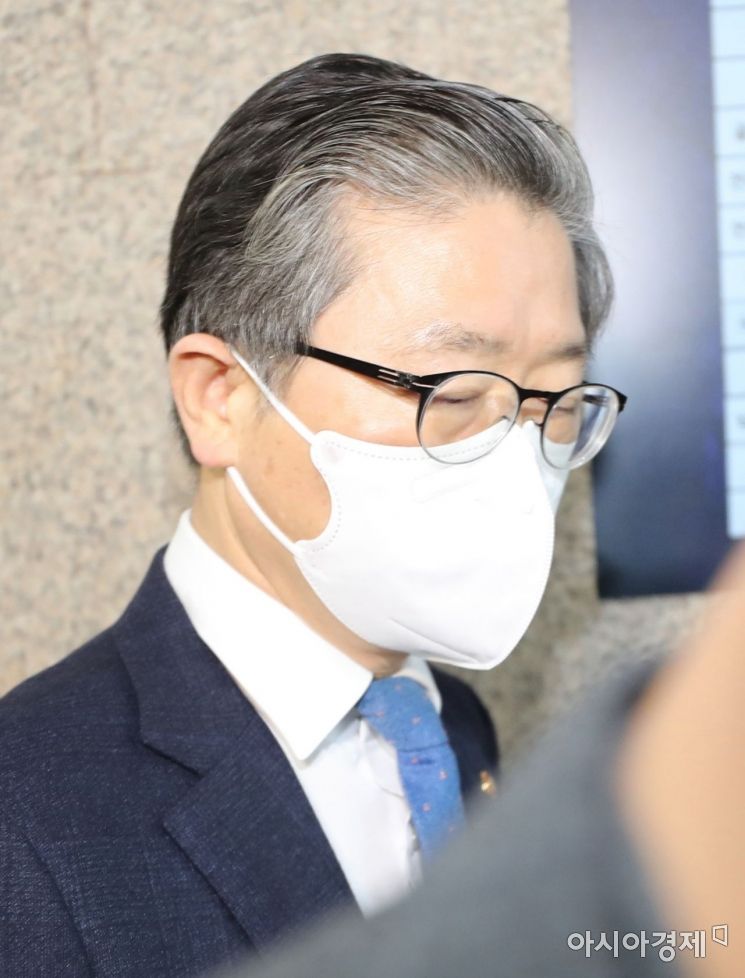 Minister of Land, Infrastructure and Transport Byeon Chang-heum is leaving the office of Representative Lee Nak-yeon after a meeting at the National Assembly on the 5th. Photo by Yoon Dong-joo doso7@
[Asia Economy Reporters Jo Gang-wook and Gu Chae-eun] As suspicions of preemptive speculation worth 10 billion won by employees of Korea Land and Housing Corporation (LH) in the Gwangmyeong-Siheung district spread rapidly, the government and political circles have hurriedly begun revising laws to prevent recurrence. The current law is criticized for being difficult to apply unless directly involved in new town projects and for imposing fines too small compared to the enormous profits gained from speculation, resulting in light punishments.
On the 5th, according to government and political sources, Lee Nak-yeon, leader of the Democratic Party of Korea, summoned Minister of Land, Infrastructure and Transport Byeon Chang-heum and Acting President of LH Jang Chung-mo to the National Assembly, ordering them to "investigate thoroughly and according to principles without any prejudice and disclose the results to the public." Lee especially told Minister Byeon, "You should have a sense of responsibility to the extent of volunteering to be investigated before anyone else."
The ruling party leadership called for a tough response. At the party’s supreme council meeting that day, No Woong-rae, a supreme council member, said, "Strict and definite measures are necessary regarding the LH incident," adding, "A large-scale audit should be conducted not only limited to the 3rd new town but over the entire development process of the past 10 years."
Kim Tae-nyeon, floor leader, said at the policy coordination meeting held the day before, "We will promptly prepare strong institutional measures to prevent speculation by public institutions and public officials," and "We will consider measures to legally punish public officials who use information related to their duties for private gain and to recover speculative profits."
Earlier, on the previous day, Democratic Party lawmaker Moon Jin-seok proposed an amendment to the ‘Special Act on Public Housing’ that significantly strengthens penalties for speculation by public officials and employees of public institutions. The amendment includes provisions that public housing developers, the Ministry of Land, related central administrative agencies, local governments, and related personnel who use or disclose information obtained during work for purposes other than intended shall face imprisonment of at least one year and fines of three to five times the profits gained. Properties acquired through such means shall be confiscated, and if the profits are large, aggravated punishment including simultaneous imprisonment and fines can be imposed. The current law only provides for imprisonment of up to five years and fines up to 50 million won, without separate provisions for confiscation of profits, raising concerns about the effectiveness of punishment.
Democratic Party lawmaker Park Sang-hyuk is also preparing an amendment to raise fines to levels comparable to financial crimes (three to five times the profits) to recover speculative gains.
The opposition party also agrees on the need to strengthen penalties. On the previous day, members of the National Assembly’s Land, Infrastructure and Transport Committee from the People Power Party who visited the Siheung site under speculation unanimously stated, "We will actively consider measures to strengthen penalties for violations of related laws." Lee Jong-bae, policy chief of the People Power Party, is also reportedly reviewing ways to strengthen punishments.
The government is also considering revising laws to expand the scope and subjects of punishment. Additionally, it plans to revise internal regulations such as personnel rules for each public institution to enable immediate enforcement where applicable.
However, it is expected to be difficult to apply the amended laws or regulations retroactively to the current LH employees, making measures such as confiscation of profits challenging.
Minister Byeon also stated at an emergency briefing held at the Government Seoul Office the previous day regarding the punishment level for LH employees, "Appropriate punishment as prescribed by law will be carried out depending on the case," but added, "Each institution can also impose penalties according to internal duty regulations or ethical codes."
After the meeting with Leader Lee that day, he said, "I was instructed to investigate thoroughly and according to principles without any prejudice and to disclose the results to the public," and "I spoke about follow-up measures and specific investigation details."
He did not respond to questions related to calls from some political circles for his resignation as minister or the possibility of canceling the 3rd new town project.
© The Asia Business Daily(www.asiae.co.kr). All rights reserved.

















