Revealing Target Figures with Economic Confidence, Numbers Set Conservatively
Quiet Exit Strategy Sought Amid China's Fiscal Policy Maintenance
[Asia Economy Beijing=Special Correspondent Jo Young-shin] Premier Li Keqiang of China publicly announced this year’s economic growth target for China as '6% or above.' The Chinese government had previously refrained from disclosing the target due to increased economic uncertainty caused by the COVID-19 pandemic. This year as well, the prevailing expectation was that the figure would not be revealed due to ongoing uncertainties related to COVID-19. Premier Li’s announcement of the figure on this day is interpreted as a surprise disclosure and a sign of confidence in the Chinese economy.
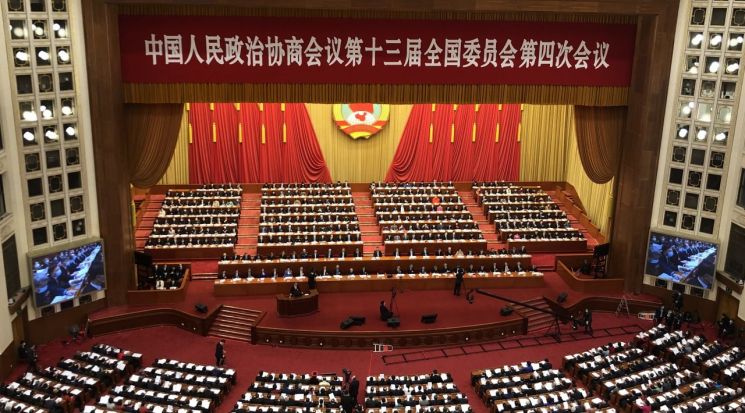
◆ China’s Economic Growth Rate Target Set at 6.0% 'or Above' = On the morning of the 5th, Premier Li stated through the 'Government Work Report' at the 4th Annual Session of the 13th National People’s Congress (NPC) held at the Great Hall of the People in Beijing that this year’s economic growth target for China is set at 6.0% or above. Premier Li also disclosed that the fiscal deficit target for this year will be adjusted to around 3.2% of the Gross Domestic Product (GDP). Additionally, he mentioned that the consumer price index is set at around 3%, and the urban unemployment rate is targeted at about 5.5%.
Premier Li explained, "The reason for setting the economic growth forecast at 6% or above this year is due to the economic recovery situation and the favorable environment for promoting reforms, innovation, and qualitative growth across various sectors."
Considering the base effect, the economic growth rate is estimated to be in the 3-4% range this year. Compared to the pre-COVID-19 period, this is still about 2 percentage points lower. China’s economic growth rate in 2019 was 6.0%.
A notable point is the use of the word 'or above.' Premier Li did not specify a range for the growth target but left room by stating 'or above.' Depending on the COVID-19 situation and the pace of global economic recovery, there is a possibility that the target could rise significantly. Conversely, the target may also reflect caution in case the COVID-19 situation worsens, the global economy fails to regain momentum, or difficulties arise from intensified US-China tensions.
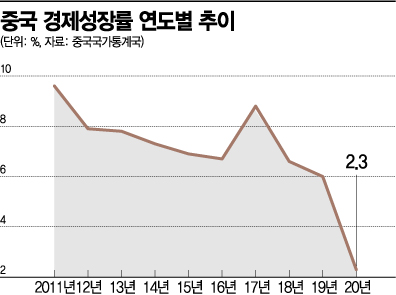
◆ Direction of China’s Economic Policy: 'Sustainable Growth and Stability' = Numerically, the emphasis appears to be on 'sustainable growth' and 'stability.' The International Monetary Fund (IMF) has forecasted China’s economic growth at 8.1% this year. The Organisation for Economic Co-operation and Development (OECD) also predicts an 8.0% growth rate for China this year. The Chinese Academy of Social Sciences (CASS), a think tank of the Chinese government, expects the growth rate to reach 7.8% this year.
Li Xuesong, Deputy Director of the Industrial and Economic Research Institute at CASS, projected that China’s economic growth rate will reach 7.8%, considering economic indicators, industrial supply chains, employment, industrial upgrading, and domestic demand.
Before the Two Sessions, 29 out of 31 provincial-level autonomous regions reported their economic growth targets to the central government, averaging 7.2%. Among provinces and municipalities, 15 including Beijing, Shanghai, and Jilin set growth targets at 6% or above. Six provinces such as Henan and Sichuan set targets above 7%, and five provinces including Yunnan set targets above 8%. Hubei and Hainan set targets above 10%. Because of this, the dominant view was that China’s economic growth rate would exceed 7% this year regardless of whether the official target was disclosed.
Some in China interpret the leadership’s conservative setting of the economic growth target as a shift in economic management from high growth to stable growth. In fact, the government aims for a consumer price index of around 3% and an urban unemployment rate of about 5.5% this year. A source in Beijing’s financial sector observed, "It is highly likely that the Chinese government will pursue a policy of sustainable and stable growth instead of high growth."
◆ Maintaining Fiscal and Monetary Policies While Seeking an Exit Strategy = This year’s fiscal deficit target relative to GDP is set at 'around 3.2%,' slightly lower than last year’s 3.6% or more. The issuance limit for special bonds by local governments, mainly used for infrastructure investment, has also been slightly reduced to 3.65 trillion yuan from last year’s 3.75 trillion yuan.
Last year, the Chinese government issued special national bonds worth 1 trillion yuan for the first time ever to stimulate the economy, but this year it has decided not to issue special bonds. This indicates that the government will not inject additional funds to revive the economy and suggests that the Chinese economy has entered a normalization track.
However, considering COVID-19 risks and the pace of global economic recovery, the government’s intention to maintain fiscal policy at last year’s level for the time being can also be inferred.
In fact, Liu Kun, China’s Minister of Finance, stated at the G20 Finance Ministers’ Meeting held on the 26th of last month, "Countries around the world need to strengthen macroeconomic policy cooperation," and emphasized, "While comprehensively promoting COVID-19 prevention and economic recovery, we must avoid withdrawing stimulus policies too quickly." He also stressed, "In 2021, China will continue to implement proactive fiscal policies and moderately accommodative monetary policies while maintaining the necessary level of support for economic recovery."
© The Asia Business Daily(www.asiae.co.kr). All rights reserved.
![Clutching a Stolen Dior Bag, Saying "I Hate Being Poor but Real"... The Grotesque Con of a "Human Knockoff" [Slate]](https://cwcontent.asiae.co.kr/asiaresize/183/2026021902243444107_1771435474.jpg)

















