Confidence in Economic Normalization, Significance in the First Year of the 14th Five-Year Plan and Dual Circulation Policy Introduction
Controversial Moves Like Hong Kong Election Law Revision Persist Amid Ongoing US-China Tensions
[Asia Economy Beijing=Special Correspondent Jo Young-shin] The Chinese government has set this year's economic growth target at "6% or above." Contrary to expectations that no target would be announced considering domestic and international economic conditions such as COVID-19, the figure was disclosed. This is interpreted as confidence in the Chinese economy.
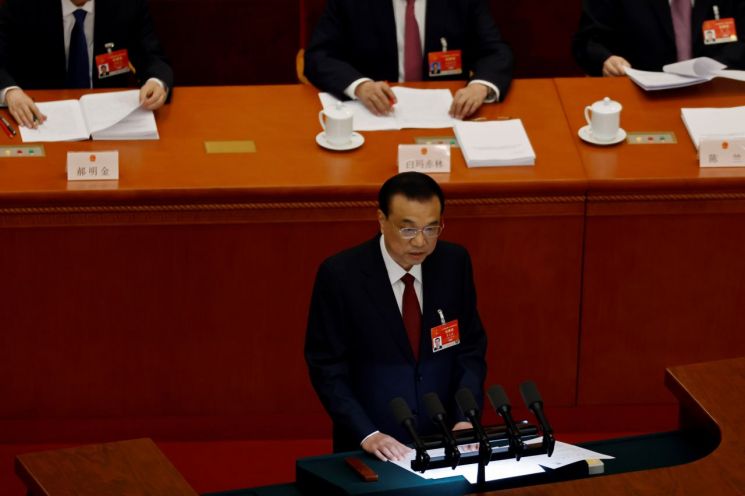
China Expresses Economic Confidence
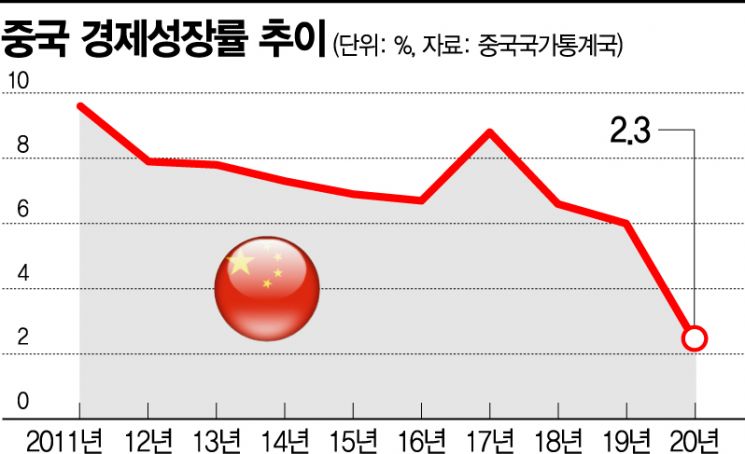
On the morning of the 5th, Chinese Premier Li Keqiang announced in the work report of the National People's Congress (NPC) that this year's economic growth target is 6% or above. Considering the base effect, this year's Chinese economic growth rate is estimated to be in the 3-4% range.
Among China's 31 provinces, 29 provincial governments have set this year's economic growth targets ranging from a minimum of 6% or above to a maximum of 10% or above.
The Chinese leadership's disclosure of the target appears to take into account that this year is the first year of the 14th Five-Year Plan (2021?2025) and the dual circulation policy, as well as the heightened uncertainty due to US-China conflicts. The economic growth target of 6% or above is 2 percentage points lower than the figures presented by global economic institutions. It is interpreted as the Chinese leadership's determination to maintain and lead the economy at a sustainable level.
Hoping to Use Economy as a Tool for Dialogue with the US
China has expressed willingness to cooperate with the US in various areas such as climate change, epidemic control, and global economic recovery.
Zhang Yesui, spokesperson for the Chinese NPC, said at a press conference with domestic and foreign media the day before, "China and the US have differences on some issues, and these differences are normal," adding, "We must control disputes and promote stable development of China-US relations through communication and cooperation."
China maintained its existing stance that cooperation with the US is possible on the premise of "mutual respect." The term "mutual respect" implies that interference in internal affairs will not be tolerated.
◇ Determination to Push Ahead with Hong Kong Election Law Amendments = While hoping for dialogue with the US, China indicated that it intends to handle issues of concern to the US, such as amendments to Hong Kong's election law, according to its original intentions.
The Chinese leadership plans to discuss the "Resolution on Improving the Electoral System of the Hong Kong Special Administrative Region" during this NPC session. It is reported that discussions will include the establishment of a high-level committee to review the qualifications of election candidates, adjustments to the election committee for selecting the Hong Kong Chief Executive, and expansion of the functional constituency scope in the Legislative Council. Given that the Chinese leadership is emphasizing the principle that "patriots govern Hong Kong," there is a high possibility that Hong Kong's electoral system will be restructured.
Spokesperson Zhang said, "The NPC has the constitutional authority to reform Hong Kong's electoral system," and added, "To implement the principle that patriots govern Hong Kong, the electoral system reform will take place next week."
Defense Budget Concerns from the US and Western Camp
China's defense budget is as much a point of concern for the US and Western countries as the Hong Kong issue.
Spokesperson Zhang firmly stated regarding China's defense budget, "China's defense spending must be consistent with the level of national economic development." He explained that the defense budget is an important factor in protecting sovereignty, security, and development interests, as well as fulfilling international responsibilities and obligations.
He further emphasized, "To determine whether one country poses a military threat to another, one must look at the defense policy that country pursues," adding, "China adheres to the path of peaceful development and pursues a defensive defense policy." He also reiterated that China has handled defense spending transparently, submitting basic data to the United Nations (UN) since 2007.
China's defense budget last year was approximately 1.2 trillion yuan, showing the lowest growth rate in 30 years at 6.6% due to the impact of COVID-19. Internally, it is expected that this year's Chinese defense budget will increase by more than 7% compared to the previous year.
© The Asia Business Daily(www.asiae.co.kr). All rights reserved.


















