"Hide or destroy brought documents
Emails must not be saved"
Evidence destruction ordered by management
Details of trade secret infringement included in final opinion
SK Inno "Could not determine what trade secrets were infringed"
Reiterates regret over ITC ruling
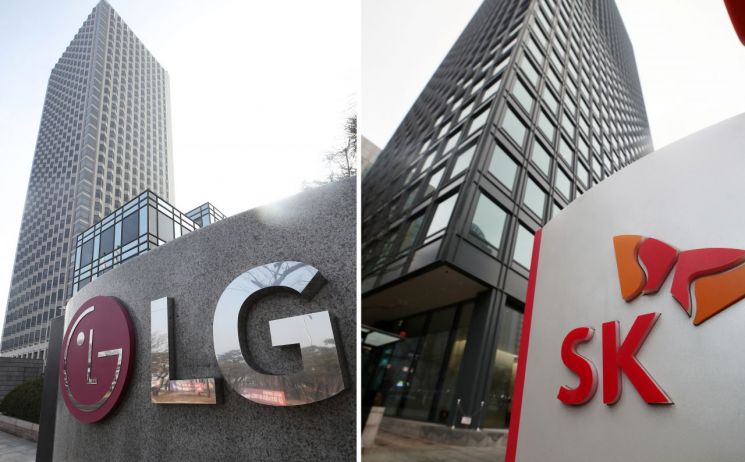 The U.S. International Trade Commission has released its final opinion stating that SK Innovation infringed on 22 trade secrets of LG Energy Solution. The photo shows the LG headquarters building in Seoul (left) and the SK headquarters building.
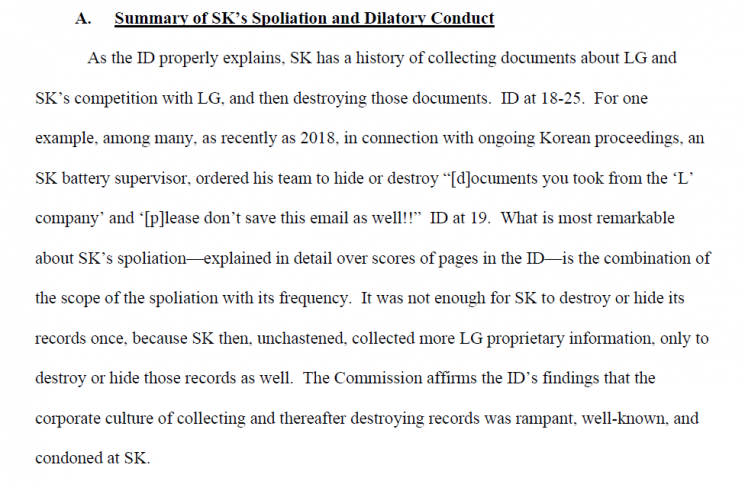
 [Asia Economy Reporter Choi Dae-yeol] "'Hide or destroy documents brought from company ‘L’. Emails must not be saved either." (SK Battery Department Manager)
"Regular security inspection recommendations for internal documents. Delete resumes and other documents no longer needed, personal information such as photos and videos, and documents that could cause unnecessary misunderstandings. Search and delete using keywords like LG, competitors, and action plans." (SK Information Security Department Senior Manager)
This is from the opinion letter released by the U.S. International Trade Commission (ITC) on the 5th. After LG Energy Solution filed a lawsuit claiming SK Innovation had stolen its employees and trade secrets for years, the ITC reviewed the case for over two years and concluded that SK’s actions were wrongful. The opinion letter, made public about a month after the final ruling last month, details SK’s company-wide evidence destruction methods and acknowledges LG’s trade secret infringement. Meanwhile, SK reiterated its regret, stating that the ITC did not determine what trade secrets were infringed upon even after these facts were revealed.
ITC: "SK’s Evidence Destruction Directed by Top Management... At a Serious Level"
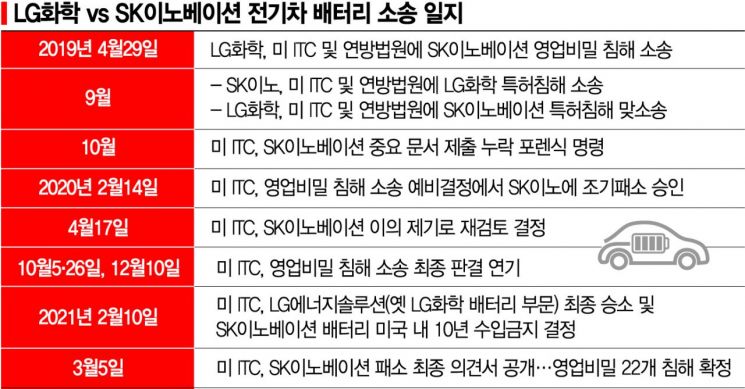
LG had raised issues about SK’s poaching of personnel and trade secret infringement even before filing the lawsuit with the ITC in April 2019. Previously, LG had won a preliminary injunction lawsuit in Korean courts in 2017 and sent two official letters to SK. According to the ITC’s opinion letter, just before LG filed the lawsuit in April 2019, SK undertook company-wide efforts to destroy evidence.
The commission stated, "Clearly, this case was not about a single employee secretly destroying evidence, but SK managers instructed multiple organizational managers to delete documents, and the company made little to no effort to disclose or mitigate these document destruction acts."
In its preliminary ruling last year, the ITC ruled against SK early on, finding the evidence destruction wrongful before even determining whether the technology or materials SK secured were trade secrets. About a year later, in last month’s final ruling, the ITC upheld this and imposed a 10-year import ban. SK’s explanations that these were regular security checks or customary practices were rejected.
On the other hand, LG explained to the ITC based on materials that were not deleted and files whose names remained though recovery was impossible. LG claimed SK secretly obtained information on LG battery costs, procurement, and pricing to gain an advantage, and this was acknowledged. The commission judged, "The excuse that document deletion was customary and the blatant malicious attempt to conceal were deliberate," and "The level of proof LG provided exceeded the standard required by the Federal Circuit Court of Appeals in previous cases."
Why SK’s Claim of "40 Years of Research" Was Not Accepted
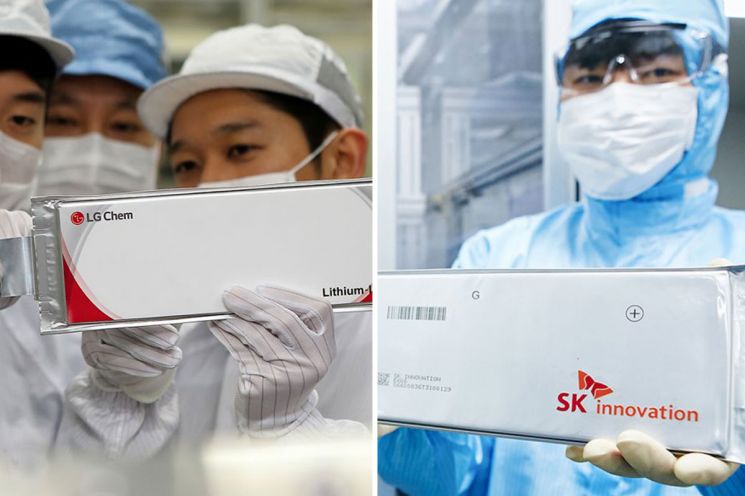
In the dispute over battery trade secrets, SK had claimed it independently developed technology since 1982. SK Innovation has developed battery technology for over 40 years, achieving milestones such as the world’s first high-density nickel battery, Korea’s first electric vehicle BlueOn, and the first mass-produced vehicle Ray. However, it is a bitter point that the ITC did not recognize SK Innovation’s claims.
The trade secrets LG claimed were infringed cover 11 fields and 22 items. They encompass the entire process, including raw material and component specifications, anode and cathode mixing and recipes (composition ratios), pouch sealing, electrolyte, and all processes necessary for battery manufacturing. It is reported that a decisive factor was confirming circumstances where SK clearly knew LG’s information during the process of securing orders from automakers. Volkswagen decided in September-October 2018 to select SK as the electric vehicle battery supplier, and the ITC accepted LG’s claim that SK knew LG’s pricing information at the time and could bid at a lower price.
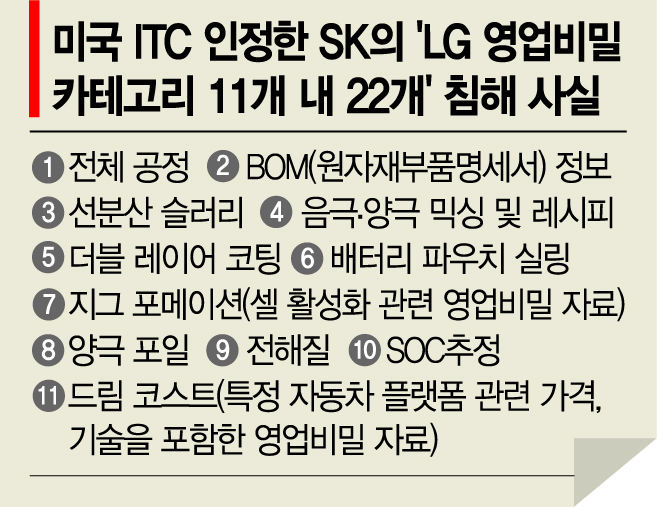
SK reiterated that the ITC did not determine what trade secrets were infringed or how they were infringed, which is the essence of this matter. SK repeated its previous claim that the decision was procedural and that no trade secrets were infringed. When the ITC asked SK to specify the infringed battery technology, LG presented a 100-page document covering the entire battery technology, which SK argued implied LG itself acknowledged the trade secret scope was vague. Conversely, LG stated that it submitted trade secrets before the originally scheduled trial and then narrowed them down to 22 items in January last year. The trial related to this lawsuit did not take place as SK received an early loss ruling last year.
Both companies indeed began battery research and development (R&D) decades ago. SK conducted a national project for electric vehicle batteries in the early 1990s during its time as Korea Telecom, and LG has long been in the home appliance business and researched lithium-ion batteries since the 1990s. However, the industry views that while LG expanded its secondary battery research for electric vehicles and energy storage systems in earnest from the 2000s, SK reduced its business scale around the same time, widening the gap.
© The Asia Business Daily(www.asiae.co.kr). All rights reserved.
![Clutching a Stolen Dior Bag, Saying "I Hate Being Poor but Real"... The Grotesque Con of a "Human Knockoff" [Slate]](https://cwcontent.asiae.co.kr/asiaresize/183/2026021902243444107_1771435474.jpg)


















