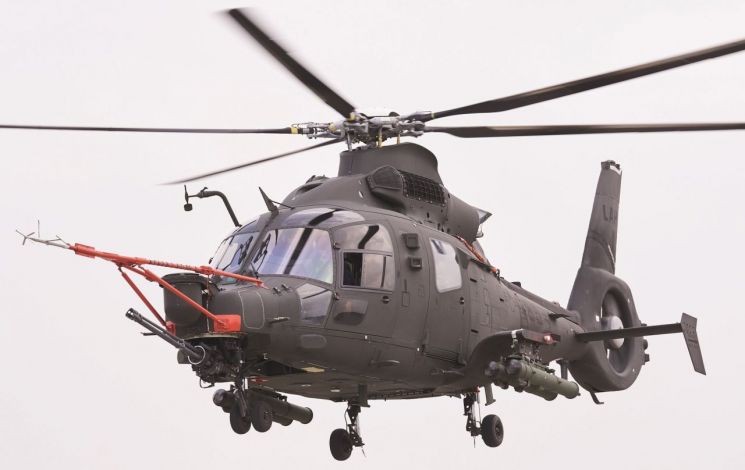
 The Korean Light Armed Helicopter (LAH), which the Army will operate as a manned-unmanned complex system from 2023 onwards. (Photo by KAI)
[Monthly Defense Times Editor-in-Chief An Seung-beom] The history of American helicopters begins with the VS-300 helicopter created by Igor Sikorsky, an immigrant from Russia, in September 1939.
The practical mass-produced model was called the R-4, delivered to the U.S. Army on May 30, 1942, and achieved success by rescuing three British liaison aircraft crew members shot down on the China-Burma-India front in April 1944, carrying out numerous search and rescue missions.
In February 1945, the improved R-5 helicopter was commissioned by the U.S. Army. During the Korean War, the U.S. Army used the R-5 and H-13 helicopters for casualty evacuation, and there was an attempt to arm a version with a single 3.5-inch bazooka.
Another masterpiece helicopter, the UH-19, first appeared in the Korean War in September 1951. The U.S. Marine Corps succeeded in the first operational flight to airlift 10 troops into a combat zone to confirm the possibility of troop transport.
The French military actively operated American-made H-19 (S-55), H-21 (20 passengers), and H-34 (18 passengers) mobility helicopters during the Algerian War, establishing the concept of heliborne operations.
When vulnerability to enemy small-arms anti-aircraft fire was revealed in operations, door guns were installed on the H-34 helicopter, and the H-21 was equipped with machine guns and rocket pods on the fuselage sides, creating the first gunship.
Thus, the first attempt at a gunship was by the French military, not the United States.
On March 7, 1958, the U.S. Army established the provisional 292nd Aviation Combat Reconnaissance Company, and from December 1961, the 8th and 57th Transportation Companies were dispatched to Vietnam. On January 12, 1962, these units conducted a surprise air assault with 32 CH-21C helicopters, airlifting South Vietnamese troops into Viet Cong (NLF) strongholds, resulting in the capture of weapons and communication equipment.
In September 1962, three battalions of CH-21C helicopters were reinforced. However, the CH-21C’s very slow cruising speed exposed it to anti-aircraft fire, raising the need for escort and escort helicopters.
On July 28, 1962, the U.S. Army deployed 15 HU-1A Iroquois helicopters equipped with machine guns from Okinawa under the name of a general-purpose tactical transport helicopter unit. During operations, modifications were made to mount 8-round 70mm rocket pods near the skids, and in November 1962, the armed UH-1B Iroquois gunship with enhanced engines and armament was introduced, replacing the outdated CH-21C helicopters.
From June 1964 onward in South Vietnam, the UH-1B gunship armed variant was primarily operated, followed by some UH-1D and improved UH-1H models used as gunships. Separately, in September 1965, Bell, the manufacturer of the UH-1, began developing a slender and sleek gunship prototype called Model 209. This was the original anti-tank attack helicopter, the AH-1G Cobra gunship.
From 1967, as ground combat intensified in the Vietnam War, the UH-1 utility helicopter, AH-1G gunship, and OH-6 light combat helicopter were operated as main forces, resulting in heavy combat losses. The AH-1G Cobra gunship, introduced in 1967, suffered 173 combat losses, and the OH-6, the predecessor of the 500MD light combat helicopter, lost 654 units, making it the most heavily damaged type. The UH-1 utility helicopter, deployed since 1962, recorded 1,211 combat losses.
By 1973, the total helicopter combat losses of the U.S. Army, Navy, Air Force, and Marine Corps in the Vietnam War were known to be around 2,580, with the UH-1 utility helicopter accounting for the highest number of losses in simple numerical terms.
Meanwhile, the Republic of Korea Army has been strengthening its aviation forces centered on the UH-1 utility helicopter and 500MD light combat helicopter since 1973.
In July 2020, the last battalion of UH-1H ended operations, but about 200 500MD light combat helicopters are still flying today. The helicopter replacing the 500MD model from over 50 years ago is the LAH helicopter, with initial mass production starting in 2023 and plans to introduce about 200 units in total. In the 2030s, the LAH light combat helicopter will be operated as a manned-unmanned combined system, enhancing survivability and establishing itself as the new aviation force of the Army.
© The Asia Business Daily(www.asiae.co.kr). All rights reserved.

















