Japan "Rockfish Entering Nuclear Plant Area... Unrelated to Other Species" Clumsy Explanation
"0% Sea Squirt Exports to Korea... Let's Avoid Discrimination and Prejudice"
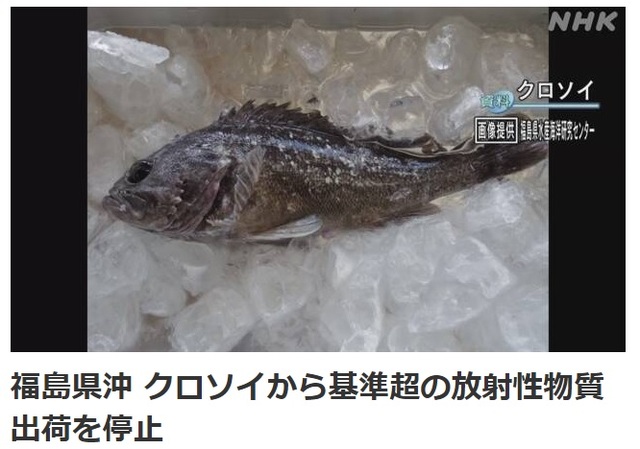 On the 22nd, rockfish caught off the coast of Fukushima Prefecture were found to contain radioactive substances at levels five times the standard limit. Photo by NHK broadcast screen capture.
[Asia Economy Reporter Kim Bong-ju] Recently, radioactive substances exceeding the standard levels were detected in rockfish caught off the coast of Fukushima, yet the Japanese government has failed to provide a clear explanation. On top of this, Japan unexpectedly voiced dissatisfaction with the South Korean government's restrictions on seafood imports.
On the 4th, Katsuie Hirasawa, Japan's Minister for Reconstruction, claimed, "Agricultural, forestry, and fishery products from Fukushima Prefecture available in the distribution market are safe," and insisted that South Korea should lift its export restrictions.
Minister Hirasawa expressed regret, saying, "It is unfortunate that some countries and regions, including Fukushima Prefecture, continue to impose import suspension and restriction measures on agricultural and marine products from certain areas in Japan," and argued, "South Korea's export restrictions stem from prejudice."
Last month, rockfish caught off the coast of Fukushima Prefecture were found to contain cesium levels five times the Japanese government’s standard and ten times the Fukushima Prefecture’s own standard.
This is the first time in two years since the skate incident two years ago that the standard has been exceeded, leading to the immediate suspension of rockfish shipment and distribution. The safety of Japanese food products is causing significant concern.
The Japanese government has yet to provide a clear explanation regarding the 'radioactive rockfish' that exceeded the standard levels.
They claim that the problematic rockfish may have entered and exited the waters around the Fukushima Daiichi Nuclear Power Plant, making it an 'unusual case' unrelated to other fish species.
However, the Japanese government only stated, "We are currently investigating the cause," and "We will closely monitor the situation of Fukushima seafood."
Shinjiro Koizumi, Japan’s Minister of the Environment, said, "We should not cause unwarranted harm to Japanese food products," and added, "I hope judgments will be made based on scientific evidence."
In addition, Minister Hirasawa expressed dissatisfaction with South Korea’s seafood import restrictions, saying, "In the case of farmed sea squirts from Miyagi Prefecture, radioactive substances exceeding the standard have not been detected for 10 years."
Currently, a total of 15 countries, including South Korea, have banned or restricted imports of Japanese seafood.
Minister Hirasawa stated, "We exported 70 to 80% of sea squirt production to South Korea. But now, the export volume is 'zero.' Let us avoid discrimination and prejudice that are not based on science."
However, Fukushima seafood does not seem to gain trust even among Japanese citizens. Fukushima seafood is currently sold at prices significantly lower than the average within Japan.
As Fukushima Prefecture plans to lift catch restrictions starting next month, pressure from the Japanese government on South Korea regarding seafood imports is expected to intensify.
© The Asia Business Daily(www.asiae.co.kr). All rights reserved.

















