Commercial Bank Shareholders Bear Losses... National Policy Banks Pay 30% High Dividends
IBK Cash Dividend of 471 Won per Share
Major Shareholder Ministry of Economy and Finance Secures Substantial Dividend Income
[Asia Economy Reporter Park Sun-mi] As a policy bank circumvented dividend restriction regulations imposed by financial authorities, it maintained high dividends, resulting in a substantial payout to its shareholder, the government. This contrasts sharply with financial holding companies that posted record profits last year but limited their dividend payout ratios to around 20% following the financial authorities' recommendations, leading to shareholder dissatisfaction.
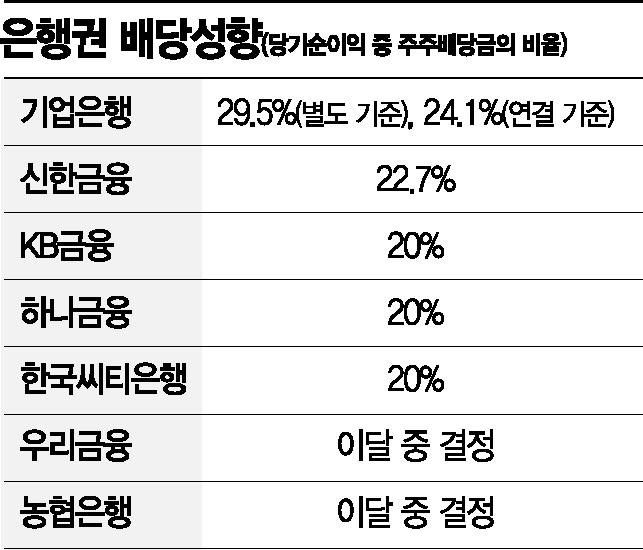
According to the Financial Supervisory Service's electronic disclosure system on the 4th, Industrial Bank of Korea (IBK) announced yesterday that it decided to pay a cash dividend of 471 KRW per common and preferred share. The total dividend amount is 372.9 billion KRW. Last year, IBK's net income, excluding subsidiaries on a separate basis, decreased by 9.3% to 1.2632 trillion KRW, and on a consolidated basis, it fell by 4.1% to 1.5479 trillion KRW. Considering this, the dividend payout ratio, which represents the proportion of net income paid out as dividends to shareholders, stands at 29.5% on a separate basis and 24.1% on a consolidated basis.
IBK's dividend payout ratio has hovered around 30% for several years. In 2012, the payout ratio was 23.0%, but it surpassed the 30% threshold in 2016 at 30.8%, followed by 30.9% in 2017, 30.1% in 2018, and 32.5% in 2019, exceeding 30% for four consecutive years. Although the payout ratio dropped below 30% to 29.5% in 2020, it has generally remained around 30% since 2014, earning IBK a reputation as a "high-dividend stock."
Even when considering the consolidated payout ratio (24.1%), it remains relatively high compared to other banks. Due to concerns over capital soundness deterioration caused by COVID-19, financial authorities recommended temporary restraint on dividends to banks to strengthen loss absorption capacity. As a result, financial holding companies listed on the stock market have reduced dividends despite achieving record profits.
KB Financial Group and Hana Financial Group set their dividend payout ratios exactly at 20%, in line with the financial authorities' recommendation to restrain dividends, and even the foreign bank Korea Citibank fixed its payout ratio at 20%, creating a trend of matching a 20% payout ratio across the banking sector. However, Shinhan Financial Group was an exception, passing the Financial Supervisory Service's "L-shaped (long-term economic recession assumption)" stress test and setting its payout ratio at 22.7%.
Policy Banks Exempt from Dividend Restriction Recommendations
No Differential Dividends for Government Shareholders
Ministry of Economy and Finance Secures Substantial Dividend Income
The reason IBK can still maintain high dividends is that, unlike commercial banks, as a policy bank, it is not considered a significant risk to capital soundness even with high dividends, reflecting the financial authorities' stance. Earlier, Financial Services Commission Chairman Eun Sung-soo explained the exclusion of policy banks from the dividend restriction recommendations for banks and bank holding companies by stating, "Because capital increases are not difficult, there is no problem securing capital soundness to respond to the COVID-19 situation."
Some argue that government agencies cannot significantly reduce bank dividends because they need to secure dividend income. Especially since IBK's performance declined due to the COVID-19 situation, lowering the dividend payout ratio substantially would sharply reduce the dividend income that the Ministry of Economy and Finance can incorporate into its budget. In fact, the Ministry of Economy and Finance holds the key to deciding IBK's dividends. An IBK official said, "IBK's position on dividends is limited," adding, "IBK employees do not participate in the dividend consultation body where the Ministry of Economy and Finance holds decision-making authority."
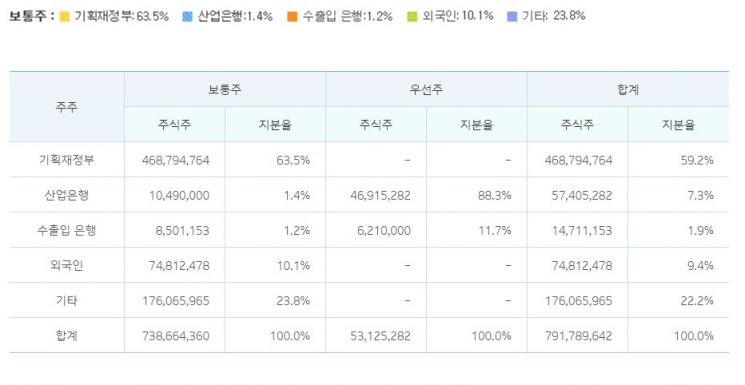
In IBK's case, the Ministry of Economy and Finance holds a 59.2% stake, including both common and preferred shares. This means that the ministry can secure more than half of the total dividend amount of 372.9 billion KRW, approximately 220.7 billion KRW, as dividend income. Last year, IBK decided on differential dividends of 670 KRW for general shareholders and 472 KRW for the government, resulting in dividend income of 166.2 billion KRW secured by the Ministry of Economy and Finance from IBK. This year, with no differential dividends, the dividend income the government receives will effectively increase compared to last year.
© The Asia Business Daily(www.asiae.co.kr). All rights reserved.


















