KDCA "Most Adverse Reactions Are Mild... Be Aware of Precautions Before and After Vaccination"
[Asia Economy Reporters Seo So-jeong and Kim Ji-hee] Concerns about COVID-19 vaccination are spreading after two patients at nursing hospitals in Gyeonggi and Pyeongtaek died following AstraZeneca COVID-19 vaccinations the previous day. The Korea Disease Control and Prevention Agency (KDCA) and the relevant local governments are conducting epidemiological investigations into the possible link between the vaccinations and the deaths. Experts agree that, based on overseas cases, most adverse reactions to the vaccine are mild symptoms such as headaches and fever, so there is no need for excessive anxiety.
◆Is there a causal relationship between vaccination and death?= According to the Central Disease Control Headquarters of the KDCA on the 4th, among 209 reported suspected adverse reactions following COVID-19 vaccination up to the previous day, there were two deaths. Both deceased were patients in their 50s and 60s with underlying conditions at nursing hospitals.
The first deceased experienced chest pain and nausea about 11 hours after vaccination at 9:30 a.m. on the 2nd and died around 7 a.m. the previous day. The second deceased showed fever and generalized muscle pain about 33 hours after vaccination at 2:30 p.m. on the 27th of last month and died around 10 a.m. the previous day.
Excluding the two deaths, the remaining 204 cases were mild symptoms such as headache, fever, nausea, and vomiting. Three other cases were reported as suspected anaphylaxis (systemic allergic shock reaction). The KDCA stated that the three suspected cases showed symptoms similar to anaphylaxis, termed ‘anaphylactoid’ reactions, and two have already recovered.
Jo Eun-hee, head of the Post-Vaccination Management Team at the COVID-19 Vaccination Promotion Task Force, explained, "Anaphylactoid reactions cause bodily symptoms through mechanisms different from anaphylaxis," and since shock does not occur, only ‘anaphylactic shock’ is classified as a severe adverse reaction.
Jung Eun-kyung, commissioner of the KDCA, emphasized, "Many deaths have been reported in other countries as well," but "there are no confirmed cases of causality with vaccination so far." According to the KDCA, the countries with the highest number of vaccinated individuals reported deaths as follows: the UK 402, France 171, Germany 113, and Canada 6.
Experts believe that although two deaths occurred after vaccination in Korea, there is no confirmed link to the vaccine yet, so there is no need for undue concern. Jo said, "The nursing hospital where the deaths occurred typically sees about 5 to 7 deaths per month." Deaths in nursing hospitals vary over time, and it cannot be ruled out that vaccination was not the direct cause in elderly patients with underlying conditions.
In the case of last year's influenza vaccination, as of the 1st, 13.76 million doses were administered, with 2,081 adverse reaction reports, but among 110 death reports, none were confirmed to be causally related to the vaccine. Professor Ki Mo-ran of the National Cancer Center said, "Elderly people with chronic and underlying diseases are prioritized for vaccination."
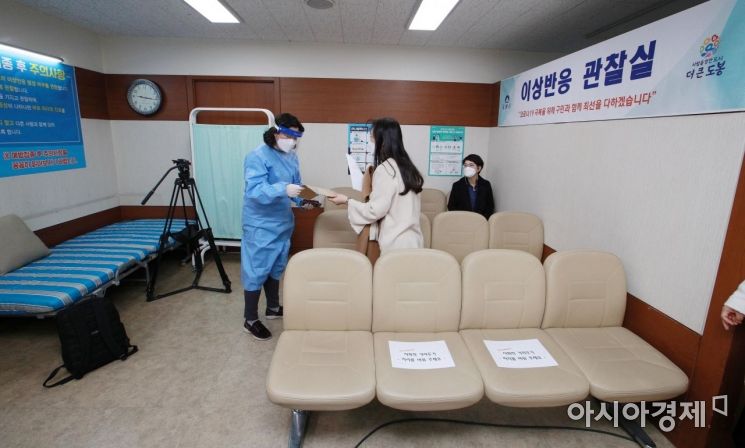 On the 26th, when COVID-19 vaccinations began in South Korea, workers at nursing hospitals and nursing facilities were waiting in the adverse reaction observation room after receiving their vaccinations at the Dobong-gu Public Health Center in Seoul. Photo by Hyunmin Kim kimhyun81@
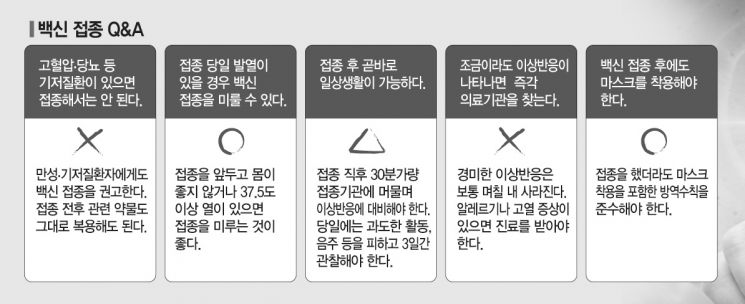
◆Observation periods of 30 minutes, 3 hours, and 3 days after vaccination= Health authorities emphasize that rather than avoiding vaccination due to excessive concerns, people should participate in vaccination while strictly following precautions before and after vaccination.
Vaccination consists of three main stages: waiting, vaccination, and observation, each requiring attention. At the waiting stage, if symptoms suspicious for COVID-19 such as fever above 37.5°C or cough appear before vaccination, it is advisable to contact the vaccination center to reschedule.
On the day of vaccination, the medical questionnaire should be filled out carefully. Especially if there has been a history of severe allergic reactions such as anaphylaxis to previous vaccines, it should be recorded in detail.
During the vaccination and observation stages, it is important to remember the 30-3-3 rule. After vaccination, individuals should wait about 30 minutes at the vaccination site to monitor for adverse reactions, as anaphylaxis mostly occurs within 30 minutes. After returning home, one should avoid excessive activity and observe carefully for 3 hours.
Adverse reactions should be monitored for at least 3 days, during which common symptoms such as fever, fatigue, headache, and nausea usually subside. However, if allergic reactions or high fever above 39°C occur, medical attention should be sought. Severe allergic reactions like anaphylaxis require immediate visit to the nearest emergency room.
As of midnight on the day, South Korea reported 424 new COVID-19 cases, marking the second consecutive day with over 400 cases. On the previous day, 65,446 people received COVID-19 vaccinations, bringing the total number of first-dose recipients to 154,421. Among them, 151,679 received the AstraZeneca vaccine, and 2,742 received the Pfizer vaccine.
© The Asia Business Daily(www.asiae.co.kr). All rights reserved.


















