Isanghan·Lee Gwanghee GIST Research Team Achieves Double Stability and 9.6% Efficiency in Perovskite Solar Cells
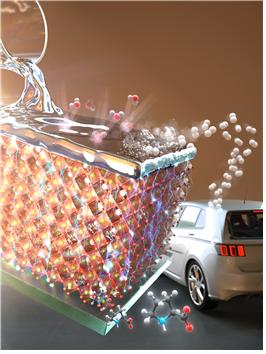 Schematic diagram of a photoelectrochemical device fabricated using perovskite solar cells, illustrating hydrogen production using electricity generated from perovskite solar cells. Provided by the National Research Foundation of Korea
[Asia Economy Reporter Kim Bong-su] A new method has been discovered to stably obtain hydrogen without carbon dioxide emissions using perovskite solar cells, one of the next-generation solar cell candidates. This is attracting attention as hydrogen is emerging as a promising alternative in renewable energy, such as hydrogen fuel cell vehicles.
According to the Korea Research Foundation on the 4th, a research team led by Professors Lee Sang-han and Lee Kwang-hee at Gwangju Institute of Science and Technology (GIST) recently confirmed that effective and stable hydrogen production is possible through controlling internal defects of perovskite and liquid metal sealing technology. Although there have been previous studies attempting to produce hydrogen using perovskite solar cells (water electrolysis and photoelectrochemical water splitting), the ionic defects of perovskite and its vulnerability to moisture have been obstacles.
The research team used L-proline, a type of amino acid, as an additive to compensate for the ionic defects of the perovskite itself. L-proline, which can have both cations and anions under specific conditions, fills both cation and anion defects inside the perovskite, thereby improving the efficiency and stability of the device. L-proline is one of the 20 amino acids that make up proteins and contains both amine and carboxyl functional groups, whose charges vary depending on the pH of the solution.
They also solved the vulnerability to moisture by sealing the perovskite with indium gallium liquid metal and titanium foil. This not only made the device resistant to moisture but also enhanced charge transfer between the electrode and the device, further increasing hydrogen production efficiency.
The device produced in this way has more than twice the stability compared to existing perovskite photoelectrochemical devices, and its hydrogen production efficiency (half-cell efficiency) is 9.6%, which is the best performance among photoelectrochemical devices using perovskite materials. The research team plans to pursue further research on perovskite materials for more stable hydrogen production and catalyst research to reduce production costs.
Meanwhile, hydrogen is one of the leading candidates for next-generation renewable energy such as hydrogen fuel cell vehicles. However, existing hydrogen for fuel is obtained through petroleum refining processes or relies on electricity generated from nuclear or thermal power plants as an energy source, inevitably causing large-scale carbon dioxide emissions. Therefore, research is focusing on photoelectrochemical water splitting techniques that produce hydrogen by decomposing water with electricity generated from solar cells.
This research achievement was published online on January 21 in the international materials science journal Advanced Functional Materials.
© The Asia Business Daily(www.asiae.co.kr). All rights reserved.
















