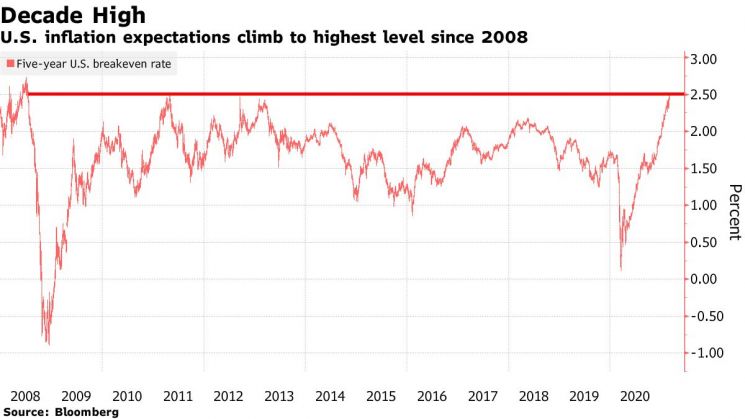
[Asia Economy Reporter Park Byung-hee] Bloomberg reported on the 3rd (local time) that the 5-year inflation expectation rate in the United States surpassed 2.5% for the first time since 2008.
The expected inflation rate is calculated by subtracting the yield of inflation-linked bonds from the yield of government bonds.
According to Bloomberg, the yield spread between the 5-year US Treasury bonds and 5-year Treasury Inflation-Protected Securities (TIPS) closed at 2.49% on the day and reached a high of 2.51% during trading. This indicates that the market expects the inflation rate five years from now to be around 2.5%.
This means that market expectations for inflation are rising.
Recently, as bond yields have continued to rise and prices of raw materials such as crude oil have maintained an upward trend, signals reflecting increased inflation expectations have been steadily detected in the market. The 5-year expected inflation rate surpassing 2.5% can also be interpreted as one of the inflation signals.
With COVID-19 vaccinations and US President Joe Biden's large-scale economic stimulus plans, expectations for the recovery of daily life and the economy are growing, while the possibility of inflation is also increasing.
On the same day, West Texas Intermediate (WTI) crude oil futures closed at $61.28 per barrel on the New York Mercantile Exchange (NYMEX), up 2.56% from the previous trading day.
Among market participants, there is analysis that the possibility of inflation is increasing, which also raises the likelihood of central banks tapering (gradually reducing economic stimulus policies).
However, officials from the US Federal Reserve (Fed) and the European Central Bank (ECB) have recently stated that despite the rise in government bond yields, they intend to maintain their stimulus stance for a while longer.
On the same day, Patrick Harker, President of the Philadelphia Fed, said that economic uncertainty remains high and that the Fed will not raise the benchmark interest rate until 2013.
Charles Evans, President of the Chicago Fed, also said that the rise in long-term government bond yields is not worrisome, that the increase in bond yields will not act as a headwind to the economy, and that the Fed will not respond by raising interest rates.
Jens Weidmann, President of the Deutsche Bundesbank and a member of the ECB's Governing Council, also said that the recent rise in Eurozone government bond yields is not yet at a particularly concerning level.
Earlier last month, the 10-year expected inflation rate, calculated by subtracting the yield of 10-year TIPS from the 10-year US Treasury bond yield, exceeded 2.2%, marking the highest level since 2014.
As of the close on the 3rd, the 10-year expected inflation rate remains at 2.2%, showing little change from a month ago.
© The Asia Business Daily(www.asiae.co.kr). All rights reserved.
![Clutching a Stolen Dior Bag, Saying "I Hate Being Poor but Real"... The Grotesque Con of a "Human Knockoff" [Slate]](https://cwcontent.asiae.co.kr/asiaresize/183/2026021902243444107_1771435474.jpg)
















