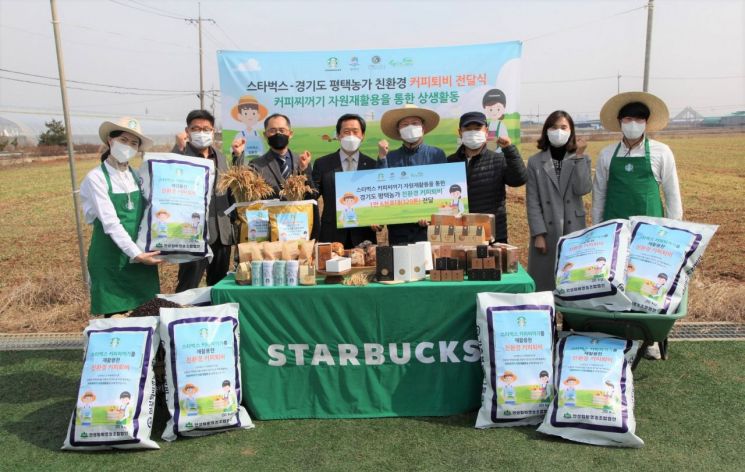
 At an eco-friendly compost delivery ceremony held on the 3rd at a farm in Pyeongtaek-si, Gyeonggi-do, Hong Seok-wan, Director of the Pyeongtaek Agricultural Technology Center (fourth from the left), Jeon Dae-gyeong, CEO of Miduyeong Agricultural Cooperative (fifth from the left), Jo Byeong-wook, CEO of Chorok Miso Village, a farm in Pyeongtaek, Gyeonggi-do (third from the right), Pyeongtaek city officials, and Starbucks partners are taking a commemorative photo.
[Asia Economy Reporter Seungjin Lee] Starbucks Coffee Korea announced on the 4th that it has supported local farms with approximately 200,000 bags of eco-friendly coffee compost, totaling about 4,000 tons (t), accumulated over seven years since 2015.
Since 2015, when Starbucks signed a cooperation agreement with Gyeonggi Province to promote agricultural product consumption and resource recycling, it has continuously conducted resource circulation campaigns utilizing coffee grounds such as coffee compost donations, carrying out various activities to create new added value for the local community environment and Korean farms.
In 2016, Starbucks became the first in the industry to sign a business agreement with the Ministry of Environment and the Resource Circulation Society Solidarity for a pilot project to activate coffee grounds recycling, through which it established a process for recycling coffee grounds.
Starbucks coffee grounds are made from 100% premium Arabica coffee beans and are rich in nitrogen, phosphorus, potassium, and other nutrients necessary for plant growth. They contain no heavy metals, helping to prevent pests and diseases and serving as a natural fertilizer with a high organic matter content.
For the first compost support of this year, Starbucks held a delivery ceremony for eco-friendly coffee compost at a farm located in Pyeongtaek City, Gyeonggi Province, on the 3rd, together with the Resource Circulation Society Solidarity. Attendees included Hong Seokwan, Director of the Pyeongtaek Agricultural Technology Center, Pyeongtaek city officials, Jeon Daegyeong, CEO of Miduyeong Agricultural Cooperative Corporation, Jo Byeonguk, CEO of Chorokmiso Village farm in Pyeongtaek, Gyeonggi Province, and Starbucks partners. The coffee compost delivered this time amounted to 16,000 bags, which is approximately 320 tons in weight.
Earlier, in April 2019, Pyeongtaek City, the Resource Circulation Society Solidarity, and Miduyeong Agricultural Cooperative Corporation signed an MOU for mutual growth to support eco-friendly coffee compost to Pyeongtaek farms and develop and sell various products using agricultural products from the area, thereby creating new added value for Korean farms and establishing a resource circulation system.
Agricultural products grown with eco-friendly compost are used as ingredients for food products, which are then sold again at Starbucks stores, linking to resource circulation activities. To date, various products such as ‘Rice Chips,’ ‘Butter-Filled Rice Cookies,’ and ‘Uri Mi Castella’ made with Korean agricultural products have been introduced, establishing close cooperation with Korean farms and becoming a new win-win model.
‘Rice Chips,’ launched in 2009, have sold over 2.5 million units cumulatively to date, with food products using Korean agricultural products growing in sales by an average of more than 30% annually, injecting new vitality into Korean farms.
Going forward, Starbucks plans to actively develop various products using Korean agricultural products and continue sustainable win-win activities with Korean farms, including resource circulation activities through support of eco-friendly coffee compost.
© The Asia Business Daily(www.asiae.co.kr). All rights reserved.
![Clutching a Stolen Dior Bag, Saying "I Hate Being Poor but Real"... The Grotesque Con of a "Human Knockoff" [Slate]](https://cwcontent.asiae.co.kr/asiaresize/183/2026021902243444107_1771435474.jpg)
















