Ministry of Employment Announces 2020 Results of Public Institution Youth Employment Quota
Extension of Quota, Originally Until This Year, to Be Pursued Until 2023
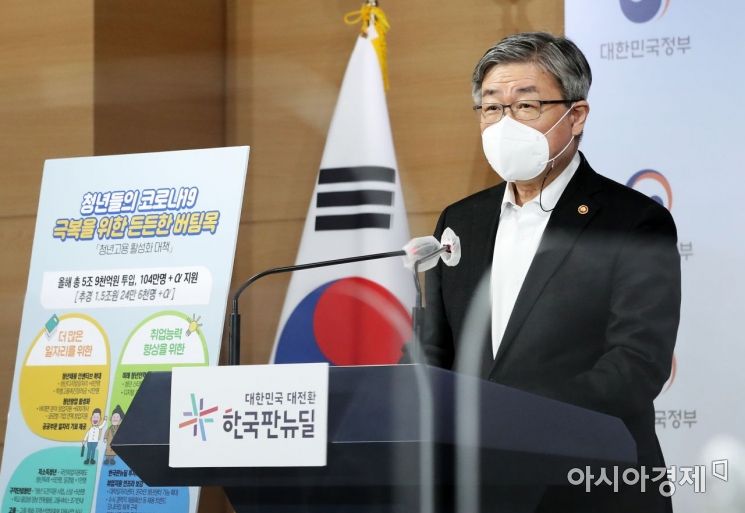 Minister Lee Jae-gap of the Ministry of Employment and Labor is announcing measures to revitalize youth employment on the 3rd at the Government Seoul Office in Jongno-gu, Seoul. Photo by Moon Ho-nam munonam@
[Sejong=Asia Economy Reporter Moon Chaeseok] The government announced that public institutions employed about 22,000 young people (aged 15-34) last year. This accounts for 5.9% of the total workforce, achieving the national policy goal of 5% for five consecutive years. The government also announced plans to amend the law to extend the mandatory youth employment period for public institutions, currently set to end this year, through 2023.
The Ministry of Employment and Labor held the '2020 Youth Employment Promotion Special Committee' meeting in writing and reviewed and approved the '2020 Public Institution Mandatory Employment System,' then reported the results to the National Assembly's Environment and Labor Committee on the 4th.
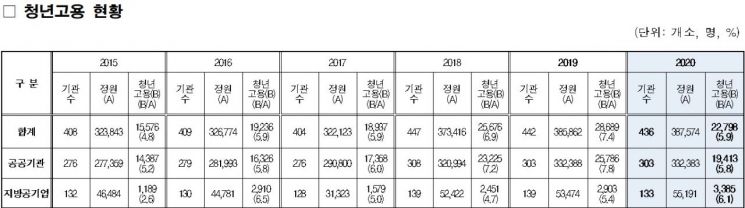
 Trends in the fulfillment of youth employment obligations by public institutions. (Data provided by the Ministry of Employment and Labor)
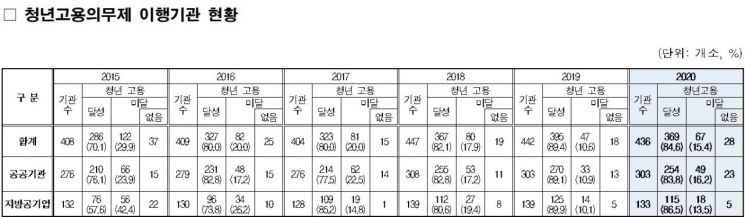
According to the Ministry of Employment and Labor, 436 institutions subject to the mandatory system employed 22,798 new young workers last year. This represents 5.9% of the total workforce of 387,574. The ministry explained that this marks the fifth consecutive year of achieving the national policy's overall average target of 5%.
The youth employment rate decreased compared to 6.9% in 2018 and 7.4% in 2019. Regarding this, a ministry official said, "This is the result of a base effect from the relatively increased youth recruitment performance in 2018-2019 and the combined impact of COVID-19 and other factors."
The mandatory system for public institutions is a rule under the Youth Employment Promotion Special Act that requires public institutions and local public enterprises to newly employ at least 3% of their workforce as young people each year. According to the Special Act, institutions with a youth new employment rate below 3% must have their names publicly disclosed and their performance reflected in management evaluations.
Kim Young-jung, Director of Employment Policy at the Ministry of Employment and Labor, said, "During a time when youth employment conditions are more difficult than ever due to COVID-19, the mandatory system for public institutions is a minimum commitment to improve youth employment conditions," and urged, "We hope each institution will continue to make efforts to fulfill their youth employment obligations."
He added, "The Ministry of Employment and Labor will do its best to encourage compliance this year as well, including holding inspection meetings for public institutions that have not fulfilled the mandatory system."
The Ministry of Employment and Labor announced a 'Youth Employment Activation Plan' the day before, stating plans to expand and implement the mandatory youth employment system for public institutions through 2023, which was originally set to end this year.
Minister of Employment and Labor Lee Jae-gap said, "We will amend the Special Act within this year to extend the mandatory system period for public institutions from this year to 2023."
© The Asia Business Daily(www.asiae.co.kr). All rights reserved.
![Clutching a Stolen Dior Bag, Saying "I Hate Being Poor but Real"... The Grotesque Con of a "Human Knockoff" [Slate]](https://cwcontent.asiae.co.kr/asiaresize/183/2026021902243444107_1771435474.jpg)













