[Asia Economy Reporter Suyeon Woo] It has been revealed that major countries around the world have established policies to increase the share of renewable energy utilization in response to climate change while maintaining the operation of nuclear power plants (NPPs).
On the 4th, the Federation of Korean Industries compared the energy policies of seven major countries including the United States, Japan, Germany, the United Kingdom, France, China, and South Korea, and found that five countries, excluding Germany and South Korea, have plans to expand or maintain nuclear power plants to address climate change (carbon emission reduction) and ensure stable power supply.
Commonly, the governments of the seven countries showed a trend of expanding the share of renewable energy generation and reducing the share of thermal power generation to reduce carbon emissions. However, nuclear power was recognized as an important baseload power source and confirmed to be continuously utilized.
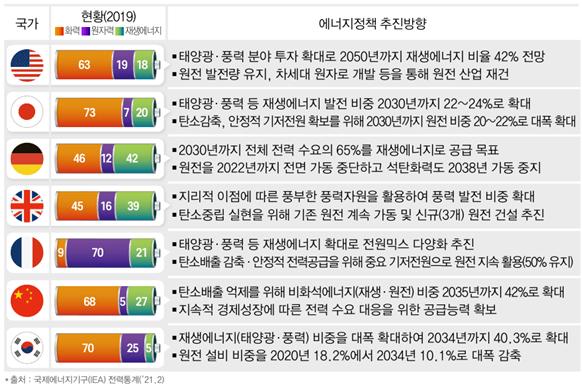 Summary of Major Countries' Energy Policy Status and Directions / Data provided by the Federation of Korean Industries
First, China is expanding the share of non-fossil energy (renewable and nuclear energy) to respond to the increase in electricity demand due to economic growth and to suppress carbon emissions. According to the China Energy Research Institute, the share of renewable energy generation, which was 26.2% in 2019, is planned to expand to 42.6% by 2035, and the share of nuclear power is also expected to nearly triple from 2019 to reach 12.2% by 2035.
Japan plans to re-expand the share of nuclear power, which had significantly decreased after the Fukushima nuclear accident (2011). In the '5th Basic Energy Plan' announced in 2018, Japan stated that it would dramatically increase the share of nuclear power from 6.6% in 2019 to 20-22% by 2030.
The United States, with the inauguration of the Biden administration, announced the goal of achieving carbon neutrality by 2050. It plans to significantly increase investment in renewable energy sectors such as wind and solar power, raising the share of renewable energy generation to 42% by 2050. Additionally, the U.S. Department of Energy announced the 'Nuclear Energy Strategic Vision' in January this year, formalizing the rebuilding of the U.S. nuclear industry ecosystem through continued operation of existing nuclear plants by renewing operating licenses, maintaining nuclear power generation, developing next-generation reactors, and expanding the nuclear industry supply chain.
The United Kingdom has actively expanded the share of wind power generation by leveraging its geographical advantage as an island nation with abundant wind resources. As a result, the share of wind power generation reached 20.7% in 2019, approximately 2.7 times the OECD average (7.8%). The UK also recognizes nuclear power as a means to achieve carbon neutrality, extending the operating life of eight operating nuclear plants and promoting the construction of three new nuclear plants.
France, where the share of nuclear power generation was about 70% in 2019, plans to diversify its power mix by expanding the share of renewable energy generation. At the same time, it recognizes nuclear power as an important baseload power source for stable power supply and plans to maintain a long-term share of around 50%.
Among the seven major countries, only Germany and South Korea have declared reductions in nuclear power operation. Germany has set a goal to supply 65% of total electricity demand from renewable energy by 2030, plans to completely stop nuclear power operation by 2022, and to phase out coal-fired power generation by 2038.
South Korea announced through the '9th Basic Plan for Electricity Supply and Demand,' which runs from 2020 to 2034, that it will reduce the share of coal-fired power (-13.1 percentage points) and nuclear power (-8.1 percentage points) facilities by 2034 and significantly expand the share of renewable energy (24.5 percentage points). More than 90% of renewable energy facility capacity is expected to be accounted for by solar power (58.6%) and wind power (32%).
© The Asia Business Daily(www.asiae.co.kr). All rights reserved.
![User Who Sold Erroneously Deposited Bitcoins to Repay Debt and Fund Entertainment... What Did the Supreme Court Decide in 2021? [Legal Issue Check]](https://cwcontent.asiae.co.kr/asiaresize/183/2026020910431234020_1770601391.png)
















