Loan Proportion and Scale of Savings Banks in Seoul Rise Annually Over Past Two Years
Regional Savings Banks Show Slight Increase or Decline
Industry Responds to Financial Authorities Considering Deregulation with "Effectiveness Doubtful"
[Asia Economy Reporter Song Seung-seop] The concentration of savings banks in the Seoul metropolitan area is intensifying. As loans are concentrated in Seoul, Incheon, and Gyeonggi regions, concerns are rising that the original purpose of providing community-based financial services to ordinary citizens is being undermined. Although financial authorities are considering regulatory relaxations to curb this metropolitan concentration, industry insiders believe it will be difficult to reverse the trend.
83% of Total Savings Bank Loans Concentrated in the Seoul Metropolitan Area, Seoul Accounts for 58.4%
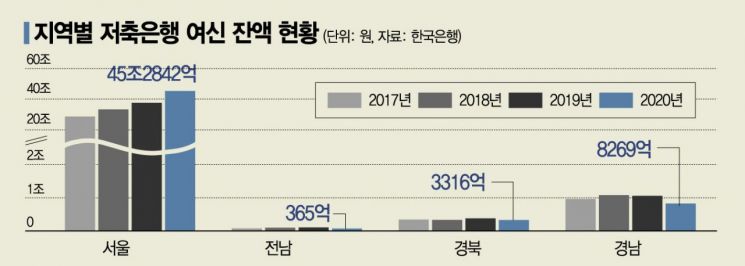
According to the Bank of Korea and the savings bank industry on the 3rd, out of last year's total savings bank loan amount of 77.4754 trillion KRW, the Seoul metropolitan area (Seoul, Gyeonggi, Incheon) accounted for 65.0738 trillion KRW, representing 83.9% of the total. Seoul alone accounted for 58.4% (45.2842 trillion KRW).
The proportion of loans in Seoul and the metropolitan area relative to the national total has been steadily increasing. Seoul's share, which was 56.3% nationwide in 2018, has increased by about 1 percentage point annually, while the metropolitan area has risen by about 2 percentage points over the past two years.
Unlike Seoul, where loan amounts have sharply increased every year, local regions have struggled, showing a decline. Over the past two years, Seoul's loan volume grew by 12.7% and 20.6% year-on-year. In contrast, Jeonnam (-11.1%, -37.9%) and Gyeongbuk (-13.7%, -12.3%) saw their loan balances shrink drastically to 36.5 billion KRW and 331.6 billion KRW, respectively. Gyeongnam's loan balance was 826.9 billion KRW, decreasing for two consecutive years (-1.9%, -21.8%).
The concentration of savings banks in the metropolitan area is more pronounced compared to other institutions in the secondary financial sector or commercial banks. Last year, the Seoul share of credit cooperatives and mutual finance was 12.4% and 10.9%, respectively. Saemaeul Geumgo (New Village Credit Cooperatives) was also around 17.5%. Including Incheon and Gyeonggi, the figure remains in the 40% range. Even commercial banks, criticized for capital concentration in Seoul, have a Seoul loan share of about 38%, which is lower than that of savings banks.
The savings bank industry argues that since large companies are based in the metropolitan area, it is natural for loans to be concentrated in Seoul. An industry insider said, "Among the six business regions, the metropolitan area and the Busan-Ulsan-Gyeongnam region together account for 70% of the total population," adding, "All of the top seven savings banks are based in the metropolitan area, and half of the industry operates single or multiple business networks in the metropolitan area, so this is a natural outcome."
There is also analysis that "economies of scale" are being realized. Large savings banks can bear the costs of digital transformation (DT), system infrastructure, and marketing driven by demand for non-face-to-face financial services, while small, resource-limited savings banks can only operate traditional relational businesses, widening the gap. Among large savings bank officials, there are reports that demand for non-face-to-face loans has rapidly increased through proprietary applications built with huge budgets.
Financial Authorities Consider Regulatory Relaxation, but Industry Questions Effectiveness
Financial authorities, recognizing the widening gap in asset size and competitiveness among savings banks, are considering regulatory relaxations on branch establishment and mergers & acquisitions (M&A). For large savings banks, they plan to strengthen soundness regulations considering size and business areas, while easing excessive obligations on small and medium-sized banks and allowing autonomous M&A within the sector for local savings banks facing a shortage of loan customers.
Accordingly, in November, the Financial Services Commission announced plans to ease business area expansion regulations for savings banks meeting certain financial conditions through a legislative notice on amendments to the Mutual Savings Banks Act to implement the "Mutual Savings Banks Sound Development Plan." They also mentioned switching to a prior notification system when establishing branches within business areas.
However, most industry insiders agree that the effectiveness is limited. This is because most large companies capable of M&A, including those in Seoul, are excluded. Among non-Seoul companies, only five have assets exceeding 1 trillion KRW, and they are reportedly not considering M&A. Moreover, despite the small volume, there is a heavy burden to handle 40% of loans within the business area.
An industry insider said, "Financial authorities have signaled that mergers among local banks are acceptable, but it is uncertain whether this will actually happen," adding, "Even if five or six regional savings banks with capital of only a few hundred billion KRW merge, they would still be smaller than one large metropolitan company, so the impact is questionable."
There are also calls for urgent incentives to increase loans and investments in local areas. Another savings bank official said, "Unless bold incentives are given to savings banks that execute loans in local areas, there is currently no incentive," adding, "Given the poor local economy, if defaults occur mainly among local companies that received loans, the banks would have to bear full responsibility, which is a heavy burden, to be honest."
He added, "Increasing guaranteed loan products to encourage local companies to actively use local savings banks is also a possible approach."
© The Asia Business Daily(www.asiae.co.kr). All rights reserved.
![Clutching a Stolen Dior Bag, Saying "I Hate Being Poor but Real"... The Grotesque Con of a "Human Knockoff" [Slate]](https://cwcontent.asiae.co.kr/asiaresize/183/2026021902243444107_1771435474.jpg)
















