[Sejong=Asia Economy Reporter Son Seon-hee] A study has revealed that about 80% of unfair trade practices occurring in the distribution industry take place in direct purchasing and special contract transactions. It is suggested that the government should focus on the correlation with 'transaction types' when investigating unfair trade practices.
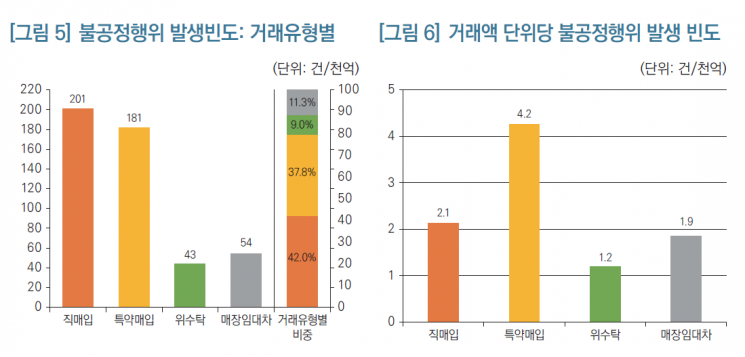
According to the report titled "Analysis of Transaction Types in Large-scale Distribution and Policy Directions" released by the Korea Development Institute (KDI) on the 3rd, a total of 422 cases of unfair trade practices were recorded in the large-scale distribution sector in Korea from 1998, when large-scale distribution began in earnest, until last year. Analyzing these by transaction type, 'direct purchasing' accounted for the largest number with 201 cases (42%), followed by special contract purchasing with 181 cases (37.8%). Next were store leasing with 54 cases (11.3%) and consignment with 43 cases (9%).
Direct purchasing refers to cases where distribution companies directly acquire ownership of products. This includes large supermarkets, corporate supermarkets (SSM), and convenience stores.
Special contracts refer to cases where the distribution company holds ownership but the supplier is responsible for sales. This mainly applies to situations where supplier-dispatched employees, not department store staff, sell products at department store counters.
Although the total number of unfair trade cases is highest in direct purchasing, this is influenced by the large number of contracts, which account for about half of the total transaction amount. When looking at the frequency per transaction amount unit (100 billion KRW), special contract purchasing is the most vulnerable to unfair trade practices with 4.2 cases. Direct purchasing follows with 2.1 cases, store leasing with 1.9 cases, and consignment with 1.2 cases.
Furthermore, the report pointed out that with the recent increase in transactions through online shopping and TV home shopping, the frequency of unfair trade practices is rising particularly in the consignment method.
Lee Jin-guk, a KDI research fellow who authored the report, suggested, "To make the monitoring and detection functions of policy authorities more efficient, transaction types should be at the center of investigations," adding, "When conducting ex officio investigations and written surveys in the distribution sector, the direction of investigations and the content of questions should be supplemented so that transaction patterns and legal violation suspicions can be identified from the perspective of transaction types."
He also stated, "While there may be a policy emphasis on expanding direct purchasing in the future to preemptively block unfair trade practices related to special contract purchasing and to stabilize and grow the supplier industry, caution is needed when intervening to select specific transaction types policy-wise," adding, "Institutions that do not consider the interrelationships among factors such as distribution types, product categories, incentives to minimize transaction costs, and bargaining power gaps may inadvertently cause market ecosystem disruption and transaction contraction."
© The Asia Business Daily(www.asiae.co.kr). All rights reserved.
!["The Woman Who Threw Herself into the Water Clutching a Stolen Dior Bag"...A Grotesque Success Story That Shakes the Korean Psyche [Slate]](https://cwcontent.asiae.co.kr/asiaresize/183/2026021902243444107_1771435474.jpg)
















