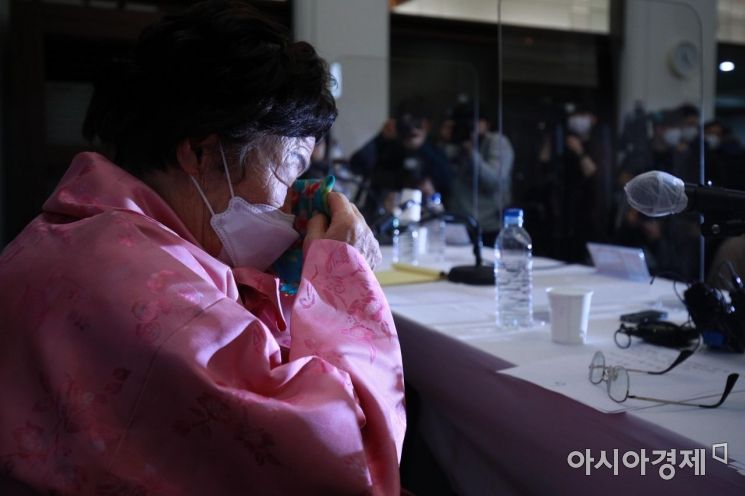
 Grandmother Lee Yong-soo, a surviving victim of the Japanese military sexual slavery, is shedding tears during a press conference on the 16th at the Press Center in Jung-gu, Seoul, urging to bring the issue of Japanese military sexual slavery to the International Court of Justice (ICJ) for judgment. Photo by Kim Hyun-min kimhyun81@
[Asia Economy Reporter Lee Ji-eun] Comfort women victim grandmother Lee Yong-soo will meet with Foreign Minister Chung Eui-yong on the 3rd to demand the filing of the comfort women issue to the International Court of Justice (ICJ). Attention is focused on what response Minister Chung, who has stated that "ICJ filing will be carefully reviewed," will provide.
Foreign Ministry spokesperson Choi Young-sam announced at a regular briefing on the 2nd that Minister Chung is scheduled to meet with Grandmother Lee at 3 p.m. on the 3rd at the Foreign Ministry building in Jongno-gu, Seoul. This will be Minister Chung's first direct meeting with a comfort women victim since taking office. The government has maintained a stance of communicating with victims based on "victim-centeredness." Spokesperson Choi said, "It will be a meaningful opportunity to sincerely exchange opinions on restoring the honor and dignity of the victims and the direction of problem resolution."
What Grandmother Lee demands is to file the comfort women issue to the ICJ. As the representative of the "Committee for Promoting the Referral of the Japanese Military Comfort Women Issue to the ICJ," she also demanded the filing during a meeting with Minister of Gender Equality and Family Jung Young-ae on the 1st. However, it is uncertain whether Minister Chung will provide a clear response to Grandmother Lee's demand in this meeting. Minister Chung previously stated that "ICJ filing will be carefully reviewed." Since the inauguration of the Biden administration in the United States, attempts to improve Korea-Japan relations have been rising within the government, and the variable of ICJ filing could push the two countries into a confrontational stance, so the government appears to be considering the repercussions.
Also, filing to the ICJ is not something one side can unilaterally initiate; both countries must agree. Therefore, even if our government decides to file, if Japan ignores it, it cannot be established. Although voices demanding ICJ filing have emerged within Japan as well, Japanese Foreign Minister Motegi Toshimitsu took a cautious stance by saying he would "refrain from commenting" on Grandmother Lee's 'ICJ referral' remarks.
If our side proposes filing the comfort women issue to the ICJ, the Japanese government may also propose filing issues such as forced labor and Dokdo to the ICJ. Japan has repeatedly suggested referring Dokdo to the ICJ, but our government maintains the position that "Dokdo is not a disputed territory."
© The Asia Business Daily(www.asiae.co.kr). All rights reserved.

















