Leading Candidate Texas Austin Plant
Two Sites in Arizona and One in New York Also Under Consideration
Expansion Preparedness Amid Semiconductor Supercycle Optimism
Foundry Sales Expected to Surge Significantly
[Asia Economy Reporters Su-yeon Woo and Hyun-jin Jung] As Samsung Electronics mentions four candidate sites for expanding its foundry plants in the United States, global semiconductor industry attention is focused on where Samsung's final investment location will be decided. Currently, the most likely candidate is the Austin plant in Texas, but Samsung is simultaneously reviewing two sites in Arizona and one in New York, showing a careful consideration of the site selection until the end.
The reason Samsung Electronics mentioned additional candidate sites even while revising proposals related to new investments is interpreted as a strategy to gain an advantageous position in the final negotiations with the city of Austin. Recently, due to a record cold wave in the southern United States, the Austin plant's operations have been halted for half a month, causing damage, and from Samsung's perspective, there is a possibility of presenting additional demands to the city of Austin.
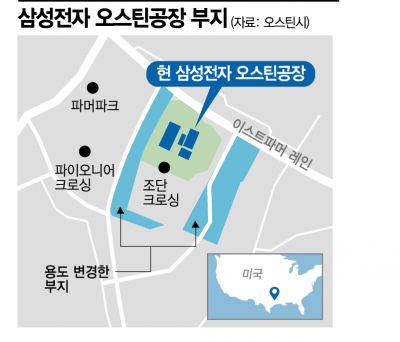
◇Texas, Arizona, New York... Samsung Electronics' Complex Calculations= Moreover, with U.S. President Joe Biden recently ordering a review of semiconductor supply chains, the necessity for each U.S. state government to attract semiconductor plants is increasing. On the 24th of last month, President Biden signed an executive order to review the supply chains of four key items?semiconductors, electric vehicle batteries, rare earth elements, and pharmaceuticals?over 100 days.
In particular, President Biden emphasized the importance of the semiconductor supply chain, and it is also analyzed that the underlying intention of this executive order is to block China's entry into the global semiconductor market by strengthening alliances with semiconductor powerhouses such as Taiwan and South Korea.
This international situation is favorable news for Samsung Electronics. Since the beginning of the Biden administration, there has been mention of expanding semiconductor production supply chains within the U.S., and various incentives such as federal subsidy programs have been offered.
Already, local lawmakers and governors from New York and Arizona are actively sending love calls to Samsung Electronics to attract factories. Chuck Schumer, the U.S. Senate Majority Leader from New York, recently met with senior Samsung Electronics officials to request the establishment of a Samsung plant in New York, while Greg Abbott, Governor of Texas, shared articles about Samsung Electronics' Austin expansion discussions on his Twitter, suggesting the possibility of collaboration between Samsung and Texas as continuous investment partners.
Faced with the U.S. government's active attraction efforts, Samsung Electronics is in a happy dilemma. Although the proposal mentioned Korean plants as investment candidates, the possibility of expanding factories in Korea seems low. This is because foundry competitor TSMC is investing $12 billion (about 13 trillion KRW) to build a 5nm foundry plant in Arizona, and U.S. state governments are offering various incentives and favorable conditions.
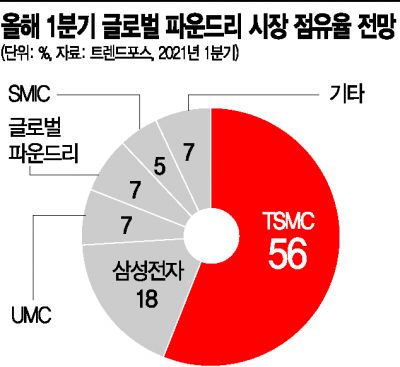
◇Semiconductor Supercycle Arrival... Urgent Foundry Expansion= Due to vehicle semiconductor supply issues and the activation of untact industries caused by COVID-19, expectations for a 'supercycle' in the semiconductor market are rising this year. In particular, significant sales growth and increased investment demand are expected in the foundry sector starting this year.
Market research firm TrendForce forecasted that the sales of the world's top 10 foundry companies in the first quarter of this year will increase by 20% compared to the previous year. TSMC, which ranks first in the industry, is expected to record a 25% increase in sales in the first quarter of this year, marking the highest quarterly sales ever.
TSMC announced plans for capital expenditures of up to $28 billion (about 31 trillion KRW) this year, and last year invested $12 billion (about 13 trillion KRW) to build a plant in Arizona, aiming for completion in 2024. As TSMC decides on large-scale capital investments to maintain its industry-leading position, attention is also focused on Samsung Electronics' foundry expansion as a direct competitor.
TrendForce projected Samsung Electronics' foundry sales in the first quarter of this year to increase by 11% year-on-year to $4.052 billion (about 4.5 trillion KRW). Both the sales growth rate and amount are less than half of TSMC's. To reduce this gap, there are forecasts that Samsung, which invested 32.9 trillion KRW in the semiconductor sector last year, will carry out investments in the high 30 trillion KRW range this year.
Samsung Securities analyst Min-seong Hwang said, "There is a growing possibility that Samsung Electronics will reconsider its investments in response to TSMC's aggressive investments," adding, "This year's semiconductor sector investment could be adjusted upward to the high 30 trillion KRW range, with memory semiconductors at the mid-to-high 20 trillion KRW level and foundry at the low 10 trillion KRW level."
© The Asia Business Daily(www.asiae.co.kr). All rights reserved.
![Clutching a Stolen Dior Bag, Saying "I Hate Being Poor but Real"... The Grotesque Con of a "Human Knockoff" [Slate]](https://cwcontent.asiae.co.kr/asiaresize/183/2026021902243444107_1771435474.jpg)












