Expectations for Strengthened COVID-19 Support to Developing Countries
Even the US, Previously Opposed, Has Turned in Favor
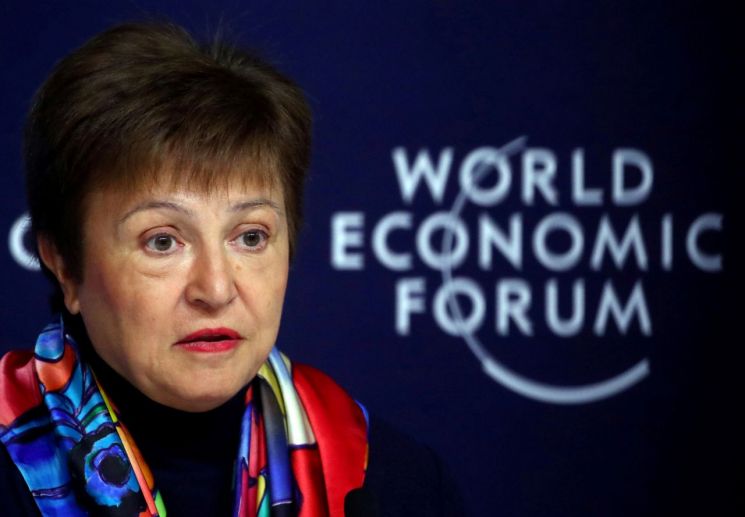
[Asia Economy Reporter Hyunwoo Lee] Kristalina Georgieva, Managing Director of the International Monetary Fund (IMF), announced that the Group of Twenty (G20) has agreed to the issuance of $500 billion (approximately 562 trillion won) worth of IMF Special Drawing Rights (SDR), signaling the full-scale launch of IMF's SDR issuance. SDRs are not recorded as national debt for each country, and since last year, they have been expected to help developing countries, which have been particularly affected by economic difficulties due to COVID-19. However, the issuance has repeatedly failed due to opposition from the U.S. Trump administration, which argued that it could serve as a funding channel to adversarial countries such as China and Iran.
According to major foreign media on the 2nd (local time), Georgieva said at the Africa Finance Forum held via video conference, "The green light has been given for the issuance of IMF Special Drawing Rights (SDR). At last week's G20 meeting, G20 countries agreed to the issuance," adding, "SDRs worth $500 billion will be issued, and all IMF members will be allocated according to their shares." She further stated, "We are also discussing ways for wealthy member countries to lend part of their allocated SDRs to countries in difficulty through the IMF."
SDRs represent the authority for IMF member countries to withdraw foreign currency as needed without collateral. Each member country receives SDRs according to their contribution ratio to the IMF and can exchange them for any foreign currency among the five currencies that make up the SDR basket: the dollar, euro, pound, yen, and yuan. In particular, SDRs are not recorded as national debt in international accounting, making them expected to be useful in supporting developing countries facing both economic and fiscal difficulties due to COVID-19.
SDRs were issued in the amount of $250 billion during the 2009 financial crisis, and since April last year, discussions have been underway within the IMF to issue $500 billion, twice the amount issued during the financial crisis, to prevent economic difficulties caused by COVID-19. However, the U.S. Trump administration opposed the issuance, arguing that it could serve as a funding channel to adversarial countries such as China and Iran, preventing issuance. China and Iran are IMF members with contribution ratios of 6.41% and 0.75%, respectively, and if SDRs are issued, they can receive support according to their contribution ratios.
With President Joe Biden's inauguration, the U.S. stance has shifted to support. Earlier, Janet Yellen, the new U.S. Treasury Secretary, expressed support for the IMF's SDR issuance, while demanding increased transparency in fund management.
© The Asia Business Daily(www.asiae.co.kr). All rights reserved.
![Clutching a Stolen Dior Bag, Saying "I Hate Being Poor but Real"... The Grotesque Con of a "Human Knockoff" [Slate]](https://cwcontent.asiae.co.kr/asiaresize/183/2026021902243444107_1771435474.jpg)
















