As of the end of last year, a decrease of 100,000 people in one year... 60,000 Koreans and 40,000 foreigners reduced
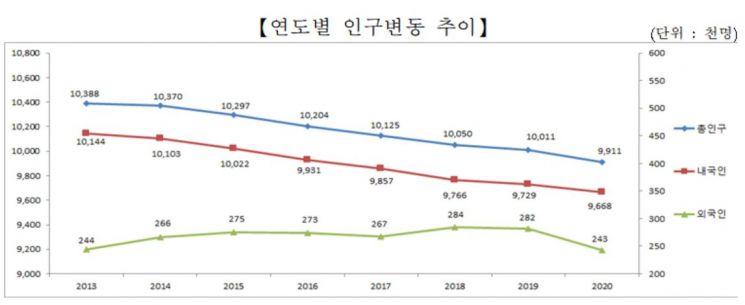
[Asia Economy Reporter Lim Cheol-young] The population of Seoul fell below 10 million at the end of last year, reaching 9.91 million, losing its title as the "Ten Million Seoul." The population of Seoul, which had been steadily decreasing since peaking at 10.97 million in 1992, dropped below 10 million for the first time in 32 years.
On the 3rd, Seoul City announced that according to the count of registered domestic residents and foreign residents, the total population of Seoul (domestic + foreign) as of the end of 2020 was 9,911,088, marking the first time since 1988 that the year-end population fell below 10 million. Compared to the previous year, the domestic population decreased by 60,000, and the foreign population decreased by about 40,000. In particular, the Chinese nationality population (including Korean-Chinese) decreased by 32,000.
The number of domestic households was 4,417,954, an increase of 90,349 households (2.09%) compared to the previous year, continuing the upward trend, while the average household size decreased by 0.06 persons to 2.19 persons. By district, Songpa-gu had the largest total population at 673,926, and Jung-gu had the smallest at 134,635. Compared to the previous year, Gangdong-gu increased by 23,608 people, Yeongdeungpo-gu by 6,381, while 23 districts including Gangseo-gu (-12,372), Nowon-gu (-10,271), and Songpa-gu (-8,815) saw population decreases.
By age group, the 25-29 age group was the largest with 858,648 people, followed by 45-49 with 819,052, and 50-54 with 807,718. Compared to the previous year, the population decreased significantly in the 15-19 age group by 42,767, 45-49 by 40,504, and 35-39 by 36,948, while the population aged 60 and over increased in all districts.
The aging rate, which indicates the proportion of the population aged 65 and over, was 9.5% in 2010, rose to 14.1% in 2018, and increased again to 15.8% in 2020. By district, except for Gangnam-gu (13.8%) and Songpa-gu (13.9%), 23 districts exceeded the aging society standard of 14.0%.
Additionally, the total dependency ratio, which represents the number of dependents (under 14 and over 65) per 100 working-age population (15-64), was 35.2, an increase of 1.3 from the previous year. The youth dependency ratio (under 14) was 13.8, down 0.3 from the previous year, while the elderly dependency ratio (65 and over) was 21.4, up 1.5. The aging index, which shows the number of elderly per 100 youth, was 154.9, an increase of 13.7 compared to the previous year.
Comparing the domestic population to 10 years ago, the population aged 64 and under decreased by 1.2 million, while the population aged 65 and over increased by 560,000, showing a more pronounced aging trend. Furthermore, due to the impact of the COVID-19 pandemic, the registered foreign population decreased by 39,253 to 242,623, a 13.9% decrease from the previous year.
Lee Won-mok, Director of Seoul City's Smart City Policy Division, said, "So far, the term 'Ten Million City Seoul' symbolized a large city with a large resident population," adding, "We will strive to provide timely population statistics to closely monitor and prepare for changes in the population structure, such as accelerating low birth rates and aging."
© The Asia Business Daily(www.asiae.co.kr). All rights reserved.

















