[Asia Economy Reporter Seo So-jeong] As COVID-19 vaccinations have begun, about half of the population agreed with the health authorities' stance that individuals cannot choose specific vaccine brands. On the other hand, 38.6% disagreed.
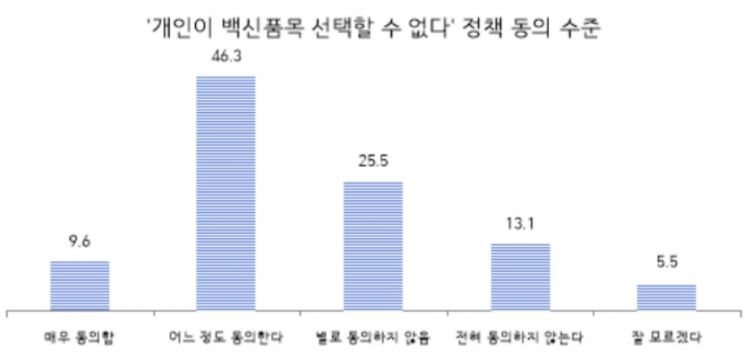
On the 2nd, the COVID-19 Planning Research Team at Seoul National University Graduate School of Public Health announced that in the second survey titled "COVID-19 and Social Health," 55.9% of respondents agreed with the policy of not allowing vaccine brand selection.
This survey was conducted from the 8th to the 17th of last month, targeting 1,084 adults aged 18 and older nationwide.
When asked whether they agreed with the health authorities' position that individuals cannot choose specific vaccine brands when promoting vaccination, 46.3% answered "somewhat agree." Another 9.6% answered "strongly agree," making a combined majority of 55.9% who agreed.
Conversely, 25.5% answered "somewhat disagree," and 13.1% answered "strongly disagree," showing that 38.6% of the total did not agree with the policy that individuals cannot choose their vaccine.
When asked, "If experts have verified the safety of the coronavirus vaccine and free vaccination is available to everyone, what action would you take regarding vaccination?" 30.6% responded "definitely get vaccinated," and 49.1% said "probably get vaccinated," indicating that 79.7% showed an intention to get vaccinated. Responses of "probably will not get vaccinated" and "definitely will not get vaccinated" were 11.2% and 2%, respectively.
Among respondents who chose "probably will not" or "definitely will not" get vaccinated, an additional question was asked: "If you could choose the vaccine brand, would you change your intention?" 62.9% answered "no," and 37.1% answered "yes."
However, when asked without any conditions, "How willing are you to get the COVID-19 vaccine?" positive willingness to vaccinate dropped to 52.5%. Negative willingness was 11.2%, and a reserved stance of "undecided" accounted for 36.3% of the total.
Vaccination willingness varied by gender and age. By gender, 58.3% of men responded that their willingness to vaccinate was high, while 46% of women responded similarly. By age, the "high" willingness responses were 63.9% for those in their 50s and 67.8% for those aged 60 and above, showing higher willingness among older adults.
Regarding the question, "How do your expectations and fears about the COVID-19 vaccine compare to last year?" the most common response was "expectations and fears are at the same level" at 41.8%. This was followed by 30.2% who said their expectations had grown more than their fears.
Compared to a preliminary survey conducted from January 8 to 10 with 1,094 adults, expectations for the vaccine slightly increased, and fears slightly decreased. At that time, 25.6% said "expectations have grown more than fears," and 28.1% said "fears have grown more than expectations."
Regarding the responsibility for vaccination, 54.4% responded that it is "everyone's responsibility." Those who said vaccination is an "individual's choice" accounted for 12.5%, and 26.7% said "both are correct."
Additionally, 74.1% agreed with the statement "I am worried about the side effects of the vaccine," and 76.7% agreed with the statement "Since the vaccine was released recently, we need to observe how it affects others."
Professor Yoo Myung-soon of the COVID-19 Planning Research Team said, "Attitudes and intentions toward COVID-19 vaccination are relatively high, but concerns about side effects are also significant," adding, "Transparent and responsible vaccine information provision and communication will be necessary going forward."
© The Asia Business Daily(www.asiae.co.kr). All rights reserved.

















