The Culture Portal, operated by the Korea Culture Information Service under the Ministry of Culture, Sports and Tourism (hereinafter referred to as the Ministry), introduces related cultural content under the theme "Long Live Korean Independence! Recommended Our Culture with History Commemorating March 1st Movement!"
Detailed information can be found on the Culture Portal's "Cultural Sympathy" section.
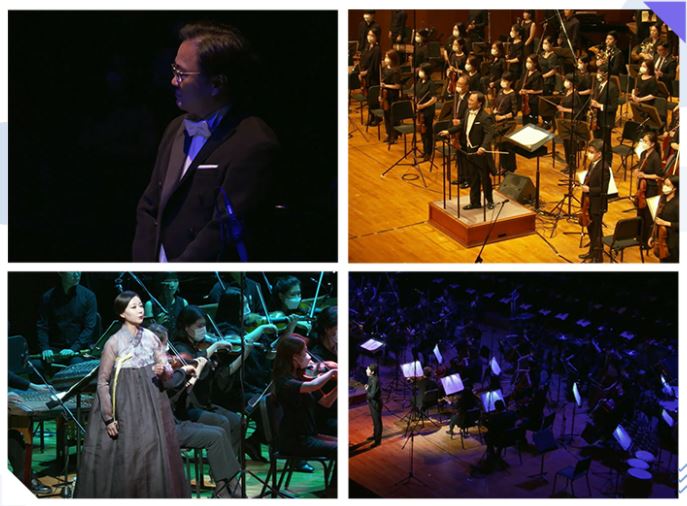
- Original Cantata 'Nae Nara (My Country)'
The National Chorus performed the original cantata 'Nae Nara' at the Liberation Day choral festival last August.
The live broadcast, held for audiences who could not attend the performance at the time, received great acclaim, and it has been re-released with lyrics subtitles so it can be viewed anytime.
'Nae Nara' is a work that depicts a journey meeting the heroes who protected the country in various ways through the voice of Baekbeom Kim Gu, a great figure of the Korean Provisional Government. The narration is led by actor Kim Hong-pa, with traditional Korean vocalists Goh Young-yeol and Jeong Ga singer Kim Na-ri adding the charm of Korean traditional music.
In particular, the song "Flower," set to a poem by Yi Yuk-sa, and "Mother's Letter," representing the heart of Jo Maria, mother of independence activist Ahn Jung-geun, received much love.
It is hoped that this grand original cantata by the National Chorus, perfectly fitting the spirit of the March 1st Movement, will help people reflect once again on the meaning of March 1st.
- Choral Symphonic Poem 'Korea Fantasy'
Are you familiar with the whale painting, National Treasure No. 285, depicted in the Bangudae Petroglyphs in Ulsan?
The choral symphonic poem
It tells the story of a baby whale who lost its mother to whale hunting, facing crises and hardships as it swims toward the Atlantic Ocean, based on the voyage stories of our ancestors who set out to find their way.
Especially, bass baritone Gil Byung-min, who gained attention on Phantom Singer 3, performed "Whale's Dream," expressing our past and future, which attracted much interest.
Additionally, the songs "Arise," sung by tenors Kim Jong-gap and Choi Sung-cheol and baritone Ham Shin-gyu, and the finale "Voyage" deliver a grand resolution and emotional message of assured victory, showing the will toward independence.
It is hoped that through 'Korea Fantasy,' people will feel the history and sorrow of the Korean Peninsula, as well as the struggles and resistance of our ancestors.
- Independence Hall Special Exhibition for the 100th Anniversary of the Independence War: I Am an Independence Fighter.
Starting with the unequal treaty with Japan in 1876, the Treaty of Ganghwa Island, our ancestors made relentless efforts to regain the country.
Beginning with the March 1st Movement in 1919, they declared the first year of the independence war in 1920 and launched a full-scale independence war against Japanese imperialism.
In 2020, marking the 100th anniversary of the independence war and the 80th anniversary of the founding of the Korean Liberation Army, the Independence Hall held a special exhibition.
Through memoirs and records left directly by independence fighters, the exhibition examined the history of the independence war, vividly conveyed the scenes of independence battles, and allowed visitors to encounter the strength of the independence fighters who led the war.
In particular, this exhibition features a notebook containing signatures and phrases from comrades of the Korean Liberation Army, as well as the lyrics of an independence song handwritten in Chinese characters by Oh Hee-ok, a surviving member of the Korean Liberation Army. It is hoped that this exhibition will provide an opportunity to remember once again those who sacrificed their lives for the country.
- Visiting the Site of the Independence Movement, Seodaemun Prison
Do you remember the drama 'Mr. Sunshine,' set in late Joseon?
It was a drama depicting young people fighting for the country amid difficult circumstances, and the friendship and love that blossomed among them.
In the 'Cultural Heritage Story Travel,' which solves curiosity about cultural heritage through mystery and talk, the site visited was Seodaemun Prison, a place filled with the pain of independence fighters and a major setting in the drama 'Mr. Sunshine.'
Seodaemun Prison, a modern prison built in 1907 at the foot of Inwangsan Mountain, designed by Japanese, was a place where many independence activists suffered hardships as Japan intensified its invasion of Korea.
Currently, it has been transformed into a learning center for the succession of history, where visitors can see reenactments of the martyrs who risked their lives for the independence movement and the circumstances of that time.
It is hoped that visitors will encounter the lives of Korean female independence activists at the historical museum, which faithfully restores the old Gyeongseong Prison and Seodaemun Prison.
© The Asia Business Daily(www.asiae.co.kr). All rights reserved.
![Clutching a Stolen Dior Bag, Saying "I Hate Being Poor but Real"... The Grotesque Con of a "Human Knockoff" [Slate]](https://cwcontent.asiae.co.kr/asiaresize/183/2026021902243444107_1771435474.jpg)











