Struggling to Fill Depleted Finances
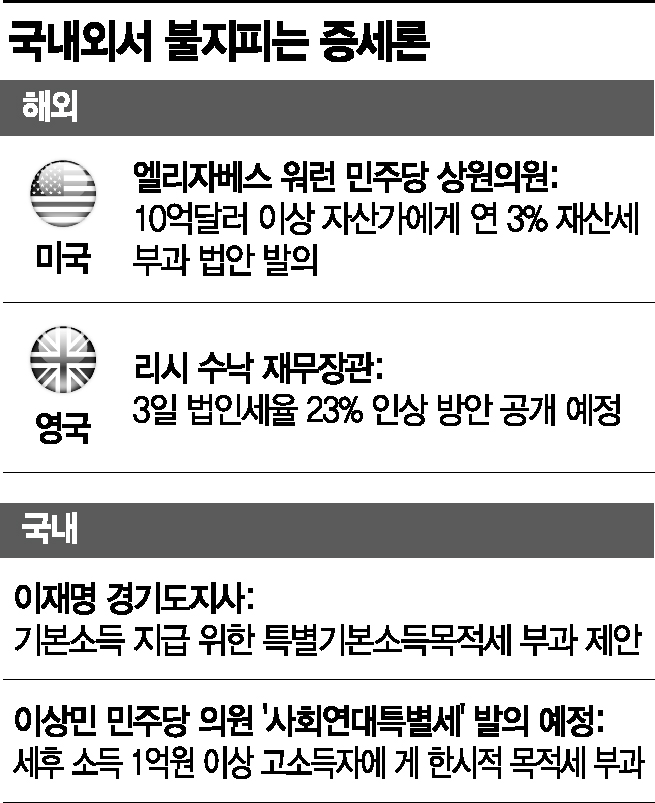
UK Corporate Tax Increase Officialized
US Ultra-Wealthy Tax Bill Proposed
Tax Increase Debate Awakens Domestically
Lee Jae-myung Mentions Earmarked Tax
Ruling Party Proposes Social Solidarity Special Tax Bill
[Asia Economy Reporters Park Byung-hee, Jeon Jin-young, Koo Chae-eun] Governments around the world, which had been pouring massive amounts of money into responding to the COVID-19 crisis, have now begun to consider ways to refill their empty coffers. They are increasingly raising the issue of tax hikes to reduce national debt. In South Korea, the political sphere has already seen tax increases become a hot topic. Ultimately, this means presenting the public with a ‘COVID-19 bill.’
Following the UK, the US also moves toward ‘COVID tax hikes’
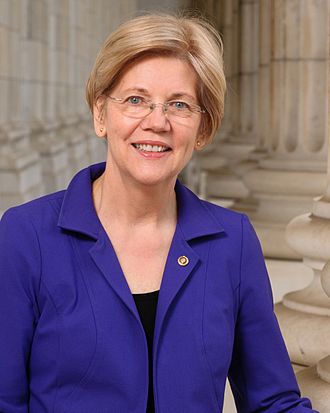
According to Bloomberg on the 1st (local time), US Democratic Senator Elizabeth Warren (pictured) introduced the Ultra Millionaire Tax Act. The bill proposes an annual wealth tax of 2% on individuals with a net worth exceeding $50 billion and 3% on those with assets over $1 billion. Bloomberg reported that the top 100 wealthiest Americans would have to pay an additional $78 billion in taxes. Their wealth increased by $598 billion last year, meaning they would pay 13% of that increase in taxes.
Bloomberg noted that while President Joe Biden and the ruling Democratic Party intend to push for tax hikes on corporations and high-income earners, they do not support taxing wealth rather than income, making the bill’s passage uncertain. The New York Times pointed out that this September marks the 10th anniversary of the Occupy Wall Street protests, which shouted "We are the 99%," and highlighted that the passage of the Ultra Millionaire Tax Act, which targets economic inequality, is drawing attention. At the state level, moves to raise income taxes are gaining momentum. New York State is considering imposing a special income tax on high earners making over $1 million annually for a limited period of 3 to 5 years, and the Washington State legislature recently passed a plan to levy a 7% tax on capital gains exceeding $25,000.
The UK is expected to announce plans to raise corporate tax rates when it unveils its budget on the 3rd. Chancellor of the Exchequer Rishi Sunak will reveal a plan to increase the current 19% corporate tax rate to 20% starting this fall, with a long-term goal of raising it to 23%. This corporate tax hike is notable given that the ruling Conservative Party has traditionally emphasized tax cuts. Since coming to power in 2010, the Conservatives steadily lowered the corporate tax rate from 28% at that time to 19%, where it has remained since 2017.
Tax hike discussions also emerging domestically
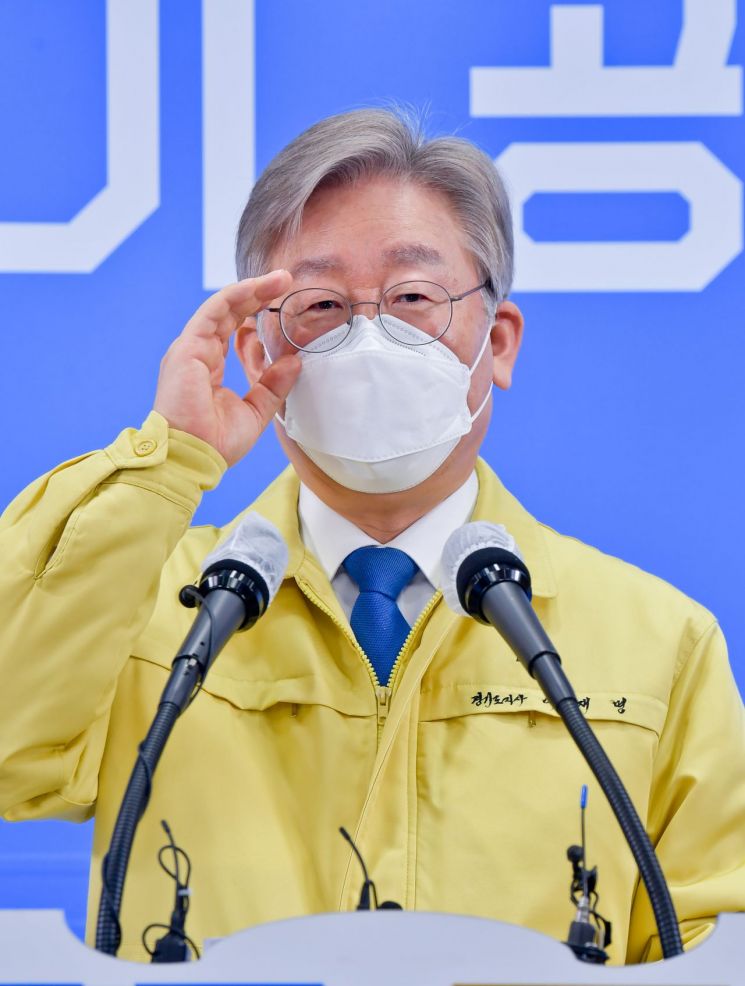
In South Korea, the most proactive advocate for tax increases is Gyeonggi Province Governor Lee Jae-myung, a leading potential presidential candidate. As a representative ‘tax hike proponent,’ Lee has mentioned plans to collect a general basic income tax and special basic income taxes, including data tax, robot tax, environmental tax, and land tax, to fund basic income payments. Recently on Facebook, Lee stated, "If a basic income tax is collected and distributed fairly as basic income, over 90% of households will receive more in basic income than they pay in taxes, making it easier to gain public consent than with general tax hikes."
Various ideas on specific tax hike methods are also emerging within the ruling party. Democratic Party lawmaker Lee Sang-min plans to introduce a ‘Social Solidarity Special Tax’ bill early this month. It proposes temporarily imposing an additional purpose tax for about three years on individuals with post-tax incomes over 100 million won (approximately $85,000) and the top 100 corporations to help overcome COVID-19. Democratic Party lawmaker Jang Kyung-tae also introduced the ‘Youth Financial Ladder Act,’ which would impose a temporary youth tax for 10 years on domestic corporations and foreign corporations with domestic-sourced income to create youth jobs. Yoon Hoo-duk, chairman of the National Assembly’s Planning and Finance Committee and a Democratic Party member, mentioned the need for tax hikes during the plenary session on the 16th of last month, saying, "By now, the fiscal authorities should be discussing tax hike measures," and added, "A system that boldly supports and boldly recovers through taxation is an honest approach."
However, both inside and outside the ruling party, there is caution against overinterpreting the tax hike discussions, with some saying, "These are not yet party-approved proposals." This is also related to the upcoming major by-elections on April 7, including the Seoul mayoral race. Particularly, Democratic Party leader Lee Nak-yeon, who has positioned the ‘new welfare system’ as a core pledge, holds a negative stance on tax hikes. In an interview with this publication last month, Lee said, "From the standpoint of tax legality, isn’t it theoretically impossible?" and added, "Tax hikes or cuts can only be done if the law is amended," expressing a fundamental position.
© The Asia Business Daily(www.asiae.co.kr). All rights reserved.



















