Discussion on Introducing 4-Day and 4.5-Day Workweek
"Increases Work Efficiency and Job Creation"
"Premature Amid Economic Downturn... Concerns Over Wage Reduction" Criticism Also Raised
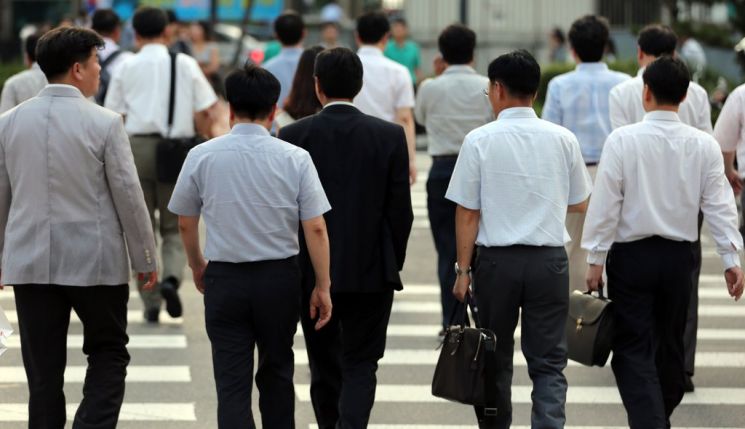
[Asia Economy Reporter Kim Young-eun] Recently, within the political sphere, the introduction of a four-day workweek is being discussed, centered around preliminary candidates for the Seoul mayoral by-election. Proponents argue that implementing a four-day workweek would reduce working hours, improve quality of life, and contribute to the creation of new jobs. On the other hand, some oppose the introduction, citing concerns such as wage reductions and decreased productivity.
The average annual working hours of South Korean workers stood at 1,967 hours in 2019, ranking second highest among OECD countries after Mexico. Advocates for the four-day workweek argue that such excessive working hours should be shortened to enhance quality of life.
Jo Jeong-hoon, a preliminary candidate for the Seoul mayoral by-election representing the Transition Era party, who has made the introduction of a four-day workweek a key campaign pledge, stated, "Long working hours are no longer related to labor productivity and are instead detrimental to workers' health and happiness." He added, "The four-day workweek is a policy that innovates society as a whole?including business, labor, gender equality, youth, and the environment?and is also an economic revitalization policy."
Jo further said, "I am confident that the introduction of a four-day workweek will maintain wage levels through increased productivity," and "Our society desires a balance between work and life. The most effective incentive for talent recruitment is the four-day workweek."
Additionally, Park Young-sun, a preliminary candidate from the Democratic Party of Korea, proposed the introduction of a '4.5-day workweek,' where one day out of the five working days involves working only in the morning or afternoon before leaving. Park stated, "Many small and medium-sized enterprises are already implementing the 4.5-day workweek, and it has resulted in significant productivity improvements," adding, "The 4.5-day workweek can increase jobs and help solve youth employment issues."
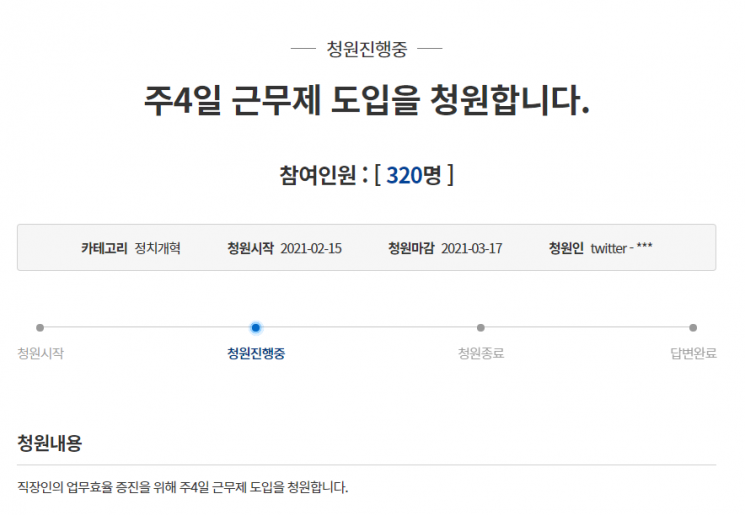
There are also many citizens who view the four-day workweek positively. According to the employment portal site Career, 82.7% of 670 adult men and women selected the 'four-day workweek' as their most desired work style. Last month, more than two petitions requesting the introduction of a four-day workweek were posted on the Blue House's national petition board.
In fact, some companies have shortened working hours in a manner similar to the four-day workweek. Woowa Brothers, the operator of the delivery app Baedal Minjok, has implemented a 4.5-day workweek with employees starting work on Monday afternoons, and the education company Eduwill has been implementing a four-day workweek for two years since the year before last.
Jeon Min-gi, team leader at the Korea Insight Institute, said on YTN Radio's "Wise Radio Life" on the 18th, "From the stories of companies that temporarily implemented a four-day workweek last year due to COVID-19, work efficiency actually increased," adding, "Implementing a four-day workweek can improve work efficiency by reducing working hours, and with increased rest periods, industries such as tourism will be revitalized, thereby boosting economic activity."

However, voices opposing the introduction of a four-day workweek at this point in time, calling it 'premature,' continue to emerge.
Given the economic downturn caused by the global spread of COVID-19, there are concerns that introducing a four-day workweek could disrupt working conditions, such as wage reductions. It is also pointed out that small business owners and self-employed individuals, who are not company employees, could suffer significant damage.
Another issue is securing funding to support companies implementing the four-day workweek; ultimately, this could be covered by taxes, leading to a burden on the public. Moreover, since the Labor Standards Act would need to be amended, there is skepticism about the immediate feasibility of the policy.
In the same survey conducted by Career, 71.2% of respondents cited 'salary reduction' as a concern regarding the four-day workweek. One netizen criticized on an online community, "With rising housing prices and a poor economy, is the four-day workweek really all good? Income is decreasing, so we need to think realistically. There are still many places with six-day workweeks; let's first establish five-day workweeks."
Reluctant responses to the four-day workweek have also come from some political circles. Woo Sang-ho, a preliminary candidate for the Seoul mayoral by-election from the Democratic Party of Korea, said, "The 52-hour workweek has not yet been fully established, so especially in Seoul, can we start this first?" He added, "While I support the intent itself, various circumstances of companies must be considered for the introduction of the system, so a practical approach is necessary."
Similarly, Oh Se-hoon, a preliminary candidate from the People Power Party, expressed a negative reaction, calling it a "pledge that makes youth suffer twice." Oh pointed out, "As of the end of last December, the youth unemployment rate was 8.1%, double the general unemployment rate, and nearly 400,000 youths are simply resting due to lack of jobs. Is a 4.5-day workweek pledge even feasible for those who are worried about their livelihoods right now?"
Meanwhile, experts have evaluated that the four-day workweek has low practical feasibility and that the timing is inappropriate. Professor Shin Se-don of the Department of Economics at Sookmyung Women's University said on CBS Radio's "Kim Hyun-jung's News Show" on the 16th of last month, "Only a few percent of companies can adopt such a cloud-like system." He added, "Rather, the current situation is a measure that causes a sense of loss to millions of unemployed people in Korea who think they would rather work an extra hour even without rest," concluding, "It is too premature now."
© The Asia Business Daily(www.asiae.co.kr). All rights reserved.